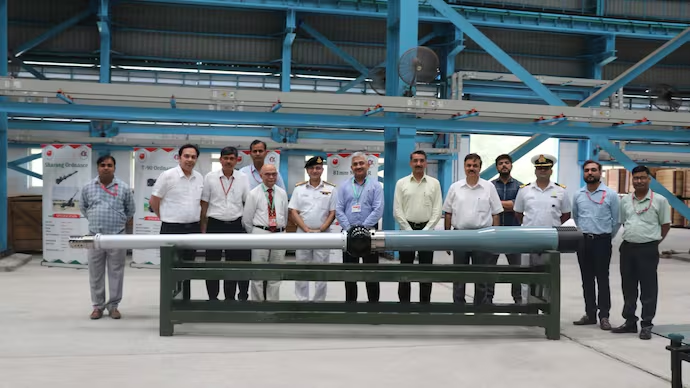
After its active role in Operation Sindoor, the Indian Navy is accelerating efforts to boost combat readiness through indigenous defence manufacturing. In a significant move toward self-reliance, the Navy has started inducting indigenously developed barrels for its key naval gun systems, marking a new chapter in its Atmanirbhar Bharat push. These developments not only cut costs but also reduce India’s dependence on foreign suppliers at a time when strategic autonomy in defence is crucial.
Indigenous breakthrough for frontline weapon system
The indigenous barrels are designed for the Navy’s Super Rapid Gun Mount (SRGM), a high-speed, medium-calibre naval artillery system. Previously, these barrels were imported or built under license from Italian defence firm OTO Melara at BHEL Haridwar. For the first time, however, they are now being manufactured locally at the Field Gun Factory in Kanpur.
Two barrels have already been delivered to the Navy, with the plan to equip all current and future warships with the Kanpur-made versions. Developed over three years by a 12-member team of engineers, the move is seen as a major step toward long-term defence sustainability.
The SRGM system, known for its versatility and rapid-fire capabilities, plays a critical role in defending warships from aerial threats, including fast-moving aircraft and incoming missiles. It has a 4,588 mm barrel and fires 76mm shells at a rate of 120 rounds per minute. Its effective range extends up to 15 km, making it ideal for layered maritime combat scenarios.
Strategic partnerships and expansion
This indigenous milestone follows a period of increased naval activity, including large-scale joint drills with the UK’s Royal Navy in the Northern Arabian Sea. These engagements underline the Indian Navy’s focus on sharpening its operational edge while enhancing interoperability with strategic partners.
To further support its firepower upgrade, the Ministry of Defence recently signed a ₹2,956.89 crore contract with BHEL Haridwar for 16 upgraded SRGM systems and associated components. While BHEL continues to play a central role in system-level integration, the shift toward indigenous barrel manufacturing marks a significant leap in localised defence production.
The Indian Navy’s actions reflect a broader national strategy—moving from import-dependence to capability-driven independence—cementing its role as a forward-looking maritime force ready to meet modern-day challenges.