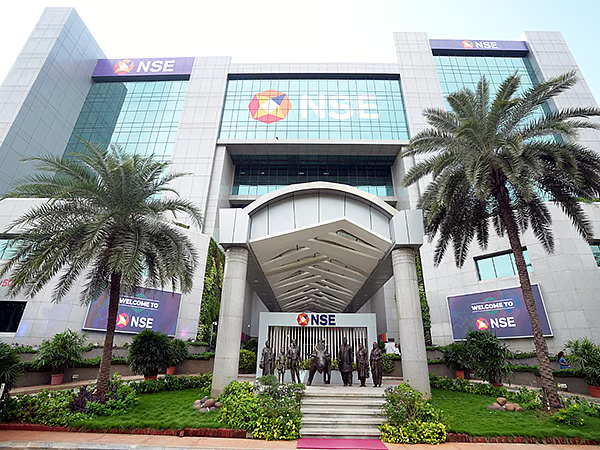
Indian equity markets ended Wednesday’s session on a subdued note, consolidating after the previous day’s sharp rally, as rising geopolitical tensions in the Middle East and heavy selling in information technology stocks weighed on investor sentiment even while benchmark indices managed to close marginally in the green.
The BSE Sensex settled 78.56 points higher at 83,817.69, holding firmly above the 83,800 mark, while the NSE Nifty 50 closed almost flat but positive at 25,776.00. Market participants largely refrained from aggressive fresh buying, choosing instead to assess global cues and book profits in select sectors following Tuesday’s surge.
Sectoral divergence defines a flat trading session
Trading through the day was marked by sharp sectoral divergence, with technology, pharma, and healthcare stocks witnessing sustained selling pressure, while energy, power, and select consumption names provided limited support to headline indices. The muted close reflected a balancing act between profit booking after a strong rally and underlying optimism driven by recent policy and trade-related developments.
The most pronounced weakness was seen in the information technology space. The Nifty IT index ended the session sharply lower, falling nearly six percent, as heavyweights such as Infosys, TCS, HCL Technologies, Tech Mahindra, and Wipro came under intense selling pressure. Investors appeared cautious about the near-term outlook for export-oriented IT companies amid global economic uncertainty, volatile currency movements, and softer cues from overseas technology markets. The sharp decline in US technology stocks overnight further dampened sentiment toward Indian IT counters, prompting traders to pare exposure after recent gains.
Pharmaceutical and healthcare stocks also contributed to the drag on the broader market. After attracting steady inflows in recent weeks as defensive bets, several pharma names saw profit booking, reflecting a shift toward a more cautious and selective approach by investors. Analysts noted that valuations in parts of the defensive space had become stretched following the recent run-up, making these stocks vulnerable to short-term corrections during phases of broader market consolidation.
In contrast, buying interest was visible in select pockets of the market. Shares of Trent emerged as one of the top performers, supported by optimism around consumption trends and company-specific growth prospects. Energy and power stocks such as ONGC and NTPC also posted gains, aided by firm crude oil prices, expectations of stable earnings, and continued focus on infrastructure and energy security. Adani Ports added to the positive momentum in the infrastructure space, reflecting confidence in trade-linked businesses despite global uncertainties.
Overall market breadth remained mixed, with advances and declines nearly evenly balanced, underscoring the lack of a clear directional bias. Traders largely adopted a wait-and-watch stance, focusing on stock-specific triggers rather than broad-based bets. Volumes were relatively moderate, suggesting that many participants preferred to stay on the sidelines until clearer signals emerged from global markets and geopolitical developments.
Global cues, Middle East tensions and investor positioning
Global factors played a significant role in shaping market sentiment during the session. Escalating tensions in the Middle East weighed on risk appetite after reports that the United States shot down an Iranian drone that was allegedly approaching a US aircraft carrier in the Persian Gulf. The incident was followed by reports of Iranian armed boats harassing a US-flagged vessel in the Strait of Hormuz, a strategically vital route for global oil shipments.
These developments raised concerns about potential disruptions to energy supplies and international trade, prompting investors to adopt a more cautious approach after the strong rally seen a day earlier. Geopolitical uncertainty typically leads to heightened volatility in financial markets, particularly in emerging economies, as foreign investors reassess risk and exposure. While energy stocks often benefit from higher crude prices during such periods, broader equity markets tend to see increased caution and selective profit booking.
Asian markets reflected this cautious mood, displaying mixed trends. Japan’s Nikkei index traded lower, mirroring weakness in technology stocks, while South Korea’s Kospi managed modest gains. Hong Kong’s Hang Seng and China’s Shanghai Composite also edged higher, but the overall regional picture lacked a strong, unified direction. The mixed performance across Asia offered limited cues to domestic investors, reinforcing the consolidative tone in Indian markets.
Overnight, US markets closed mostly lower. The Dow Jones Industrial Average ended slightly down, while the Nasdaq and S&P 500 registered sharper losses, led by selling in technology shares. The weakness on Wall Street followed a period of strong gains and reflected investor nervousness over global growth prospects, interest rate expectations, and escalating geopolitical risks. The negative close in US tech stocks, in particular, had a direct impact on Indian IT shares during Wednesday’s session.
Despite the cautious global backdrop, institutional flows provided some stability to domestic equities. Foreign institutional investors turned net buyers, purchasing shares worth ₹5,426 crore on February 3. Domestic institutional investors also remained supportive, buying equities worth ₹345 crore on the same day. This marked a notable shift from the trend seen in December 2025, when foreign investors had sold shares worth over ₹34,000 crore, even as domestic institutions stepped in with purchases exceeding ₹79,000 crore to cushion the market.
Investor sentiment is still influenced by the strong rally witnessed on Tuesday, when benchmark indices surged sharply on positive trade-related news. The Sensex had jumped more than 2,000 points, while the Nifty gained over 600 points, driven by optimism after US President Donald Trump announced a reduction in tariffs on Indian goods from 50 percent to 18 percent. The move was widely seen as a boost for Indian exporters and a positive signal for bilateral trade relations, sparking broad-based buying across sectors.
Wednesday’s flat close suggests that while the underlying market sentiment remains constructive, investors are increasingly selective and sensitive to global developments. Market participants are closely tracking geopolitical news from the Middle East, movements in global equity and commodity markets, and the sustainability of recent institutional inflows. Analysts believe that in the near term, Indian equities may continue to witness consolidation, with sharp sectoral rotations and stock-specific action dominating trade as investors balance domestic optimism with global uncertainty.