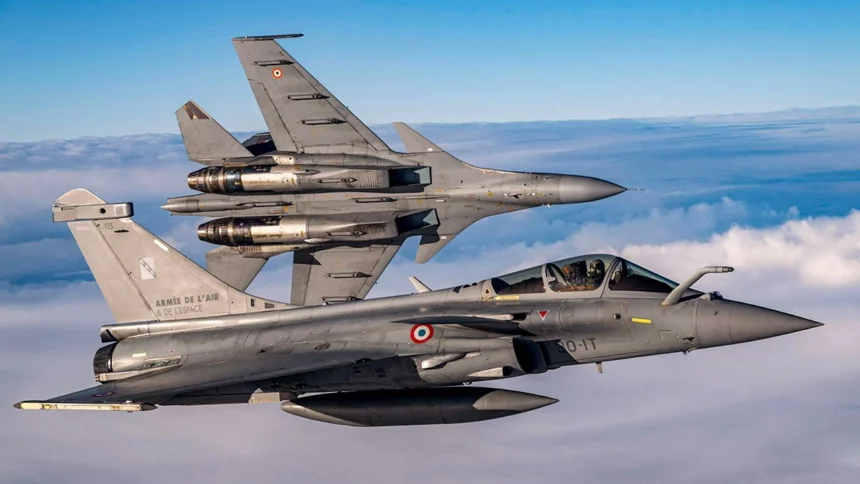
India is significantly strengthening its air defense and strike capabilities through the acquisition and integration of advanced missile systems with its fleet of Dassault Rafale fighter jets, marking a major step forward in its strategic defense modernization. The development reflects India’s broader effort to enhance its military preparedness amid evolving regional security challenges and increasing geopolitical competition in South Asia.
The Rafale jets, procured from France, are among the most advanced multi-role fighter aircraft in the world, capable of carrying out a wide range of missions including air superiority, ground attack, reconnaissance, and nuclear deterrence. Their versatility and advanced technology make them a crucial component of India’s air power, particularly at a time when the country is seeking to modernize its aging fleet and maintain a technological edge over potential adversaries.
A key aspect of this enhancement lies in the integration of sophisticated missile systems that significantly expand the operational capabilities of the aircraft. Among these, the SCALP cruise missile stands out as a long-range, precision-guided weapon designed for deep-strike missions. It enables the Rafale to hit high-value targets with accuracy from a safe distance, reducing exposure to enemy defenses.
In addition to SCALP, India is also focusing on acquiring and integrating the Meteor air-to-air missile, widely regarded as one of the most advanced beyond-visual-range missiles in the world. This missile provides the Rafale with superior engagement capabilities, allowing it to neutralize aerial threats at extended distances with high precision.
Strategic Importance of Missile Integration and Defense Modernization
The integration of these advanced missile systems transforms the Rafale into a formidable force multiplier for the Indian Air Force. By combining cutting-edge avionics, sensor fusion, and high-precision weaponry, the aircraft is capable of executing complex missions in contested environments. This capability is particularly important in modern warfare, where speed, accuracy, and technological superiority play a decisive role.
India’s focus on strengthening its air power comes against the backdrop of regional security concerns involving neighboring countries such as China and Pakistan. The need to maintain a credible deterrence capability has driven the government to invest heavily in defense modernization, including large-scale procurement programs and technological upgrades.
The Rafale program is a central element of this strategy. India already operates a fleet of Rafale jets, and plans are underway to expand this number significantly through additional acquisitions. The proposed procurement of over 100 additional aircraft highlights the scale of India’s ambitions to build a robust and future-ready air force.
Moreover, the integration of indigenous weapons systems is also being explored, reflecting India’s push for self-reliance in defense manufacturing. Missiles such as the BrahMos are expected to play a role in future upgrades, further enhancing the versatility and effectiveness of the Rafale platform.
India-France Defense Partnership and Future Outlook
The Rafale deal underscores the deepening defense partnership between India and France, which has evolved into a key pillar of bilateral relations. Beyond aircraft procurement, the partnership includes cooperation in areas such as technology transfer, joint production, and maintenance support. This collaboration not only strengthens India’s military capabilities but also contributes to the development of its domestic defense industry.
France has emerged as one of India’s most reliable defense partners, providing advanced technology and supporting India’s efforts to modernize its armed forces. Recent developments indicate that both countries are exploring opportunities for co-production and increased localization, aligning with India’s “Make in India” initiative.
At the same time, negotiations between the two sides have also highlighted challenges, particularly regarding access to critical technologies such as source codes and system integration capabilities. India’s insistence on greater control over its defense assets reflects its desire to achieve strategic autonomy and reduce dependence on foreign suppliers.
The ongoing expansion of the Rafale fleet, combined with the integration of advanced missile systems, signals a clear shift in India’s defense posture. It demonstrates a move toward building a highly capable, technologically advanced military force that can respond effectively to emerging threats.
As global security dynamics continue to evolve, India’s investment in platforms like the Rafale and its associated weapon systems will play a crucial role in shaping its strategic capabilities. The emphasis on precision strike, long-range engagement, and multi-role flexibility reflects a broader transformation in how modern militaries operate, placing India in a stronger position to safeguard its national interests.