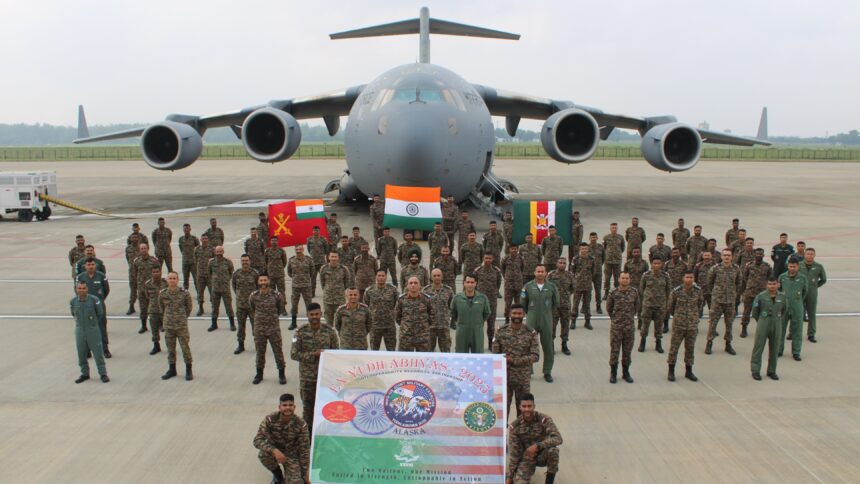
The Indian Army has embarked on a strategic deployment to the United States to participate in the 21st edition of the India-US Joint Military Exercise Yudh Abhyas 2025, marking a key moment in bilateral defense cooperation amid ongoing global discussions on trade and tariffs. Scheduled from September 1 to September 14, this exercise will bring Indian and US troops together to train in heliborne operations, mountain warfare, unmanned aerial systems, counter-UAS operations, and joint tactical drills. The deployment of Indian troops to Fort Wainwright, Alaska, reflects India’s commitment to strengthening operational interoperability with allied forces, enhancing readiness for high-altitude and complex battlefield scenarios, and contributing to multi-domain preparedness, including United Nations peacekeeping operations. The Ministry of External Affairs shared images of the Indian contingent assembled in front of a C-17 Globemaster III aircraft, symbolizing the scale and significance of this collaborative military endeavor.
The Indian Army has embarked on a strategic deployment to the United States to participate in the 21st edition of the India-US Joint Military Exercise Yudh Abhyas 2025, marking a key moment in bilateral defense cooperation amid ongoing global discussions on trade and tariffs. Scheduled from September 1 to September 14, this exercise will bring Indian and US troops together to train in heliborne operations, mountain warfare, unmanned aerial systems, counter-UAS operations, and joint tactical drills. The deployment of Indian troops to Fort Wainwright, Alaska, reflects India’s commitment to strengthening operational interoperability with allied forces, enhancing readiness for high-altitude and complex battlefield scenarios, and contributing to multi-domain preparedness, including United Nations peacekeeping operations. The Ministry of External Affairs shared images of the Indian contingent assembled in front of a C-17 Globemaster III aircraft, symbolizing the scale and significance of this collaborative military endeavor.
Strategic Deployment and Training Objectives of Yudh Abhyas 2025
The Indian contingent, comprising personnel from a battalion of the Madras Regiment, will train alongside soldiers of the US 11th Airborne Division, particularly the 1st Battalion, 5th Infantry Regiment, known as the “Bobcats” of the Arctic Wolves Brigade Combat Team. Over the course of two weeks, the troops will rehearse a series of tactical operations, including heliborne insertions, high-altitude mountain maneuvers, casualty evacuation procedures, rockcraft, and combat medical aid. Emphasis will also be placed on the integrated use of artillery, aviation, and electronic warfare systems, demonstrating the exercise’s comprehensive approach to modern battlefield scenarios. These operations will provide Indian soldiers with exposure to advanced US operational practices, allowing for the exchange of knowledge, adaptation of best practices, and improvement of battlefield agility in challenging terrains.
Additionally, Indian and US defense experts will conduct working group sessions focusing on unmanned aerial systems (UAS) and counter-UAS tactics, information warfare, communications, and logistics coordination. These collaborative sessions will allow personnel to develop innovative strategies for real-time battlefield challenges, enabling a synchronized approach to surveillance, threat neutralization, and operational command. The exercise will also simulate joint operational planning for multi-domain scenarios, where air, land, and electronic warfare assets must operate in tandem, reflecting the modern demands of integrated combat operations. By incorporating these training elements, both armies will be able to evaluate interoperability, refine joint operational protocols, and enhance preparedness for missions that extend beyond conventional battlefields, including high-altitude conflicts and UN peacekeeping deployments.
Operational Integration, Multi-Domain Preparedness, and Tactical Maneuvers
The exercise’s culmination will involve a series of high-intensity, jointly executed tactical maneuvers, ranging from live-fire exercises to complex, multi-domain combat scenarios. The focus will include mountain warfare tactics, heliborne assault drills, casualty management, and the operational integration of surveillance and artillery support, ensuring that both contingents can operate seamlessly in complex combat environments. Through these maneuvers, Indian troops will gain firsthand experience in US joint tactical doctrines, while US forces will benefit from insights into Indian strategies and operational adaptability in extreme terrain.
The training will also enhance capabilities for United Nations peacekeeping operations, with emphasis on rapid deployment, multi-national coordination, and strategic decision-making in diverse operational theaters. The exercise will simulate real-world scenarios requiring the integration of air, land, and cyber operations, highlighting the importance of interoperability between partner nations in addressing emerging threats. Both armies will analyze and optimize logistics, command and control mechanisms, and battlefield communications to ensure that multi-domain operations can be executed efficiently and effectively. The experience is expected to strengthen professional relationships, foster mutual understanding of operational doctrines, and lay the groundwork for future collaborations in regional security, humanitarian assistance, and joint counter-terrorism efforts.
The Indian Army’s participation in Yudh Abhyas 2025 represents a broader commitment to enhancing global military partnerships, modernizing operational readiness, and developing specialized skills for complex warfare environments. By engaging in exercises that emphasize mountain warfare, heliborne operations, and multi-domain integration, Indian troops will return with improved tactical knowledge, heightened coordination capabilities, and the ability to operate seamlessly with allied forces. In turn, these skills will be applied to India’s domestic defense operations, enhancing readiness for natural disaster responses, counterinsurgency missions, and high-altitude border defense tasks.
Beyond the immediate tactical and operational benefits, the exercise will underscore India’s evolving defense diplomacy, signaling a strengthened military-to-military relationship with the United States. The deployment will showcase India’s commitment to regional stability, global security partnerships, and preparedness to collaborate on shared defense challenges. Both nations will likely analyze lessons learned from the exercise to inform future operational planning, joint training programs, and bilateral defense agreements, ensuring sustained cooperation in addressing emerging threats and complex battlefield scenarios.
The Indian contingent’s presence in Alaska will also provide opportunities to observe US military infrastructure, technological advancements, and strategic operational planning in extreme environments. Training alongside the 11th Airborne Division will expose Indian soldiers to advanced tactics in mountain warfare, aerial deployment strategies, and integrated battlefield coordination. This interaction is expected to cultivate an understanding of multi-domain operations that seamlessly combine infantry, aviation, artillery, and cyber capabilities, enabling Indian forces to adapt and refine their operational strategies for high-intensity and unconventional scenarios.
Throughout the exercise, both contingents will maintain rigorous standards of safety, operational discipline, and performance evaluation. Tactical drills, live-fire exercises, and mountain maneuvers will be assessed for efficiency, precision, and coordination, ensuring that operational outcomes meet the highest standards of preparedness. The inclusion of subject-matter experts and continuous after-action reviews will allow participants to refine strategies, correct procedural inefficiencies, and strengthen collaborative protocols, providing a foundation for future joint initiatives and operational excellence.
Yudh Abhyas 2025 will also highlight the importance of leveraging technology in modern warfare. Unmanned aerial systems and counter-UAS operations will be central to the exercise, reflecting the growing significance of drone warfare, reconnaissance, and real-time intelligence in contemporary military operations. Both Indian and US forces will share insights on the deployment, tracking, and neutralization of UAS threats, enhancing situational awareness and decision-making capabilities in dynamic combat environments. By integrating technology-focused training into traditional combat exercises, the armies will ensure readiness for hybrid warfare scenarios and reinforce their ability to respond effectively to both conventional and emerging threats.
Furthermore, the exercise will foster leadership development, operational planning skills, and inter-service coordination among Indian officers. Exposure to US tactical methodologies, command hierarchies, and operational procedures will help Indian leaders enhance decision-making under stress, refine strategic planning, and develop innovative approaches to mission execution. This exchange of knowledge is expected to strengthen Indian Army leadership and operational capacity, ensuring that officers can lead complex multi-domain operations with confidence and competence.
The Ministry of Defence emphasized that Yudh Abhyas 2025 will strengthen India-US strategic ties, enhance tactical interoperability, and prepare both nations for collaborative missions that extend beyond national borders. Joint planning, execution, and evaluation of exercises will improve mutual understanding of operational doctrines, highlight strengths and areas for improvement, and foster an environment of cooperation that supports regional security, humanitarian operations, and multinational peacekeeping initiatives.
As the exercise progresses, Indian soldiers will continue to develop expertise in high-altitude maneuvers, rapid deployment strategies, casualty management, and multi-domain operational integration. These skills will reinforce India’s defense capabilities, improve operational coordination with allied forces, and enable the Indian Army to respond effectively to complex security challenges both domestically and internationally. By the conclusion of Yudh Abhyas 2025, the exercise will leave a lasting impact on bilateral defense cooperation, operational readiness, and the professional growth of participating personnel.
The 21st edition of Yudh Abhyas marks a continuation of India’s longstanding commitment to joint training initiatives with the United States, reflecting a strategic partnership that emphasizes interoperability, knowledge exchange, and shared readiness. The exercise will provide both nations with insights into emerging threats, battlefield tactics, and multi-domain operational planning, reinforcing the foundation for sustained military collaboration in years to come.
The Indian Army’s deployment to Fort Wainwright, Alaska, for Yudh Abhyas 2025 will serve as a landmark in India-US defense cooperation, demonstrating the capability, professionalism, and strategic intent of Indian forces in a global military context. The rigorous training, joint tactical exercises, and multi-domain operational focus will strengthen India’s military proficiency, enhance bilateral ties, and contribute to broader regional and international security objectives.
By participating in Yudh Abhyas 2025, the Indian Army will reinforce its position as a modern, adaptable, and strategically capable force, capable of operating in high-altitude, multi-domain, and technologically complex environments. The exercise will highlight the importance of continuous learning, international collaboration, and innovation in defense strategy, preparing Indian troops for evolving threats, joint operations, and global peacekeeping responsibilities.
Ultimately, Yudh Abhyas 2025 will demonstrate India’s commitment to operational excellence, multi-domain readiness, and international defense collaboration, providing a robust platform for the Indian Army to enhance capabilities, strengthen partnerships, and showcase its preparedness for complex security challenges in the years ahead.
The Indian contingent, comprising personnel from a battalion of the Madras Regiment, will train alongside soldiers of the US 11th Airborne Division, particularly the 1st Battalion, 5th Infantry Regiment, known as the “Bobcats” of the Arctic Wolves Brigade Combat Team. Over the course of two weeks, the troops will rehearse a series of tactical operations, including heliborne insertions, high-altitude mountain maneuvers, casualty evacuation procedures, rockcraft, and combat medical aid. Emphasis will also be placed on the integrated use of artillery, aviation, and electronic warfare systems, demonstrating the exercise’s comprehensive approach to modern battlefield scenarios. These operations will provide Indian soldiers with exposure to advanced US operational practices, allowing for the exchange of knowledge, adaptation of best practices, and improvement of battlefield agility in challenging terrains.
Additionally, Indian and US defense experts will conduct working group sessions focusing on unmanned aerial systems (UAS) and counter-UAS tactics, information warfare, communications, and logistics coordination. These collaborative sessions will allow personnel to develop innovative strategies for real-time battlefield challenges, enabling a synchronized approach to surveillance, threat neutralization, and operational command. The exercise will also simulate joint operational planning for multi-domain scenarios, where air, land, and electronic warfare assets must operate in tandem, reflecting the modern demands of integrated combat operations. By incorporating these training elements, both armies will be able to evaluate interoperability, refine joint operational protocols, and enhance preparedness for missions that extend beyond conventional battlefields, including high-altitude conflicts and UN peacekeeping deployments.
Operational Integration, Multi-Domain Preparedness, and Tactical Maneuvers
The exercise’s culmination will involve a series of high-intensity, jointly executed tactical maneuvers, ranging from live-fire exercises to complex, multi-domain combat scenarios. The focus will include mountain warfare tactics, heliborne assault drills, casualty management, and the operational integration of surveillance and artillery support, ensuring that both contingents can operate seamlessly in complex combat environments. Through these maneuvers, Indian troops will gain firsthand experience in US joint tactical doctrines, while US forces will benefit from insights into Indian strategies and operational adaptability in extreme terrain.
The training will also enhance capabilities for United Nations peacekeeping operations, with emphasis on rapid deployment, multi-national coordination, and strategic decision-making in diverse operational theaters. The exercise will simulate real-world scenarios requiring the integration of air, land, and cyber operations, highlighting the importance of interoperability between partner nations in addressing emerging threats. Both armies will analyze and optimize logistics, command and control mechanisms, and battlefield communications to ensure that multi-domain operations can be executed efficiently and effectively. The experience is expected to strengthen professional relationships, foster mutual understanding of operational doctrines, and lay the groundwork for future collaborations in regional security, humanitarian assistance, and joint counter-terrorism efforts.
The Indian Army’s participation in Yudh Abhyas 2025 represents a broader commitment to enhancing global military partnerships, modernizing operational readiness, and developing specialized skills for complex warfare environments. By engaging in exercises that emphasize mountain warfare, heliborne operations, and multi-domain integration, Indian troops will return with improved tactical knowledge, heightened coordination capabilities, and the ability to operate seamlessly with allied forces. In turn, these skills will be applied to India’s domestic defense operations, enhancing readiness for natural disaster responses, counterinsurgency missions, and high-altitude border defense tasks.
Beyond the immediate tactical and operational benefits, the exercise will underscore India’s evolving defense diplomacy, signaling a strengthened military-to-military relationship with the United States. The deployment will showcase India’s commitment to regional stability, global security partnerships, and preparedness to collaborate on shared defense challenges. Both nations will likely analyze lessons learned from the exercise to inform future operational planning, joint training programs, and bilateral defense agreements, ensuring sustained cooperation in addressing emerging threats and complex battlefield scenarios.
The Indian contingent’s presence in Alaska will also provide opportunities to observe US military infrastructure, technological advancements, and strategic operational planning in extreme environments. Training alongside the 11th Airborne Division will expose Indian soldiers to advanced tactics in mountain warfare, aerial deployment strategies, and integrated battlefield coordination. This interaction is expected to cultivate an understanding of multi-domain operations that seamlessly combine infantry, aviation, artillery, and cyber capabilities, enabling Indian forces to adapt and refine their operational strategies for high-intensity and unconventional scenarios.
Throughout the exercise, both contingents will maintain rigorous standards of safety, operational discipline, and performance evaluation. Tactical drills, live-fire exercises, and mountain maneuvers will be assessed for efficiency, precision, and coordination, ensuring that operational outcomes meet the highest standards of preparedness. The inclusion of subject-matter experts and continuous after-action reviews will allow participants to refine strategies, correct procedural inefficiencies, and strengthen collaborative protocols, providing a foundation for future joint initiatives and operational excellence.
Yudh Abhyas 2025 will also highlight the importance of leveraging technology in modern warfare. Unmanned aerial systems and counter-UAS operations will be central to the exercise, reflecting the growing significance of drone warfare, reconnaissance, and real-time intelligence in contemporary military operations. Both Indian and US forces will share insights on the deployment, tracking, and neutralization of UAS threats, enhancing situational awareness and decision-making capabilities in dynamic combat environments. By integrating technology-focused training into traditional combat exercises, the armies will ensure readiness for hybrid warfare scenarios and reinforce their ability to respond effectively to both conventional and emerging threats.
Furthermore, the exercise will foster leadership development, operational planning skills, and inter-service coordination among Indian officers. Exposure to US tactical methodologies, command hierarchies, and operational procedures will help Indian leaders enhance decision-making under stress, refine strategic planning, and develop innovative approaches to mission execution. This exchange of knowledge is expected to strengthen Indian Army leadership and operational capacity, ensuring that officers can lead complex multi-domain operations with confidence and competence.
The Ministry of Defence emphasized that Yudh Abhyas 2025 will strengthen India-US strategic ties, enhance tactical interoperability, and prepare both nations for collaborative missions that extend beyond national borders. Joint planning, execution, and evaluation of exercises will improve mutual understanding of operational doctrines, highlight strengths and areas for improvement, and foster an environment of cooperation that supports regional security, humanitarian operations, and multinational peacekeeping initiatives.
As the exercise progresses, Indian soldiers will continue to develop expertise in high-altitude maneuvers, rapid deployment strategies, casualty management, and multi-domain operational integration. These skills will reinforce India’s defense capabilities, improve operational coordination with allied forces, and enable the Indian Army to respond effectively to complex security challenges both domestically and internationally. By the conclusion of Yudh Abhyas 2025, the exercise will leave a lasting impact on bilateral defense cooperation, operational readiness, and the professional growth of participating personnel.
The 21st edition of Yudh Abhyas marks a continuation of India’s longstanding commitment to joint training initiatives with the United States, reflecting a strategic partnership that emphasizes interoperability, knowledge exchange, and shared readiness. The exercise will provide both nations with insights into emerging threats, battlefield tactics, and multi-domain operational planning, reinforcing the foundation for sustained military collaboration in years to come.
The Indian Army’s deployment to Fort Wainwright, Alaska, for Yudh Abhyas 2025 will serve as a landmark in India-US defense cooperation, demonstrating the capability, professionalism, and strategic intent of Indian forces in a global military context. The rigorous training, joint tactical exercises, and multi-domain operational focus will strengthen India’s military proficiency, enhance bilateral ties, and contribute to broader regional and international security objectives.
By participating in Yudh Abhyas 2025, the Indian Army will reinforce its position as a modern, adaptable, and strategically capable force, capable of operating in high-altitude, multi-domain, and technologically complex environments. The exercise will highlight the importance of continuous learning, international collaboration, and innovation in defense strategy, preparing Indian troops for evolving threats, joint operations, and global peacekeeping responsibilities.
Ultimately, Yudh Abhyas 2025 will demonstrate India’s commitment to operational excellence, multi-domain readiness, and international defense collaboration, providing a robust platform for the Indian Army to enhance capabilities, strengthen partnerships, and showcase its preparedness for complex security challenges in the years ahead.