India and the United States are preparing for a critical phase in their bilateral relationship as signals emerge that both sides may soon take a call on resuming long-pending trade talks. The renewed focus on economic engagement comes at a moment when global diplomacy is unusually crowded, with the United States weighing options on Iran, major leadership figures in Asia recalibrating their foreign policy priorities, and emerging power equations reshaping regional and global alignments. Together, these developments underline how trade, security, and geopolitics are increasingly intertwined, influencing markets, diplomacy, and strategic decision-making across continents.
India–Us trade negotiations and the search for common ground
The possibility of India and the United States restarting structured trade talks has been closely watched by investors, businesses, and policymakers in both countries. Over the past few years, trade relations between the two partners have oscillated between optimism and friction. While bilateral trade has continued to grow in absolute terms, disagreements over tariffs, market access, and regulatory standards have repeatedly stalled efforts to reach a comprehensive agreement.
India has consistently sought greater access for its goods and services, particularly in sectors such as information technology, pharmaceuticals, textiles, and engineering exports. New Delhi has also emphasised the importance of predictable visa regimes and mobility for skilled professionals, an issue of long-standing concern for Indian companies operating in the United States. At the same time, India has been cautious about opening sensitive sectors, especially agriculture and dairy, where domestic livelihoods and political considerations play a central role.
On the American side, there has been sustained pressure for India to lower tariffs on select products and to offer clearer, more transparent regulatory frameworks for foreign investors. Washington views India as a key economic and strategic partner in the Indo-Pacific, but it has also made clear that partnership must be accompanied by reciprocal market access. These differing priorities have made negotiations complex, requiring political will and diplomatic finesse to bridge gaps.
Recent indications that both sides may soon take a formal call on trade talks have helped lift sentiment in financial markets. Investors tend to view improved India–US trade relations as a positive signal for exports, foreign investment, and broader economic stability. Even incremental progress, such as limited sectoral agreements or tariff rationalisation, could have a meaningful impact on business confidence.
Beyond economics, the trade dialogue carries strategic weight. For India, deeper economic engagement with the United States fits into a broader effort to diversify supply chains, reduce overdependence on any single market, and strengthen ties with major global economies. For the United States, closer trade ties with India support its goal of reinforcing partnerships with democratic nations and counterbalancing China’s economic influence.
However, trade talks do not occur in isolation. They are shaped by political atmospheres, leadership priorities, and external pressures. As a result, developments in other parts of the world—particularly West Asia and East Asia—are playing an indirect but significant role in framing the context in which India–US negotiations unfold.
Iran, Asian leadership shifts, and the wider geopolitical backdrop
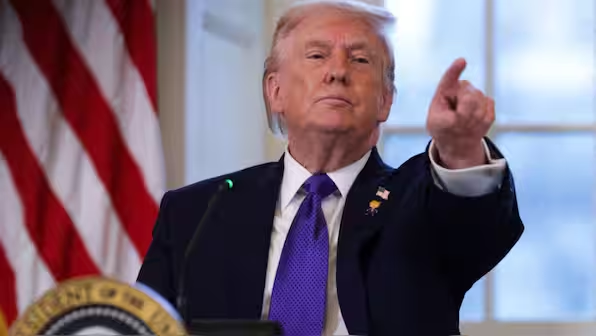
While trade discussions gather momentum, the United States is simultaneously grappling with high-stakes decisions on Iran. President Donald Trump has been briefed on a range of options amid escalating tensions and unrest inside Iran. Washington’s deliberations, which reportedly include diplomatic, economic, cyber, and military pathways, have heightened global uncertainty. Any major escalation involving Iran has the potential to disrupt energy markets, regional stability, and global trade flows, with ripple effects felt far beyond West Asia.
Iran’s situation has also drawn reactions from Europe, Israel, and neighbouring countries, adding layers of complexity to an already volatile environment. For India, stability in the region is particularly important given its energy interests, diaspora presence, and strategic investments such as connectivity projects. For the United States, Iran remains a central challenge in its Middle East policy, influencing broader alliances and diplomatic priorities.
At the same time, Asia is witnessing notable leadership movements that are reshaping diplomatic engagements. In East Asia, political figures are recalibrating their foreign policy stances amid economic uncertainty, security concerns, and evolving alliances. Japanese leader Sanae Takaichi has emerged as a prominent voice in debates over Japan’s economic and strategic direction, including its engagement with major powers. Her approach reflects a broader regional trend of balancing economic cooperation with security considerations, particularly in relation to China and the United States.
In South Korea, opposition leader Lee Jae-myung continues to shape political discourse with positions that could influence Seoul’s external relations depending on future electoral outcomes. South Korea’s choices on trade, technology, and security alliances are closely watched, given its role as a major economy and a key US ally in the region.
Another development drawing attention is the planned visit of Canadian political figure Mike Carney to China. Such engagements highlight ongoing efforts by countries to manage economic ties with Beijing even amid strategic competition and political disagreements. These diplomatic moves reflect a global reality in which nations are seeking to protect economic interests while navigating an increasingly fragmented international order.
Against this backdrop, India’s position is distinctive. New Delhi maintains strategic autonomy, engaging with multiple power centres while avoiding formal alliances. Its relationship with the United States has grown steadily stronger, encompassing defence cooperation, technology partnerships, and people-to-people ties. At the same time, India remains mindful of its relations with other major players, including Russia, the European Union, and countries in West and East Asia.
The convergence of trade talks, Iran-related tensions, and leadership shifts across Asia illustrates how interconnected today’s global challenges have become. Decisions taken in Washington, Tehran, Tokyo, Seoul, Ottawa, or Beijing can influence economic sentiment and diplomatic calculations in New Delhi. For India and the United States, navigating this environment requires careful coordination, clear communication, and a willingness to separate areas of cooperation from areas of disagreement.
As discussions around trade potentially move forward, both sides are aware that success will depend not only on resolving technical issues but also on sustaining political trust. The broader geopolitical environment, marked by uncertainty and competition, adds urgency to efforts to stabilise and strengthen key partnerships. In this sense, the renewed focus on India–US trade talks is not merely about tariffs or market access, but about positioning both countries within a rapidly changing global landscape where economics and geopolitics are inseparable.