The political debate over India’s interim trade arrangement with the United States has intensified, with the Congress raising serious concerns about its potential impact on cotton farmers and the textile export industry.
Congress leader Rahul Gandhi has launched a sharp attack on the Union government, accusing it of misleading the country and undermining two of India’s most employment-intensive sectors through what he describes as an unfair and damaging interim trade deal with the United States. According to Gandhi, the agreement places India at a structural disadvantage by imposing an 18 per cent tariff on Indian garment exports to the US, while allowing competing countries to enjoy zero-duty access under conditions that India has not been transparently informed about. He has argued that the deal threatens the livelihood of millions dependent on cotton farming and textile manufacturing, and reflects a deeper failure of negotiation and policy clarity.
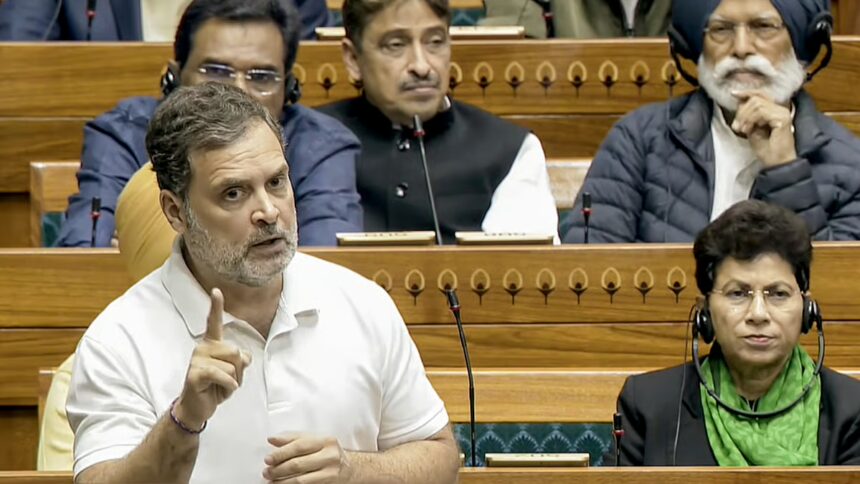
Speaking publicly and through social media, Gandhi alleged that the government has attempted to obscure critical details of the agreement, particularly in comparison with the trade concessions available to Bangladesh. He contended that such selective disclosures have created confusion among farmers, exporters, and the wider public, while masking what he believes is a fundamentally flawed trade strategy. The controversy has revived broader questions about India’s approach to trade negotiations, the balance between protecting domestic producers and accessing global markets, and the political accountability surrounding high-stakes economic decisions.
Tariff disparities, Bangladesh comparison, and accusations of policy concealment
At the heart of Gandhi’s criticism lies the sharp contrast he drew between India’s tariff burden and the concessions allegedly extended to Bangladesh under US trade arrangements. He claimed that while Indian garment exports face an 18 per cent tariff in the American market, Bangladesh enjoys zero-duty access, provided it imports cotton from the United States. According to Gandhi, this asymmetry has placed Indian exporters at a competitive disadvantage in one of the world’s most important apparel markets.
Gandhi argued that the government has failed to communicate this reality clearly to the public. He said that when he raised the issue in Parliament following the announcement of the 18 per cent tariff on Indian garments, a minister responded that India could also secure similar benefits if it agreed to import American cotton. Gandhi questioned why this condition was not disclosed upfront and asked whether such an arrangement could genuinely be described as a choice for India.
He framed the situation as a policy trap rather than a negotiated opportunity, suggesting that India has been pushed into a dilemma with no favourable outcome. According to his argument, accepting American cotton imports to gain tariff concessions would undermine domestic cotton farmers, while rejecting such imports would leave Indian textile exporters uncompetitive against countries enjoying zero-duty access. He described this as a “well in front, ditch behind” scenario, where either path leads to economic harm.
The Congress leader accused the government of deliberately hiding these trade-offs from public debate until confronted in Parliament. He questioned the transparency of the negotiation process and argued that policies with such wide-ranging consequences for employment and rural livelihoods should be openly discussed and scrutinised. In his view, the lack of clarity has eroded trust and raised doubts about whether national interest was adequately protected during negotiations.
Beyond the immediate tariff issue, Gandhi linked the controversy to a broader critique of India’s trade policy direction. He suggested that instead of strengthening domestic value chains and enhancing export competitiveness through structural support, the government has relied on arrangements that shift pressure onto farmers and small producers. He argued that this approach risks locking India into unfavourable terms while competitors gain an edge in global markets.
Impact on cotton farmers, textile industry, and broader employment concerns
Gandhi placed particular emphasis on the potential consequences for India’s cotton farmers, a group already vulnerable to price volatility, rising input costs, and climate-related uncertainties. He warned that large-scale imports of American cotton, if pursued to secure tariff concessions, could depress domestic prices and displace Indian produce in its own market. According to him, such an outcome would devastate farmers who depend on cotton cultivation for their livelihoods, particularly in states where the crop forms the backbone of rural economies.
He argued that cotton farming is not an isolated activity but part of a wider economic ecosystem that supports ginning units, transport networks, and rural employment. Any policy that weakens this sector, he said, would have cascading effects across multiple layers of the economy. In this context, Gandhi described the prospect of increased American cotton imports as not merely a trade adjustment but a structural shock with long-term social consequences.
At the same time, Gandhi cautioned that refusing to import American cotton would expose the textile and garment industry to intense global competition without adequate protection. With countries like Bangladesh enjoying zero-duty access to the US market, Indian exporters would struggle to match prices and maintain market share. He argued that this could lead to factory closures, job losses, and a contraction of one of India’s most labour-intensive manufacturing sectors.
Highlighting the scale of the industry, Gandhi noted that textiles and garments employ millions of workers, many of them women and migrants from economically weaker regions. He said that policies undermining export competitiveness in this sector risk pushing large numbers of families into unemployment and economic insecurity. In his view, the trade deal fails to account for the social cost of reduced competitiveness and prioritises headline agreements over ground-level realities.
Gandhi contrasted the current situation with what he described as a more visionary approach to governance. According to him, a government genuinely committed to national interest would have negotiated an agreement that simultaneously protected cotton farmers and strengthened textile exporters. He argued that such an outcome would require tougher bargaining, clearer red lines, and a more holistic understanding of domestic economic interdependencies.
He accused the government of doing the opposite, alleging that it accepted terms that exposed both sectors to risk while presenting the deal as a success. In his assessment, the controversy reflects a deeper pattern of economic decision-making where the interests of primary producers and labour-intensive industries are subordinated to short-term diplomatic or political considerations.
The issue has also taken on a wider political resonance, feeding into ongoing debates about transparency, parliamentary oversight, and the balance of power in trade negotiations. Gandhi’s intervention has forced the government to respond publicly and has drawn attention to the complexities of modern trade deals, which often involve conditional market access rather than straightforward tariff reductions.
As the debate continues, the India–US interim trade deal has become a focal point for broader questions about how India positions itself in global trade while safeguarding domestic livelihoods. Gandhi’s critique has underscored the political sensitivity of agriculture and textiles, sectors that sit at the intersection of economic policy and social stability. With millions of jobs at stake, the controversy highlights the high costs of perceived policy missteps and the enduring challenge of aligning global engagement with domestic economic security.