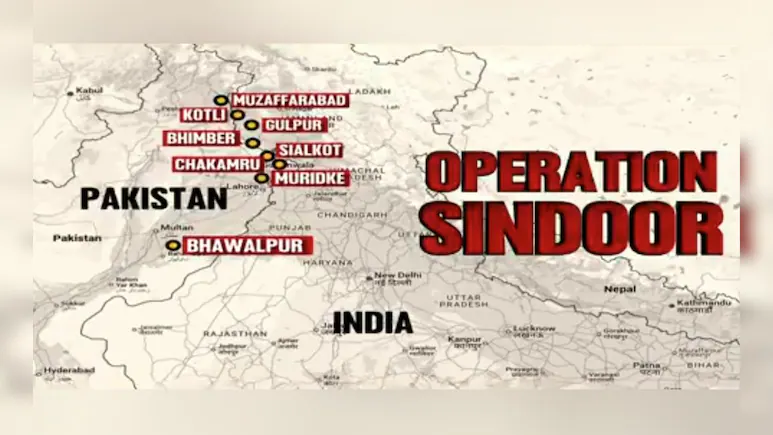
In a powerful response to the Pahalgam terror attack, India carried out precision strikes on nine terrorist-linked facilities in Pakistan and Pakistan-occupied Kashmir (PoK) on Wednesday. These targets were not random—they were high-value locations that have long operated as launch pads, training hubs, and indoctrination centres for terror groups like Jaish-e-Mohammed (JeM), Lashkar-e-Taiba (LeT), and Hizbul Mujahideen (HM), with the backing of Pakistan’s Army and intelligence establishment.
How Pakistan’s military infrastructure aids terrorism
Counter-terrorism officials said these locations were not only providing sanctuary to terrorists but were deeply embedded in Pakistan’s military and civilian infrastructure. Several camps operated under the guise of public health centres and government buildings, often located close to army cantonments. These facilities provided logistical and tactical support to militants and helped coordinate infiltration into Indian territory. Camps such as Sarjal–Tehra Kalan in Narowal and Mehmoona Joya in Sialkot functioned from Primary Health Centres and Basic Health Units, offering cover for launching drone missions, building infiltration tunnels, and smuggling arms.
Many of these centres have been repurposed or renamed to escape international scrutiny, with groups adopting labels like The Resistance Front and Kashmir Tigers. However, intelligence inputs confirmed their continuing affiliation with banned outfits. The use of high-frequency communication systems at these facilities helped plan attacks and maintain coordination with infiltrated terrorists across the Line of Control.
Key terror hubs linked to past attacks
Among the most prominent targets was the Markaz Subhan Allah in Bahawalpur, JeM’s operational headquarters. Not only is it home to JeM chief Masood Azhar and top commanders, but it also played a key role in planning the Pulwama attack of 2019. Another crucial target was Markaz Taiba in Muridke, associated with LeT and historically linked to the 26/11 Mumbai attacks. These centres double as training grounds and ideological indoctrination hubs.
Other facilities targeted included the Shawai Nallah Camp in Muzaffarabad, which was used for training in weapons and guerrilla tactics, and the Markaz Abbas and Markaz Syedna Bilal in Kotli and Muzaffarabad respectively, which serve as major infiltration and staging posts. Pakistani Special Services Group (SSG) commandos are believed to provide jungle and mountain warfare training at some of these sites, enhancing the militants’ capabilities.
India’s operation underscores a shift in its counter-terror approach, where cross-border safe havens used for orchestrating violence on Indian soil will no longer go unchallenged.