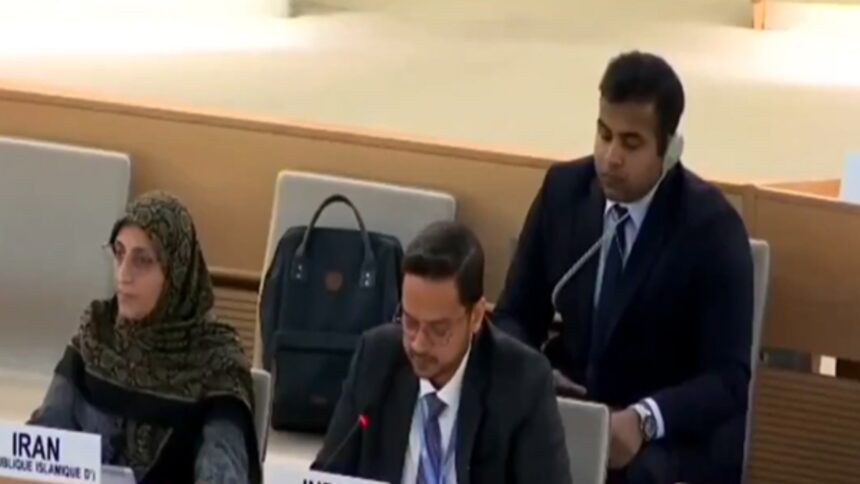
India launched a sharp counterattack against Pakistan at the United Nations Human Rights Council (UNHRC), dismissing Islamabad’s accusations of human rights violations in Jammu and Kashmir and branding it a “failed state” that survives on international aid. Speaking at the seventh meeting of the 58th UNHRC session in Geneva, India’s representative Kshitij Tyagi strongly criticized Pakistan’s leadership, accusing it of spreading falsehoods dictated by its military and misusing international platforms to further its anti-India rhetoric. The remarks came in response to allegations made by Pakistan’s Law Minister Azam Nazeer Tarar, who had accused India of rights violations in the region.
India’s diplomatic offensive underscored Pakistan’s repeated attempts to distort facts and divert global attention from its own internal crises. Tyagi stated that Pakistan has turned the Organisation of Islamic Cooperation (OIC) into its personal propaganda tool and was attempting to misuse the UNHRC for the same purpose. He emphasized that Pakistan has long been a destabilizing force in the region, using instability as a means of survival while relying on foreign handouts. The Indian envoy further slammed Pakistan’s hypocrisy, calling its rhetoric a mockery of international institutions and asserting that Islamabad has no credibility to lecture any nation on human rights or democracy. He pointed out that while Pakistan levels accusations against India, its own record is marked by widespread human rights abuses, persecution of minorities, suppression of political dissent, and its open support for UN-sanctioned terrorists.
The Indian delegation reiterated that the Union Territories of Jammu & Kashmir and Ladakh are, and will always remain, integral parts of India, dismissing Pakistan’s repeated attempts to internationalize the issue. Tyagi highlighted the remarkable political, social, and economic progress made in Jammu & Kashmir in recent years, contrasting it with Pakistan’s claims of turmoil in the region. He stated that the positive developments in the Union Territory are a testament to the Indian government’s commitment to restoring normalcy after decades of terrorism sponsored by Pakistan. He further argued that while Pakistan continues to push its propaganda, India remains focused on strengthening democracy, ensuring development, and upholding the dignity of its citizens—values that Pakistan would do well to learn from.
India’s latest rebuke at the UNHRC follows a strong statement made earlier by India’s Permanent Representative to the United Nations, Ambassador Parvathaneni Harish. Speaking at the United Nations Security Council (UNSC) during an Open Debate on February 19, Harish firmly rejected Pakistan’s reference to Jammu & Kashmir, reiterating that the region has been and will always be an inseparable part of India. The Indian envoy’s remarks were a direct response to Pakistan’s Deputy Prime Minister and Foreign Minister, who had sought to bring up the issue in the UNSC.
The escalating diplomatic battle between the two nations highlights India’s firm stance against Pakistan’s continued efforts to raise the Kashmir issue on global platforms. New Delhi has repeatedly countered such attempts by exposing Pakistan’s track record of state-sponsored terrorism, political instability, and internal repression. India’s latest statement at the UNHRC serves as another strong reminder that Pakistan’s credibility on human rights and democracy remains in question, and its attempts to malign India on international platforms will not go unchallenged.