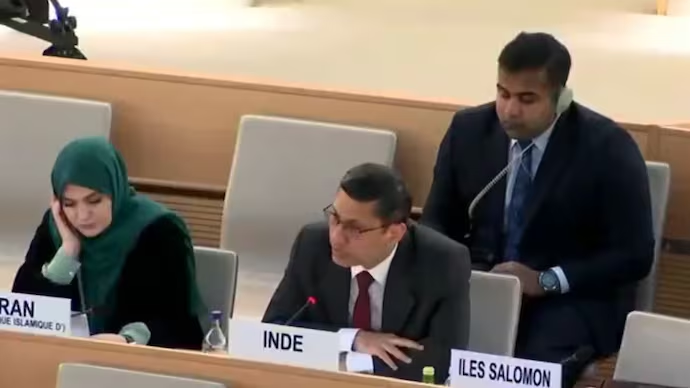
India has strongly countered United Nations human rights chief Volker Turk’s remarks on Kashmir and Manipur, asserting that the country remains a thriving democracy with a pluralistic society. India’s permanent representative to the UN in Geneva, Arindam Bagchi, made the statement during the 58th regular session of the UN Human Rights Council, emphasizing that concerns raised about India were “unfounded and baseless.”
Bagchi highlighted that India, as the world’s largest democracy, has time and again disproved such misplaced apprehensions. He urged for a better understanding of India’s diverse and open societal ethos, which continues to shape its civic space. Rejecting Turk’s observations, he said the remarks did not reflect the ground realities and stood in stark contrast to India’s democratic framework.
Referring to the elections held in Jammu and Kashmir, Bagchi pointed out that the region has witnessed notable progress, including high voter participation, economic growth, and a surge in tourism. He criticized the UN official’s reference to Jammu and Kashmir as merely “Kashmir,” asserting that this misrepresentation fails to acknowledge the true situation. He stressed that the significant voter turnout in provincial elections and rapid infrastructure development in the region indicate growing stability.
During his global update to the Human Rights Council, Turk had raised concerns about violence and displacement in Manipur, urging India to step up peacebuilding efforts while protecting human rights. He also expressed concern over alleged restrictions on human rights defenders and journalists, pointing to “harassment” and “diminished civic space” in Kashmir.
India, however, dismissed these claims, stating that its democratic institutions remain strong and have always upheld diversity and development. Bagchi emphasized that democracy is a continuous process requiring active participation at all levels of society. He reiterated that India’s governance remains committed to inclusion, progress, and the protection of rights, underscoring that allegations of restrictive laws and suppression of freedoms were not reflective of reality.
India’s response marks yet another instance of its firm stance against international criticism over its internal affairs. The government has consistently maintained that issues related to Kashmir and Manipur are sovereign matters and do not warrant external interference. By reaffirming its democratic values and ongoing developmental efforts, India has sought to counter global narratives that question its human rights record.