New Delhi, March 2, 2026:
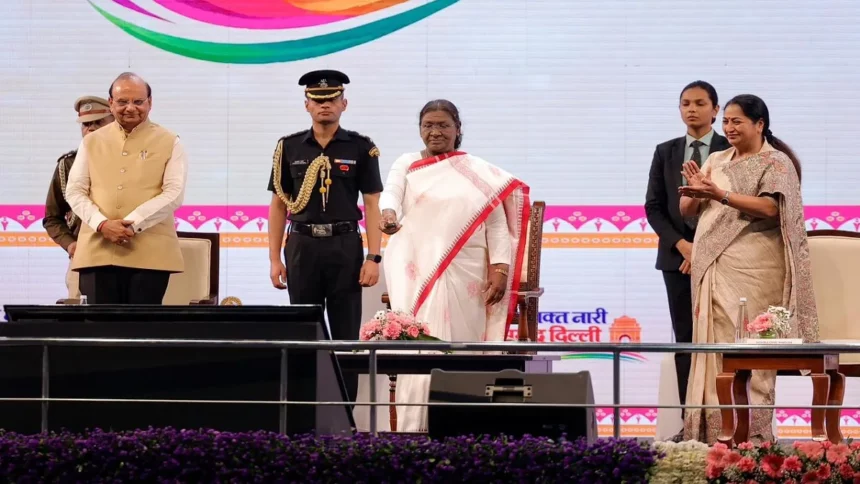
In a significant step toward strengthening women’s empowerment in the national capital, President Droupadi Murmu on Monday launched four major welfare schemes aimed at the holistic development of women and girls in Delhi. The initiatives were unveiled at a grand event titled “Sashakt Nari, Samriddh Delhi” held at the Indira Gandhi Indoor Stadium.
The President formally inaugurated the Delhi government’s Lakhpati Bitiya Yojana, Saheli Pink Smart Card, and the provision of free LPG cylinders on Holi and Diwali for eligible beneficiaries. In addition, under the campaign “Meri Punji, Mera Adhikar”, more than ₹100 crore was transferred through Direct Benefit Transfer (DBT) to 40,642 eligible girl beneficiaries under the Ladli scheme.
Lieutenant Governor V. K. Saxena, Union Minister of State Harsh Malhotra, Chief Minister Rekha Gupta, Cabinet Minister Manjinder Singh Sirsa, Dr. Pankaj Kumar Singh, and thousands of women beneficiaries and girls attended the event.
President Highlights Women’s Role in Nation-Building
Addressing the gathering, President Murmu described the newly launched initiatives as crucial steps toward enabling women to become self-reliant. She expressed confidence that schemes such as Meri Punji, Mera Adhikar, Saheli Smart Card, and Lakhpati Bitiya Yojana would bring positive change in the lives of women and contribute significantly to building a prosperous Delhi.
Referring to India’s rich tradition of revering women as symbols of power, knowledge, and prosperity, she recalled the contributions of Ahilyabai Holkar, Rani Lakshmibai, Savitribai Phule, Rani Gaidinliu, and Sarojini Naidu. She noted that women today are achieving new milestones in the armed forces, science, sports, politics, administration, and business. However, she also acknowledged the persistent challenges of violence, economic inequality, social neglect, and health issues that need urgent attention.
The President emphasized that true empowerment is possible only when women are given equal rights, access to education, security, and the freedom to make independent decisions with dignity and self-respect. She cited central government initiatives such as Beti Bachao Beti Padhao, Pradhan Mantri Ujjwala Yojana, Pradhan Mantri Mudra Yojana, and various maternity benefit schemes as efforts that have strengthened women’s path toward self-reliance. Increased political participation through Panchayati Raj institutions and the Nari Shakti Vandan Act has further advanced women-led development.
Stating that women’s empowerment is not solely the government’s responsibility but a collective duty of society, she urged citizens to educate daughters, build their confidence, and ensure safe environments for them. Referring to the goal of making India a developed nation by 2047, she remarked that this vision cannot be achieved without empowering half of the population. She described men and women as the two wheels of the chariot of life, stressing that balanced strength between them is essential for national progress.
Delhi as a Model for Women-Led Development
The President underlined the importance of Delhi, as the national capital, setting an example in women-led development. She said that ensuring women in Delhi are safe, educated, and financially independent would have a positive ripple effect across the country. She called upon citizens to prioritize women’s dignity and equal opportunity.
Lieutenant Governor Calls Schemes ‘Game Changer’
Lieutenant Governor V. K. Saxena described the initiatives as a landmark step in Delhi’s journey toward women’s empowerment. He said the schemes would directly benefit lakhs of women in the capital and strengthen not only individuals but also their families.
He termed the Lakhpati Bitiya Yojana a visionary initiative that ensures structured financial support for girls from birth through higher education and vocational training. He added that empowerment goes beyond financial strength and includes equal opportunities, security, respect, and community participation. As the national capital, Delhi has a responsibility to set a benchmark for inclusive and just development.
Chief Minister Calls It a Historic Moment
Chief Minister Rekha Gupta described the launch as a historic milestone for Delhi. She said the day marked not just the inauguration of schemes but a strong commitment to women’s dignity, self-reliance, and confidence.
Under the Meri Punji, Mera Adhikar campaign, a special drive was undertaken to clear pending Ladli scheme dues. In the first phase, around 30,000 girls received ₹90 crore through DBT. On Monday, more than 40,000 beneficiaries received over ₹100 crore directly into their bank accounts.
Gupta explained that earlier beneficiaries often lacked clarity regarding pending amounts. The new Lakhpati Bitiya Yojana has been designed as a robust, future-oriented, fully digital and faceless system. Under the scheme, the government will deposit a total of ₹61,000 in installments from birth to graduation, which with accrued interest will mature to approximately ₹1.25 lakh. A budget provision of ₹128 crore has been allocated. Girls residing in child care institutions will also be covered, with the government assuming the role of guardian. The objective, she said, is to ensure that no girl in Delhi drops out of education.
Highlighting mobility and safety, Gupta described the Saheli Pink Smart Card as more than a travel facility, calling it a “dignity card.” Aligned with the “One Nation, One Card” vision, it will be usable in DTC buses and other public transport, ensuring secure and convenient travel for women while improving transparency.
She further announced that, fulfilling the government’s promise, installments for free LPG cylinders on Holi and Diwali were released directly into the accounts of eligible ration card holders. Approximately ₹130 crore was transferred to women beneficiaries to provide financial relief in household expenses.
Concluding her address, Gupta said women’s empowerment now represents a national commitment. She extended greetings on International Women’s Day and Holi, expressing hope for a brighter future for all women and girls in Delhi.