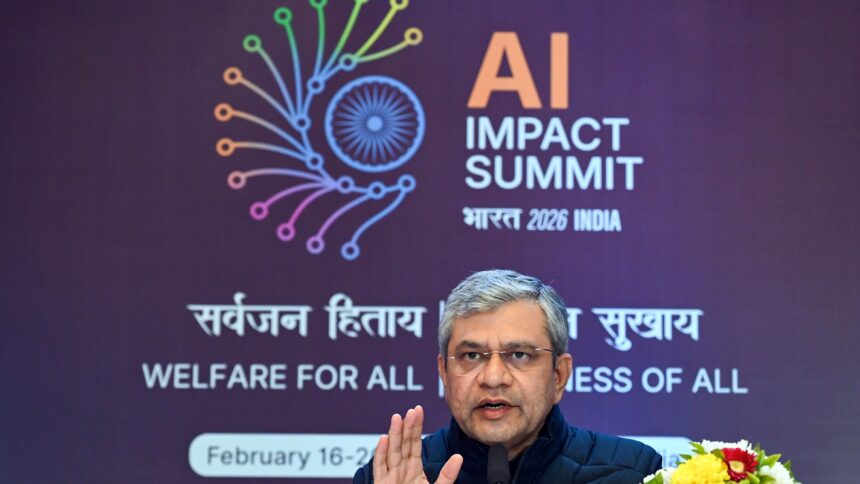
India is preparing to host one of the largest and most significant artificial intelligence gatherings in South Asia, the AI Impact Summit 2026, in New Delhi from 16 to 20 February. The event will bring together thousands of delegates, global technology executives, policymakers, and innovators to discuss the future of AI, its role in shaping economies, and its potential to transform human lives. Ahead of the summit, top CEOs from leading technology companies including OpenAI, Accenture, Qualcomm, Adobe, and Amazon have shared their perspectives on the importance of India’s role in the AI revolution and their commitments to supporting the growth of artificial intelligence in the country. These insights underscore the anticipation surrounding India’s first global AI gathering in the Global South and highlight the country’s increasing influence in shaping the next phase of AI innovation worldwide.
Global Tech Leaders Highlight India’s Central Role in Shaping Artificial Intelligence Evolution
Leading executives attending the India AI Impact Summit 2026 have emphasised India’s growing significance in the global AI ecosystem. Sam Altman, Chief Executive Officer of OpenAI, revealed that India is the company’s second-largest market globally after the United States and is on track to become its largest market given the rapid technological adoption. Altman emphasised OpenAI’s commitment to building AI in India, with India, and for India, ensuring that AI tools are accessible to all citizens regardless of income, education, or prior technological experience. He highlighted the importance of practical and near-term initiatives that can enable Indians to unlock the transformative potential of AI. Altman also hinted at new partnerships with the Indian government aimed at broadening access to AI technologies across the country, reflecting OpenAI’s strategic focus on enabling innovation in diverse sectors and communities.
Adobe CEO Shantanu Narayen pointed to India as a country where imagination meets ambition, praising Prime Minister Modi and the Ministry of Electronics and IT for spearheading the summit. He highlighted the potential of AI to drive inclusive growth, unlock human potential, and contribute to a sustainable future. Narayen stressed that this summit serves as a platform for collaborative innovation, where global technology leaders and Indian stakeholders can explore creative AI solutions that enhance productivity, creativity, and economic development. By positioning India as a hub for responsible AI, he reinforced the narrative that the country is emerging as a center of innovation capable of shaping global technological discourse.
Accenture Chairperson and CEO Julie Sweet shared her perspective on the transformative potential of AI, asserting that the technology will define the next decade and revolutionise work, economic growth, and societal structures. She emphasised that for AI to benefit everyone, deeper collaboration, responsible leadership, and human-centric oversight are essential. Sweet pointed to the importance of the Global South, particularly India, in influencing AI’s trajectory, and highlighted the summit as a forum to align global efforts toward building a future where AI empowers societies, rather than exacerbates inequalities. Her remarks underscored the necessity of integrating ethics, equity, and accountability into the design and deployment of AI systems, ensuring that technological advances translate into meaningful social and economic outcomes.
Integration, Innovation, and Real-World Impact: Perspectives on AI’s Next Phase
Cristiano Amon, President and CEO of Qualcomm, highlighted that the next phase of AI development will be defined by its seamless integration into everyday life. He described a vision where intelligence permeates all devices—from phones and PCs to industrial machines, cars, and robots—delivering personalised experiences, enhanced productivity, and more efficient learning systems. Amon stressed that the evolution of AI will reshape industries, creative processes, and educational paradigms, while emphasising the importance of understanding context, the physical environment, and human needs in designing AI applications. This vision reinforces India’s potential as a global hub for AI-enabled innovation, capable of driving transformative impacts across sectors and communities.
David Zapolsky, Chief Global Affairs and Legal Officer at Amazon, articulated the company’s long-term commitment to India, announcing plans to invest an additional $30 billion through 2030. He highlighted India’s emergence as a global innovation hub, capable of solving real-world problems through technology. Zapolsky emphasised that AI’s true promise is realised when it addresses tangible challenges for people and communities, such as increasing agricultural productivity, enabling small businesses to scale globally, and improving access to essential services. His remarks underscored a vision where AI functions not merely as a technological advancement but as a tool for social and economic empowerment.
The perspectives of these global technology leaders converge on several critical themes. First, India is increasingly recognised as a major player in AI development, both in terms of market potential and as a site for innovative application. Second, AI’s transformative power is closely linked to its accessibility and inclusivity, highlighting the need for initiatives that bridge socio-economic and educational divides. Third, collaboration between governments, corporations, and communities is essential to ensure AI’s ethical deployment and societal benefit. Collectively, these insights frame the India AI Impact Summit 2026 not merely as a conference but as a milestone in aligning global AI innovation with inclusive development goals.
The AI Impact Summit 2026 is anticipated to attract over 35,000 registrations from delegates representing more than 100 countries, reflecting the scale of India’s growing prominence in global AI discussions. The summit provides a unique platform for cross-sector dialogue, where technological capabilities, policy frameworks, and human-centered design converge to shape the future of AI. Attendees are expected to explore a wide range of AI applications—from enterprise solutions and creative tools to healthcare, agriculture, education, and governance—demonstrating the breadth of AI’s potential impact.
India’s hosting of this summit also signifies a broader strategic ambition: positioning itself as a leading voice in global AI governance while fostering domestic innovation ecosystems. The event allows India to showcase its technological expertise, human capital, and regulatory foresight, while facilitating international collaboration that strengthens the country’s influence in shaping AI standards, policies, and ethical frameworks. As multinational corporations and Indian startups converge at the summit, the discussions are likely to influence investment flows, research priorities, and regulatory approaches for years to come.
In addition to technical and economic considerations, the summit foregrounds social and ethical implications of AI adoption. Leaders have repeatedly emphasised that the development of AI must prioritise human welfare, equity, and accountability. Issues such as bias in algorithms, transparency of AI decision-making, and the ethical use of AI in sensitive sectors are central to discussions, reflecting a commitment to ensuring that AI technologies enhance, rather than undermine, societal well-being. By integrating these dimensions into the global AI dialogue, the summit aims to establish India as a center for responsible and human-centered AI development.
Looking ahead, the India AI Impact Summit 2026 represents a critical opportunity to shape the next chapter of artificial intelligence, drawing upon India’s unique combination of human capital, technological expertise, and policy leadership. As top global CEOs, policymakers, and innovators gather in New Delhi, the summit is poised to catalyse discussions that will influence the trajectory of AI development across continents. The insights shared by leaders from OpenAI, Accenture, Qualcomm, Adobe, and Amazon highlight the convergence of ambition, imagination, and responsibility necessary to ensure AI’s transformative potential is realised for all.
The upcoming summit underscores the role of India not just as a participant but as a driver of global AI innovation. By providing a platform for collaboration between governments, industry, and civil society, the summit reinforces the country’s leadership in defining AI’s ethical, economic, and societal frameworks. From expanding access to AI tools to promoting inclusive innovation, the discussions in New Delhi are expected to influence policy, investment, and research agendas worldwide, shaping a future where AI serves as a catalyst for sustainable development, productivity, and human empowerment.