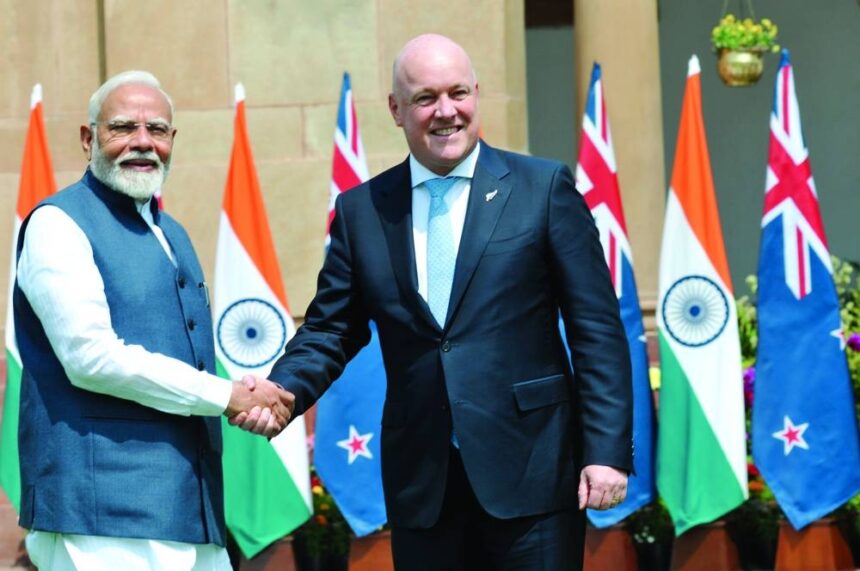
India and New Zealand have taken a significant step towards deepening bilateral relations, with both nations signing an ambitious agreement to institutionalize defence ties and enhance cooperation in the Indo-Pacific region. Prime Minister Narendra Modi, during his meeting with his New Zealand counterpart Christopher Luxon, raised concerns about pro-Khalistani elements engaging in anti-India activities in the island nation.
The meeting resulted in six agreements covering various sectors, including education, sports, agriculture, and climate change. Both leaders also emphasized the importance of a roadmap for cooperation in the defence industry sector. Additionally, discussions took place on strengthening economic ties, with a mutual commitment to concluding negotiations for a Free Trade Agreement (FTA) that aims for deeper economic integration.
Jaideep Mazumdar, Secretary (East) in the Ministry of External Affairs, indicated that the two countries aim to finalize the FTA by the end of the year. Prime Minister Narendra Modi reiterated India’s stance on a free, open, and secure Indo-Pacific, emphasizing a policy of development over expansionism, in light of global concerns over China’s assertive actions in the region.
Luxon’s five-day visit to India underscores New Zealand’s intent to enhance economic engagement. As part of the FTA negotiations, discussions also commenced on facilitating the mobility of professionals and skilled workers to address irregular migration challenges. Moreover, both sides agreed to explore early implementation of cooperation in the digital payments sector.
During the talks, PM Narendra Modi highlighted the need for decisive action against terrorism, citing the 2019 Christchurch attack and the 26/11 Mumbai strikes as reminders of the global threat posed by terrorism. He stressed that strong measures must be taken against those responsible for terrorist activities. Narendra Modi also expressed concerns over anti-India elements operating in New Zealand and conveyed confidence that the Kiwi government would take appropriate actions against such groups.
The issue of pro-Khalistani activities was also discussed, with India raising concerns about the misuse of democratic freedoms to glorify terrorism and threaten Indian diplomats. New Zealand acknowledged these concerns and assured cooperation in addressing them.
On defence and security, both leaders agreed to institutionalize their partnership, enhance joint exercises, training, and port visits, and draft a comprehensive roadmap for cooperation in the defence sector. The agreements signed included a mutual recognition pact between the Central Board of Indirect Taxes and Customs of India (CBIC) and New Zealand’s Customs Service.
Maritime security also featured in discussions, with New Zealand welcoming India’s participation in the Combined Maritime Forces. Both leaders lauded the strengthening of defence ties during New Zealand’s leadership of Command Task Force 150.
Beyond bilateral concerns, the two leaders discussed global issues, including the Middle East crisis, reaffirming their support for peace and stability. They called for continued negotiations towards a two-state solution for Palestine and the release of all hostages in the Gaza conflict. On Ukraine, Narendra Modi and Luxon underscored the need for a lasting peace based on international law and territorial integrity.
Counterterrorism measures were also a focal point, with both leaders condemning terrorism in all forms and calling for global action against UN-proscribed terrorist organizations. They emphasized the necessity of dismantling terror financing networks and bringing perpetrators to justice.
Additionally, both sides explored the feasibility of direct flights between India and New Zealand to enhance connectivity and foster closer ties. With a strong commitment to deepening their partnership, India and New Zealand look forward to furthering their cooperation across various strategic and economic domains.