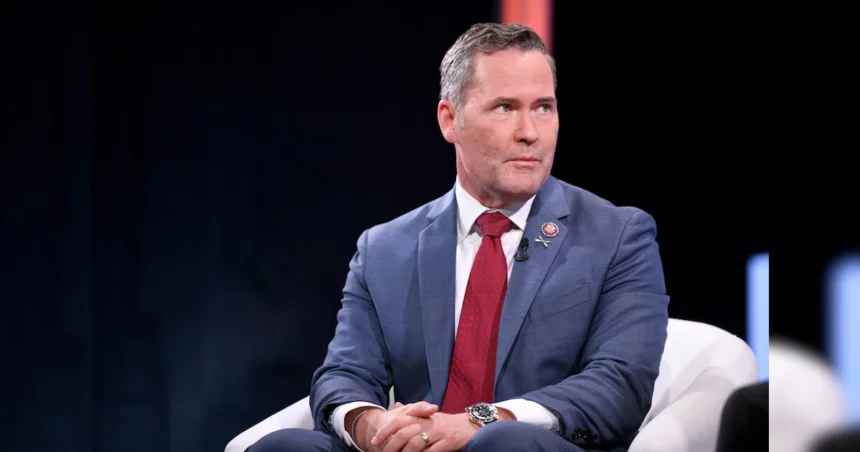
Mike Waltz, the incoming National Security Advisor (NSA) under President-elect Donald Trump, has indicated that several key aspects of the outgoing Biden administration’s China and Indo-Pacific policies will be carried forward under the new leadership. Mike Waltz made these comments during an appearance at the US Institute of Peace (USIP), where he discussed his views on the critical national security issues facing the United States, particularly in relation to China and its growing influence in the Indo-Pacific region.
Mike Waltz, who will officially assume his role as NSA on January 20 when Trump is sworn in as the 47th president of the United States, made it clear that China remains the “greatest adversary” to the US. He emphasized that the incoming administration would continue to adopt a strategic approach towards Beijing, balancing national security concerns with economic considerations. “The President-elect firmly believes we can avoid conflict with the Chinese Communist Party because they need our markets. We are going to use the leverage we have, in a way that’s in line with our national security priorities, while we still can,” Mike Waltz said during the panel discussion, which also featured the outgoing NSA, Jake Sullivan.
One of the highlights of Mike Waltz’s remarks was his acknowledgment of India as a critical partner for the United States in the coming years. Mike Waltz pointed out that his connection to India is longstanding, having served as the Republican chair of the US-India Caucus in the last Congress. He shared a light-hearted moment with Sullivan, who had just returned from India, saying that there was significant enthusiasm in India about his role in strengthening the US-India relationship. Sullivan remarked that Mike Waltz is “very popular in India” and that the US-India Congressional Caucus is held in high regard by Indian leaders.
The conversation then turned to broader US foreign policy, particularly regarding multilateral agreements like AUKUS and the Quad, which have remained consistent from one administration to the next. Mike Waltz indicated that these alliances would continue to be a focal point of the new administration’s strategy, particularly in reinforcing supply chains and dealing with the growing challenges posed by China. He also mentioned the need to address the backlog of military equipment purchases related to Taiwan, signaling continued US support for the island as a deterrent measure against Chinese aggression.
A significant point of focus for the incoming NSA will be strengthening partnerships with countries in the Indo-Pacific region. Mike Waltz emphasized the importance of continuing the trilateral dialogues between the United States, Japan, and South Korea, as well as the trilateral engagement between the US, Japan, and the Philippines. He stated that these dialogues help nations overcome historical animosities and align on a shared vision of a free and open Indo-Pacific. Mike Waltz also reiterated India’s importance as a critical partner for the US in the future.
Sullivan, reflecting on Mike Waltz’s comments, agreed that a strong China strategy is integral to a successful Asia strategy. He stressed that the Biden administration’s work with allies and partners would serve as a foundation for the incoming administration’s approach to Asia. Sullivan also pointed out the importance of Europe in the broader strategy, highlighting the need for the US to work closely with European allies to counter China’s unfair economic practices and to ensure supply chain resilience. Additionally, he spoke about the importance of technological investment and innovation, particularly in the context of the CHIPS and Science Act, which has yet to be fully funded.
Sullivan also emphasized the need for the US to protect its technological edge, ensuring that critical technologies with national security applications are not used against the country or its allies by adversarial states like China. He suggested that America’s strength has historically been built on its investments in research and development, driving innovations that shape the future.
As the incoming administration prepares to take office, it is clear that key elements of the US approach to China and the Indo-Pacific will remain largely unchanged. The continued emphasis on strengthening relationships with allies, countering China’s economic and technological ambitions, and reinforcing multilateral security agreements like AUKUS and the Quad will be central to the national security strategy under Mike Waltz’s leadership as NSA.