When PM Narendra Modi chose Varanasi as his parliamentary constituency in 2014, it was more than a symbolic decision. The holy city of Kashi became the stage where development, politics, and faith fused seamlessly, reshaping not only Varanasi’s urban and cultural landscape but also the Bharatiya Janata Party’s political fortunes across eastern Uttar Pradesh. Over the last decade, PM Modi’s continuous engagement with the constituency, his emphasis on Hindutva symbolism, and his focus on modern infrastructure have elevated Varanasi from a crumbling pilgrimage town to a model city that reflects both India’s ancient spiritual ethos and a forward-looking vision of growth.
The Political Gamble That Changed Eastern Uttar Pradesh
It was Saturday, March 14, 2014, when the Bharatiya Janata Party announced that PM Narendra Modi, then the chief minister of Gujarat, would contest from Varanasi in Uttar Pradesh. At that time, the Congress-led United Progressive Alliance government was floundering, while the BJP sought to maximize its prospects in the Hindi heartland. The party decided to move sitting MP Murli Manohar Joshi, who had barely scraped through in 2009, to Kanpur. This left Varanasi open for PM Modi, who was already being projected as the BJP’s prime ministerial face.
On April 24, 2014, PM Modi arrived in Varanasi and declared in his first election speech, “Na kisi ne mujhe bheja hai, na main yaha aaya hu, mujhe to maa Ganga ne bulaya hai.” By equating his arrival with a spiritual call from the river Ganga, PM Modi tied his candidacy to civilizational symbolism that resonated strongly in a city considered one of the oldest living centers of Hindu spirituality. Locals recall how he described his feeling as that of a child returning to his mother’s lap. This fusion of faith and politics gave his campaign a distinctive aura.
Political analysts note that the choice of Varanasi was not just electoral but symbolic of PM Modi’s larger ambition. Contesting from Vadodara in Gujarat would have been safe and predictable, but by simultaneously fighting from Varanasi, PM Modi positioned himself as a leader rooted in India’s civilizational ethos, not merely a regional satrap from Gujarat. Varanasi thus became the fulcrum of his pan-Indian identity.
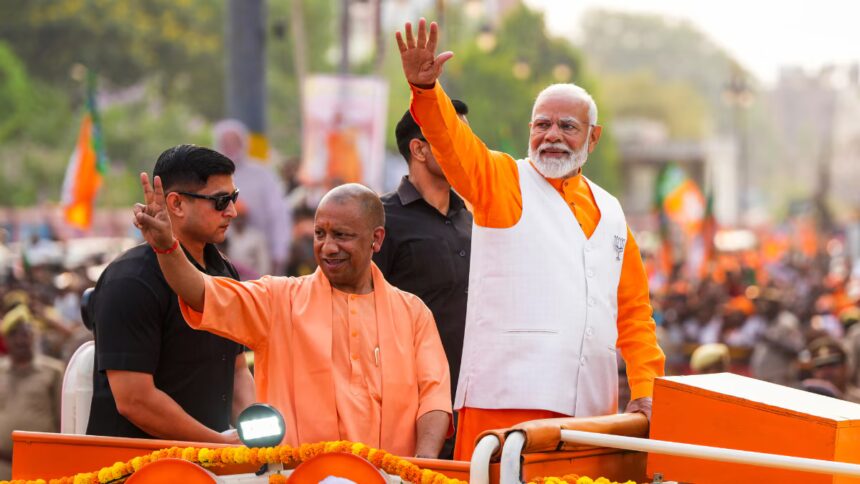
Yet, the gamble carried risk. Varanasi was not a BJP fortress. In the 2012 assembly polls, the party’s performance in the district had been uneven. Even a veteran like Murli Manohar Joshi had managed only a narrow victory over Mukhtar Ansari, a strongman with a Muslim-Yadav support base. But PM Modi’s decision electrified the atmosphere. His roadshows drew unprecedented crowds, and the election turned into a spectacle that transcended conventional politics.
When PM Modi won both Vadodara and Varanasi in 2014, he retained Varanasi despite the much larger victory margin in Gujarat. This was a deliberate political signal. The caste arithmetic of Purvanchal traditionally favored the Samajwadi Party and the Bahujan Samaj Party, but PM Modi’s decision to stay anchored in Varanasi suggested his intent to expand the BJP’s reach in a region where it had historically struggled. Over the next decade, his personal association with Varanasi helped the party dominate eastern Uttar Pradesh in national elections, with the 2014 and 2019 results showing near-total sweep for the BJP and its allies across the belt.
Transforming Varanasi: From Pilgrimage Town to Model City
Once he became prime minister, PM Modi consistently emphasized his bond with Varanasi, visiting the constituency 52 times over 11 years, a record unmatched by any of his predecessors. His presence went beyond ceremonial appearances. Each visit was marked by the unveiling of ambitious projects designed to transform the city into both a modern urban center and a showcase of India’s cultural pride.
The most iconic project has been the Kashi Vishwanath Corridor, which created a grand plaza linking the ancient Kashi Vishwanath temple with the ghats of the Ganga. This project not only improved access for pilgrims but also symbolized the merging of tradition with modernity, with state-of-the-art facilities surrounding one of Hinduism’s holiest shrines. Similarly, PM Modi oversaw the revamp of the Ganga aarti ceremony at Dashashwamedh Ghat, turning it into a cultural spectacle that draws visitors from across the world.
Infrastructure development has been extensive. The city-airport road, ring road project, perishable cargo center, trade facilitation hub, and an inland port have upgraded connectivity and trade. Underground cabling was introduced to free the skyline from tangled wires, while new roads, bridges, and renovated ghats gave the ancient city a modern sheen. The International Cooperation and Convention Centre, designed for global summits, added to Varanasi’s stature as a hub for cultural diplomacy. The Trinetra central command and control center, integrated with CCTV cameras across the city, enhanced urban governance.
Healthcare also became a priority. Two cancer hospitals were inaugurated, offering modern facilities to the region. Alongside, improved sanitation measures and better waste management systems upgraded the city’s cleanliness. Residents note that encroachments were removed wherever possible, roads were widened and repaired, and civic amenities improved in ways unseen in decades.
The scale of investment has been remarkable. Over ₹52,000 crore worth of projects were launched in Varanasi in eleven years, reshaping the city’s identity. According to locals like Rajendra Kumar Gupta, a businessman, traffic congestion has eased considerably thanks to the ring road, while cleanliness and civic order have visibly improved. Residents like Shashi Mishra describe the transformation as Varanasi adopting PM Modi as much as PM Modi adopted Varanasi.
The development narrative has also been amplified by the international spotlight. Varanasi has hosted visits by six foreign dignitaries since 2015. Japanese Prime Minister Shinzo Abe accompanied PM Modi to attend the Ganga aarti, French President Emmanuel Macron toured the city in 2018, and German President Frank-Walter Steinmeier interacted with students. Mauritius leaders Anerood Jugnauth and Navin Ramgoolam attended events in the city, while Sri Lankan Prime Minister Mahinda Rajapaksa visited in 2020. Each such visit reinforced the image of Varanasi as a bridge between India’s cultural depth and its global partnerships.
Former legislator Shatarudra Prakash points out that these projects have helped reposition the city. What was once dismissed as a crumbling pilgrimage town has been recast as a model of PM Modi’s governance template—development tied to cultural pride. Every major event staged in Varanasi sent a wider political message to Purvanchal and neighboring Bihar: that the prime minister was deeply invested in the region’s future. This sentiment translated into electoral dividends, with the BJP expanding its footprint across a region once dominated by caste-driven regional parties.
Over the past decade, Varanasi has become more than a parliamentary constituency. It has become the living embodiment of PM Modi’s political philosophy—where development is inseparable from cultural identity, where infrastructure is as important as ritual, and where faith reinforces political legitimacy. PM Modi’s personal imprint is visible across the city’s ghats, roads, temples, and public spaces, making Varanasi not just the PM’s home constituency but a symbol of his larger national project.