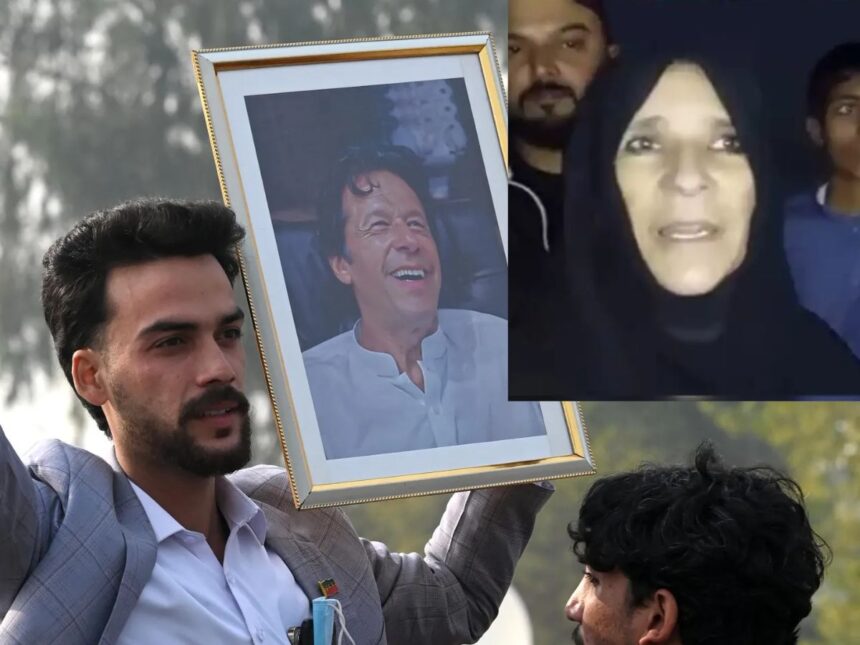
Amid a growing wave of public anxiety, political unrest, and widespread rumours about former Pakistan prime minister Imran Khan’s well-being, the authorities at Adiala Jail in Rawalpindi permitted his sister, Uzma Khanum, to meet him after weeks of restricted access. The development, which came at a time when Pakistan Tehreek-e-Insaf supporters intensified protests demanding proof of Khan’s physical and mental condition, provided a rare moment of clarity even as allegations of psychological coercion, solitary confinement and denial of family visitation continued to fuel nationwide concern.
Family Allowed Supervised Access After Weeks of Restrictions as Rumours of Imran Khan’s Death Intensify
The decision to allow Uzma Khanum entry into the prison premises came after days of escalating pressure and accusations from PTI leaders and family members who claimed that Imran Khan had been held under unusually harsh conditions. Large crowds of PTI supporters accompanied her to the jail gates, where they gathered in protest, demanding transparency and accountability from prison authorities. The situation intensified after several reports suggested the authorities had repeatedly refused visitation rights, despite court orders explicitly allowing family access.
Her visit came at a time when fears regarding Imran Khan’s wellbeing had reached a boiling point, exacerbated by his prolonged isolation and the absence of any communication with his children or siblings. Khanum stated after the meeting that the former prime minister appeared physically stable but expressed that he was being “mentally tortured,” allegedly implicating Pakistan’s powerful military establishment. Her comments, shared widely on social media and broadcast across multiple Pakistani and international platforms, ignited further political turmoil.
For nearly a week, Imran Khan’s son, Kasim Khan, had publicly demanded verifiable proof that his father remained alive, accusing the authorities of systematically blocking all communication. According to him, Khan had been imprisoned for 845 days and kept in solitary confinement for six weeks in a so-called “death cell,” raising severe concerns about the human rights implications of such treatment.
The controversy gained further traction when Khyber Pakhtunkhwa chief minister Sohail Afridi claimed that neither Imran Khan nor his wife, Bushra Bibi, had been allowed to meet any family members since October 27, despite repeated legal provisions and instructions permitting such interactions. This prolonged blackout of information created an atmosphere of uncertainty, leading to widespread speculation, politically charged narratives, and heightened public pressure on the government and jail officials.
Despite the prolonged absence of communication, the jail administration maintained that Imran Khan was in “good health,” dismissing allegations of harm or mistreatment. Yet, these assurances failed to quell the growing mistrust among PTI supporters, who accused the government of deliberately withholding information to exert psychological pressure on Khan and suppress political dissent ahead of upcoming electoral processes.
The PTI, meanwhile, claimed that the government’s sudden permission for Uzma Khanum’s visit was merely an attempt to quell public outrage and avoid further protests. The party reiterated that all previous attempts by the family to meet the former prime minister had been blocked without justification. In its official statement, PTI emphasised that while the government had finally permitted a meeting, it remained to be seen whether they would “honour their commitment” in the coming days or whether this was an isolated gesture intended to pacify immediate political pressure.
The Punjab government also responded with heightened security measures to prevent PTI’s planned demonstrations. Authorities deployed the entire Rawalpindi police force across Adiala Road, restricting movement and operationalising Section 144, which prohibits gatherings of more than four individuals. Backup forces, including station house officers from multiple police stations, were stationed outside the prison facility in anticipation of larger protests.
This unprecedented security mobilisation highlighted the political sensitivity surrounding Imran Khan’s incarceration and the government’s determination to prevent mass mobilisation that could amplify the crisis further. Despite these measures, PTI supporters continued to stage demonstrations outside the Islamabad High Court and the jail, accusing authorities of manipulating legal processes and intimidating the former prime minister’s family.
Reports also indicated that for several weeks, PTI’s senior leadership had been unable to secure permission to meet Imran Khan, raising questions about transparency and the human rights standards being applied in politically sensitive detentions. The party has consistently argued that the restrictions are politically motivated, designed to break Khan’s morale and isolate him from his supporters and advisers.
The meeting between Imran Khan and his sister therefore represented a significant moment amid a complex web of legal battles, political confrontations, and public outrage. It provided temporary insight into the state of the incarcerated former leader, even as broader questions about due process, mental coercion, and political neutrality remained unresolved.
PTI Claims Psychological Pressure on Former Prime Minister as Legal and Political Tensions Escalate
Uzma Khanum’s brief meeting with her brother shed new light on the conditions under which Imran Khan is being held. She stated that although he appeared physically stable, he explicitly told her he was being subjected to psychological pressure, which he described as “mental torture.” Such claims carry deep political resonance in a country where civilian-military tensions have historically shaped the careers of prime ministers.
Her remarks, after meeting Imran inside Adiala Jail, struck a nerve across Pakistan’s political landscape. They were swiftly circulated across social media platforms, generating intense debate about the extent to which political detainees—especially those with large public followings—are subjected to specialized detention protocols designed to break their resolve.
Uzma Khanum also indicated that she would issue a more detailed statement after consulting her sisters, Aleema Khan and Noreen Khan, both of whom have been vocal about their inability to see their brother in recent weeks. The family’s growing anxiety has been driven not only by rumours of death but also by recurring reports that authorities denied visits despite explicit judicial orders allowing them.
PTI leaders described the restrictions as unlawful, punitive, and politically motivated. They argued that prolonged solitary confinement and denial of family contact are psychological tactics aimed at weakening the morale of Pakistan’s most popular opposition leader.
Further compounding the controversy was the claim that neither Imran Khan nor Bushra Bibi had received any visits from family members since late October. Such prolonged isolation—especially for a former prime minister—has raised several questions about transparency, administrative conduct, and the legal safeguards available to political prisoners.
Authorities, however, consistently maintained that Imran Khan was healthy and that the restrictions stemmed from security concerns rather than political motives. But these assurances did little to reassure PTI supporters or ease public suspicion, partly because the government had simultaneously deployed large contingents of police along key roads and government offices in anticipation of unrest.
The imposition of Section 144 in Rawalpindi and Islamabad further inflamed tensions. PTI members accused the government of using emergency measures to suppress legitimate protest and silence public expression. The detention of PTI supporters at various checkpoints and the aggressive security build-up outside Adiala Jail underscored the political stakes involved.
Meanwhile, PTI took its protests to the Islamabad High Court, denouncing what it described as a systematic attempt to isolate Imran Khan and prevent him from communicating with his family and party leadership. Crowds outside the court and jail chanted slogans demanding transparency and accountability, turning both locations into symbolic centres of resistance.
Reports from local media suggested that the political environment is likely to grow more volatile as the party continues to press for access, legal clarity, and a review of the conditions under which Imran Khan is being held. Senior PTI leadership has vowed to escalate peaceful protests if the government fails to provide consistent visitation rights and verifiable information about Khan’s condition.
As of now, the brief meeting allowed between Imran Khan and his sister provides only a partial picture of the reality inside Adiala Jail. The political uncertainty surrounding the former prime minister, combined with allegations of mental coercion, restricted access, and heavy-handed policing, continues to dominate Pakistan’s national discourse.