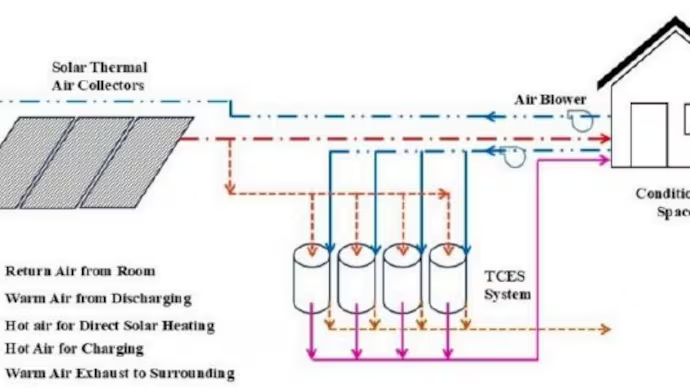
Facing freezing Himalayan winters, local residents and Indian Army personnel often rely on diesel heaters, which are expensive, polluting, and challenging to transport through difficult mountain terrain. Now, a breakthrough from IIT Bombay researchers offers a cleaner and cost-effective alternative with a solar heat storage system that works without electricity, designed specifically for harsh winter conditions in the Himalayas.
Harnessing Sunlight with Salt Storage
The innovative system uses solar air collectors to heat air during the summer months, which is then used to heat strontium bromide hexahydrate. This chemical loses water molecules during heating, effectively storing thermal energy in a dry, charged form. When winter arrives, moist air passed through the charged salt triggers a reverse chemical reaction, releasing the stored heat to warm homes and shelters. This system functions much like a thermal battery but without the need for continuous electricity or diesel fuel.
The system is compact, roughly the size of two LPG cylinders, making it easy to install and transport. Dr. Rudrodip Majumdar, who contributed to the project, highlighted the inspiration behind the technology, reflecting on his treks in the Himalayas where he witnessed villagers walking long distances to collect firewood and relying on diesel heaters that contribute to pollution.
Potential for Long-Lasting, Cost-Effective Heating
The prototype developed by the IIT Bombay team can store up to 500 kilowatt-hours of energy, sufficient to heat a small Himalayan home for up to four months during the harsh winter season. Dr. Sandip Kumar Saha, who led the study, explained that the units could be pre-charged in sunny states like Rajasthan and then transported to high-altitude regions before winter sets in, offering a practical and scalable solution for seasonal heating needs.
While solar collectors themselves are not new, the concept of seasonal heat storage using a chemical medium is the innovation that sets this system apart. According to the researchers, the Levelized Cost of Heating (LCOH) using this system is around Rs 31 per kWh in Leh, which is significantly cheaper than diesel heating when accounting for fuel transport costs and environmental impacts.
Despite its promise, the system still requires real-world testing to address challenges such as upfront installation costs and varying climate conditions in different Himalayan regions. However, the IIT Bombay team remains optimistic, believing the system could soon provide sustainable heating not only for civilians in remote hill towns but also for Indian Army camps stationed at high altitudes, bringing cleaner and long-lasting warmth to India’s coldest areas while reducing reliance on diesel fuel and mitigating carbon emissions.