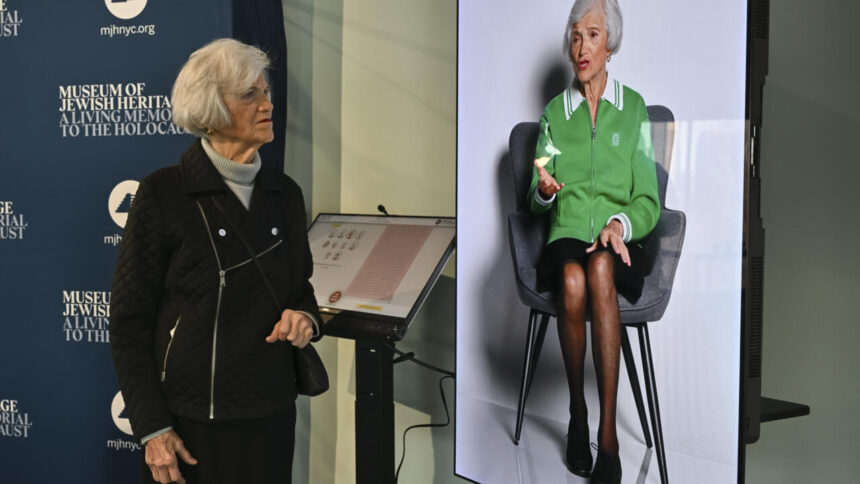
In a groundbreaking project aimed at preserving the memory of the Holocaust, survivors have entrusted their recollections of the Nazi death camps to artificial intelligence, ensuring that the horrors of the genocide remain accessible for generations to come. The Museum of Jewish Heritage (MJH) in New York is spearheading this effort, allowing 10 Holocaust survivors to record extensive interviews on various aspects of their experiences, including their childhoods, survival in the camps, and their recollections of liberation. These interviews are then used to create virtual likenesses of the survivors that can interact with future visitors, answering their questions in real-time through AI-driven responses.
The initiative, which is a collaboration between the MJH and the University of Southern California Libraries, aims to provide a lasting archive of the survivors’ testimonies. Using cutting-edge technology, members of the public will be able to ask questions to the virtual survivors, who will respond with pre-recorded answers. The project ensures that the voices of those who lived through the Holocaust will continue to resonate, even as time passes and fewer survivors remain.
Toby Levy, one of the survivors involved in the project, poignantly recalled her father’s words: “You will be the one who will have to tell the world.” Born in Poland in 1933, now part of Ukraine, Levy emphasized the importance of preserving the memories of those who suffered and survived the atrocities of the Holocaust. “Somebody will survive because we have to tell the world what happened – and maybe it’s us,” she said, reflecting on her role in ensuring future generations understand the significance of the Holocaust.
Levy was among the 200 Holocaust survivors who gathered recently to commemorate the 80th anniversary of the liberation of the Auschwitz concentration camp. The survivors, many of whom had made their way to the United States after the war, assembled to watch the live ceremony held in front of Auschwitz-Birkenau in Poland. During the event, several survivors spoke out against the rising tide of anti-Semitic hatred around the world, a troubling reminder of the persistence of such hatred.
Alice Ginsburg, born in 1933 in what was then Czechoslovakia (now Hungary), also participated in the project. Ginsburg shared her harrowing experience of being deported to Auschwitz in 1944, where she came close to death from hunger and forced labor. She was liberated from the camp in January 1945 and arrived in the United States two years later. For Ginsburg, sharing her story is vital: “It’s important to publicize it so it should never happen again,” she said, adding, “This is man’s inhumanity to man.” Like many survivors, Ginsburg expressed concern over the increasing number of Holocaust deniers and the growing presence of anti-Semitism, warning that it is crucial to keep the memory of the Holocaust alive to prevent history from repeating itself.
Jerry Lindenstraus, born in Germany in the early 1930s, also contributed to the project. Lindenstraus, who spent time in exile in Shanghai and South America before finally settling in New York, emphasized the need to educate younger generations. “I give talks here to high school students who have no idea what happened,” he said, highlighting the importance of ensuring that the horrors of the Holocaust are not forgotten.
The AI-driven project aims to protect the memories of the survivors forever, making their stories accessible to anyone who seeks to learn about the Holocaust. According to Mike Jones, the project’s lead, this initiative is a powerful way to preserve these personal testimonies for future generations: “There’s a timelessness that it’s always going to be important and urgent until the day that there’s simply just peace on Earth.”
This innovative use of technology marks a new chapter in the effort to ensure that the memories of the Holocaust survivors are preserved for all time. As more survivors pass away, their stories and experiences are at risk of being lost. Through this collaboration, however, their voices will continue to educate, inspire, and remind the world of the atrocities of the past, helping to combat the forces of hatred and intolerance that still exist today.