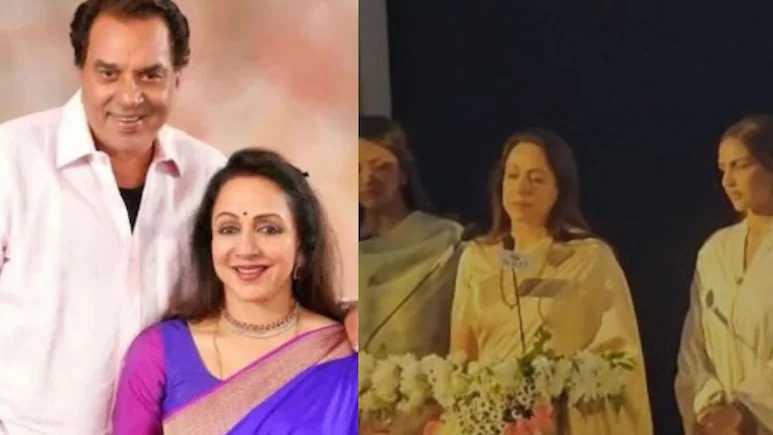
Hema Malini’s moving tribute to Dharmendra at a prayer gathering in Delhi became a moment of collective remembrance, blending personal grief with the universal admiration audiences have long held for the beloved actor. Held at the Dr Ambedkar International Centre, the ceremony brought together family, friends, colleagues and dignitaries who assembled to honour Dharmendra’s extraordinary journey in Indian cinema and the profound human values he embodied. For Hema Malini, the occasion was not merely a formal farewell; it was an intimate reckoning with the loss of a lifelong partner whose presence had shaped her world on-screen and off. Speaking through tears, she reflected on a companionship defined by affection, quiet strength and the shared language of art, especially Dharmendra’s deep love for poetry—a passion she revealed he had hoped to pursue further but could never complete.
A poignant remembrance of love, partnership and the legacy of a man who lived with grace
As Hema Malini took the stage, her emotions were palpable. She began by welcoming the gathering, but her voice trembled as she acknowledged the weight of the moment. She confessed that she had never imagined a day would come when she would have to host a prayer meeting for Dharmendra, the man she affectionately called “Dharam ji.” For her, the loss was more than the passing of a celebrated actor; it was the end of a partnership that had weathered decades of life’s unpredictable turns. She shared that while the world mourned his death, her grief was immeasurably deeper—marked by the shattering of a bond that had remained steadfast across time.
Her words painted a portrait of Dharmendra not just as a legendary star but as someone who carried immense humility. She described how he never considered himself superior to anyone and treated all—rich or poor, familiar or unfamiliar—with warmth and respect. This quality, she said, defined his character far more than fame ever could. His ability to speak with sincerity, to meet people with compassion, and to connect beyond barriers of status was what made him beloved not only in cinema but in life.
Hema Malini also reflected on how Dharmendra’s gentleness was inseparable from his strength. Despite being celebrated as Hindi cinema’s “He-Man,” his real heroism, she emphasized, lay in his sensitivity and the profound kindness he extended to everyone he encountered. As she spoke of their shared memories, the audience could sense the magnitude of her loss and the tenderness that shaped their relationship. Their journey had spanned decades—through iconic films, personal milestones, and the unspoken companionship that binds two lives together.
She then shared a deeply emotional revelation about his passion for poetry, a facet of Dharmendra that remained largely private. He wrote extensively, poured his feelings into words and dreamed of producing a collection of poems. “But woh kaam adhura reh gaya,” she said, acknowledging the heartbreak of an unfinished dream. This sentiment, carried in her trembling voice, captured the pain of losing not just a partner but an artist whose creative spirit was still yearning for expression.
A gathering filled with memories, reverence and shared admiration for an irreplaceable icon
The prayer meet unfolded as a dignified celebration of a life that touched millions. Attendees included film fraternity members, political leaders, admirers and those who had known Dharmendra closely throughout his long career. Their presence underscored the vastness of his impact, reaching far beyond cinema into cultural memory and emotional legacy.
Speakers remembered his luminous debut, his ascent as one of Indian cinema’s most bankable stars and his ability to shift effortlessly between genres—romantic dramas, action films, comedies and socially poignant stories. But what resonated most during the gathering was not his filmography alone; it was the consistent warmth he radiated, the integrity with which he lived and the affection he extended to colleagues and fans. His humanity often outshone his stardom.
Hema Malini noted that Dharmendra’s most remarkable quality was his rootedness. Even at the height of his fame, he continued to see himself as part of a larger family—his audience, his colleagues, his friends and the countless people he met in day-to-day life. She recalled how he always insisted on speaking to everyone with dignity. He never let success alter his nature, nor did he allow the demanding world of cinema to harden his heart.
As memories were shared, Dharmendra’s artistic passion stood out as a unifying thread. His love for poetry was revisited through anecdotes, his notebooks filled with handwritten verses and his long-held dream of publishing a collection. To many, this revelation offered a deeper understanding of the man behind the screen—a performer who channelled emotion not only through acting but through words that spoke to the core of his sensibilities.
Hema Malini spoke of his creativity with a mixture of pride and sorrow, acknowledging the dreams he nurtured quietly. Poetry, she said, gave voice to his deepest thoughts—his reflections on life, beauty, love and the fragility of time. His absence has left those pages suspended in incompletion, a haunting reminder of the work that now remains a silent part of his legacy.
The prayer meet became an intimate intersection of personal mourning and public reverence. Those who had known Dharmendra as a mentor remembered his guidance, those who had known him as a friend recalled his humour and warmth, and those who admired him from afar felt the emotional weight of Hema Malini’s words. The gathering was not marked by spectacle but by sincerity—a reflection of the values Dharmendra embodied throughout his life.
As the ceremony concluded, the room resonated with a shared understanding that an era had ended. Dharmendra’s contribution to Indian cinema remains monumental, but his true legacy lives in the values he carried: humility, compassion, creativity and an unwavering devotion to relationships. Through her tears, Hema Malini’s tribute offered a window into the depth of his character and the profound love that defined their journey. Her grief, expressed with honesty and grace, allowed the audience to see Dharmendra not just as a cinematic icon but as a man whose life had been woven with gentleness and sincerity until its final chapter.