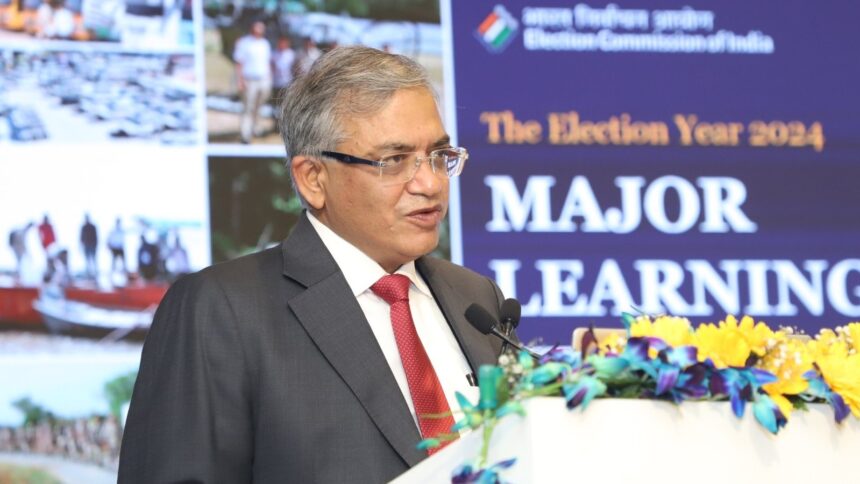
The Central government on Monday announced the appointment of Gyanesh Kumar as the new Chief Election Commissioner (CEC) of India, succeeding Rajiv Kumar. Gyanesh Kumar, a 1988-batch IAS officer from the Kerala cadre, brings with him a wealth of administrative experience and is currently the senior-most among the three-member Election Commission panel. His appointment comes at a crucial time as the Election Commission of India gears up for upcoming electoral challenges and reforms.
The government has also announced the appointment of Vivek Joshi as an Election Commissioner, filling the vacant seat in the three-member body. Joshi, who previously served as the Registrar General of India and Census Commissioner, joins Gyanesh Kumar and Sukhbir Singh Sandhu in the Election Commission panel. Sandhu, an officer from the Uttarakhand cadre, had been appointed as an Election Commissioner earlier. With these appointments, the Election Commission now stands at full strength, ensuring a smooth transition of leadership and continuity in electoral governance.
The selection process for the new Chief Election Commissioner was conducted by a three-member selection committee, which convened on Monday under the leadership of Prime Minister Narendra Modi. The meeting was attended by the Leader of the Opposition in Lok Sabha, Rahul Gandhi, and Union Home Minister Amit Shah, who was nominated to the panel by the Prime Minister. The committee was responsible for finalizing the successor to Rajiv Kumar, whose tenure officially concludes on February 18, 2025.
This appointment marks a significant moment in India’s electoral history, as it is the first time a Chief Election Commissioner has been appointed under the new Chief Election Commissioner and Other Election Commissioners Act, 2023, which came into effect in December 2023. This law introduced significant procedural reforms in the appointment of top officials within the Election Commission of India, seeking to streamline the selection process and enhance transparency.
Earlier, in March 2024, the government had appointed Sukhbir Singh Sandhu and Gyanesh Kumar as Election Commissioners under the same legislative framework. These appointments were necessitated by vacancies that emerged following the resignation of Arun Goel and the retirement of Anup Chandra Pandey. With the latest additions, the Election Commission of India is now fully staffed and prepared to handle the upcoming electoral processes with renewed administrative strength.
Rajiv Kumar, the outgoing Chief Election Commissioner, has had a distinguished tenure in the Election Commission. He initially joined the body as an Election Commissioner on September 1, 2020, and subsequently took charge as the 25th Chief Election Commissioner of India on May 15, 2022. His leadership was marked by several crucial reforms and administrative improvements that strengthened the electoral process in India. Over his tenure of approximately 4.5 years, Kumar spearheaded significant structural and technological advancements within the Election Commission, along with bolstering capacity development, voter communication strategies, international collaborations, and overall electoral administration.
Under his leadership, the Election Commission successfully conducted elections across 31 States and Union Territories, along with overseeing the Presidential and Vice-Presidential elections in 2022 and the Lok Sabha elections in 2024. Additionally, his tenure witnessed the smooth execution of Rajya Sabha renewals, ensuring continuity in the parliamentary process. His ability to maintain electoral integrity and efficiency was evident in the peaceful conduct of elections with minimal incidents of violence or repolls, a testament to the robust electoral framework that he helped refine.
With Gyanesh Kumar now set to assume office, the focus shifts to the future trajectory of the Election Commission under his leadership. As India continues to navigate a dynamic political landscape, his administration will play a crucial role in maintaining electoral transparency, enhancing voter participation, and implementing further reforms to modernize the election process. The upcoming years are expected to bring significant developments in election technology, voter accessibility, and the overall efficiency of electoral management, shaping the democratic processes of the world’s largest democracy.