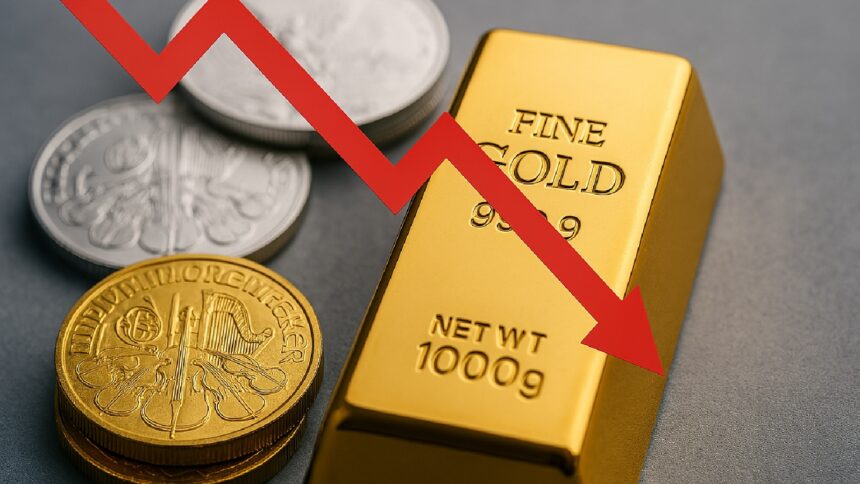
Despite rising geopolitical tensions in the Middle East, particularly the US airstrikes on Iran’s Fordow nuclear facility, gold prices have shown a surprisingly muted response in global and Indian markets. Traditionally viewed as a safe haven during crises, gold failed to register significant gains this time, with experts suggesting that its recent rally may have already peaked. While global prices dipped slightly, domestic gold remained mostly flat, raising questions about what could drive the next big move in the bullion market.
Lacklustre Market Reaction Amid Escalating Conflict
As of Monday morning, gold prices were down 0.19% in the international market. In India, gold prices on the Multi Commodity Exchange (MCX) edged up just 0.01% in early trading. The Indian rupee also weakened by 17 paise to 86.72 against the US dollar following a surge in global crude oil prices triggered by the US’s military action.
According to Aksha Kamboj, Vice-President of the India Bullion and Jewellers Association, “Gold initially reacted to the US strike but couldn’t sustain the rally, indicating the metal may have hit its short-term peak.” She suggested the market may be waiting for retaliatory steps from Iran before gold resumes its upward trend.
Rahul Kalantri of Mehta Equities pointed out that both gold and silver prices have remained volatile. “Prices hovered near $3,360 and $36 per ounce respectively on Monday,” he said, noting that while tensions have escalated, the market seems to have already priced in much of the geopolitical risk.
Experts Say Market Already Priced in War Fears
Ajay Kedia of Kedia Advisory explained that gold surged on the first day of the Iran-Israel conflict but has since remained largely unchanged, even as tensions intensified. “This indicates the initial fear-driven rally has matured. Historically, gold tends to take a pause and then recover. A strong upward move will likely require gold to break above the $3,500 mark,” he said.
Spot gold fell 0.25% to $3,377.20 an ounce on Monday, suggesting that even with the ongoing conflict, investors may now be looking toward other market signals.
Focus Shifts to US Economic Indicators
Apart from geopolitical tensions, the bullion market is also being influenced by macroeconomic cues from the United States. Analysts say that concerns over inflation—partly driven by rising oil prices—and a potentially slower pace of interest rate cuts by the US Federal Reserve are affecting gold’s trajectory.
This week, market participants are eyeing key events such as US Fed Chair Jerome Powell’s testimony before Congress and the release of the Personal Consumption Expenditures (PCE) inflation data. These indicators will offer insights into how the Fed might respond to both domestic economic pressures and international instability.
According to Kalantri, “Investors are trying to gauge the Fed’s stance amid rising risks from tariffs, inflation, and conflict. The outcome of these events could determine gold’s short-term direction.”
Price Outlook and Predictions
Market experts suggest that gold may see a correction in the coming months. Quant Mutual Fund, in its June 2025 factsheet, noted that gold has likely peaked and may drop by 12–15% in dollar terms over the next two months. However, they continue to recommend including precious metals as a key part of a diversified portfolio for the medium and long term.
In terms of technical levels, gold has support at $3,335–$3,315 and resistance at $3,380–$3,400 internationally. In India, support lies at ₹98,650–₹98,350 per 10 grams, with resistance at ₹99,550–₹99,840. Silver is expected to trade between ₹1,04,700 and ₹1,08,000 in the near term.
In Mumbai, gold prices were ₹92,300 per 10 grams for 22-carat and ₹1,00,690 for 24-carat gold, reflecting the continued stability despite global uncertainty.