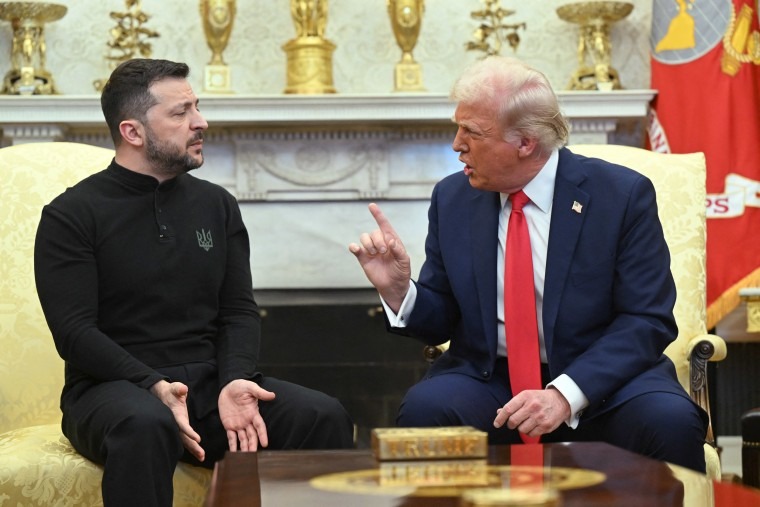
The dramatic confrontation between Ukrainian President Volodymyr Zelensky, US President Donald Trump, and Vice President JD Vance at the Oval Office has triggered a wave of strong reactions from world leaders, US lawmakers, and geopolitical analysts. The meeting, which ended abruptly, has intensified concerns over the future of US-Ukraine relations, with accusations of Trump and Vance siding with Russian President Vladimir Putin.
In Washington, Senate Democrats lashed out at the administration, with Senate Minority Leader Chuck Schumer declaring that “Trump and Vance are doing Putin’s dirty work.” Republican Representative Don Bacon of Nebraska also criticized the meeting, calling it “a bad day for America’s foreign policy,” while Democratic lawmakers condemned Trump’s stance, describing the meeting as a victory for Putin. One House representative went as far as to call Trump and Vance “the best lackeys” Putin has ever had.
Meanwhile, Moscow openly mocked Zelensky, with Russian Foreign Ministry spokeswoman Maria Zakharova remarking that it was “a miracle of restraint” that Trump and Vance did not resort to physical aggression. Former Russian President Dmitry Medvedev ridiculed Zelensky on social media, referring to him as a “cocaine clown” and applauding the “proper slap down” he received. Moscow’s top negotiator, Kirill Dmitriev, labeled the confrontation between Trump and Zelensky as “historic.”
Ukraine’s leadership, however, remained defiant. Foreign Minister Andrii Sybiha praised Zelensky for his courage, stating that he “stands up for Ukraine and the goal of a just and lasting peace.” European leaders have also rallied behind Ukraine. French President Emmanuel Macron reiterated that “Russia is the aggressor and Ukrainians are the aggressed people,” emphasizing that European nations, along with the US, Canada, and Japan, must continue supporting Ukraine. Spanish Prime Minister Pedro Sánchez expressed his country’s solidarity with Ukraine, posting messages in Spanish, English, and Ukrainian affirming Spain’s unwavering support.
German Chancellor Olaf Scholz assured that Ukraine could rely on Germany and Europe in its fight for peace, while Germany’s likely next chancellor, Friedrich Merz, warned against confusing the aggressor and the victim in this war. Italian Prime Minister Giorgia Meloni called for an urgent summit between the US, Europe, and allied nations to address the ongoing crisis.
British Prime Minister Keir Starmer also reaffirmed his commitment to Ukraine’s sovereignty and security. However, Hungary’s Prime Minister Viktor Orbán took a different stance, praising Trump for standing “bravely for peace” and stating that “strong men make peace, weak men make war.”
Other European leaders, including Poland’s Donald Tusk, Norway’s Jonas Gahr Støre, Sweden’s Ulf Kristersson, Lithuania’s Gitanas Nausėda, Ireland’s Simon Harris, Czech Republic’s Petr Fiala, and Latvia’s Evika Siliņa, all reaffirmed their support for Ukraine. The European Union also stood firmly behind Zelensky, with European Commission President Ursula von der Leyen and European Council President Antonio Costa assuring him that he is “never alone.” The EU’s top diplomat, Kaja Kallas, raised concerns about US leadership in the transatlantic alliance, declaring that “the free world needs a new leader” and that Europe must now step up to that role.
The global fallout from this fiery exchange underscores the growing geopolitical divisions and raises questions about the trajectory of US foreign policy under Trump’s leadership. With Ukraine’s war against Russia still raging, the Oval Office showdown has only deepened the divide between those advocating for continued Western support and those pushing for a redefined approach to the conflict.