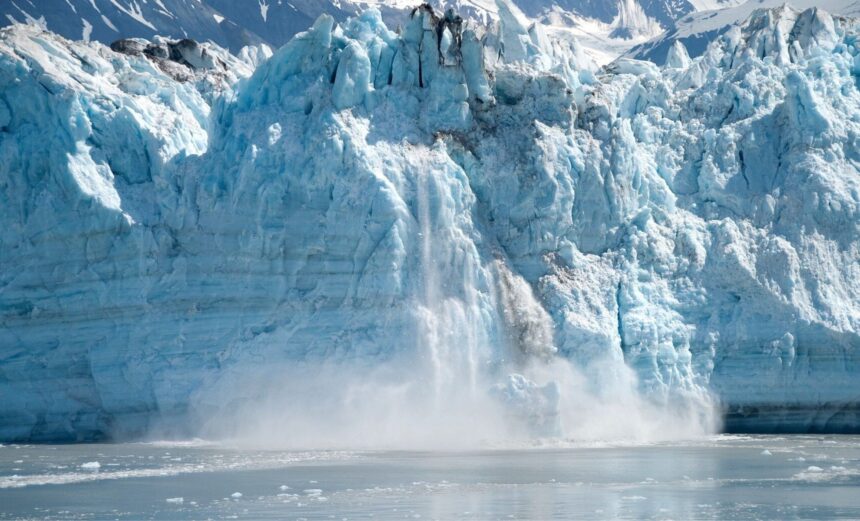
The world has witnessed an unprecedented loss of glacier mass over the past three years, marking the most severe decline in recorded history, according to a report by the World Meteorological Organisation (WMO) and the World Glacier Monitoring Service (WGMS). This alarming revelation coincided with the first-ever World Glaciers Day and underscores the critical need for glacier preservation.
Glaciers, often referred to as “eternal ice,” are rapidly disappearing, and WMO has warned that many of them may not survive beyond the 21st century. Five of the past six years have recorded the fastest glacier retreat ever observed, with more than 275,000 glaciers worldwide covering approximately 700,000 square kilometers. These glaciers, along with ice sheets, store nearly 70% of the world’s freshwater resources, making them essential to global water security.
The rapid depletion of glaciers has severe consequences for millions of people who rely on them for water supply. High mountain regions act as natural water towers, storing water in the form of ice during winters and releasing it in summer. However, as glaciers continue to shrink, water availability is at risk, particularly in dry and arid regions. Short-term effects include an increase in natural hazards such as floods due to accelerated ice melt.
The United Nations General Assembly has declared 2025 as the International Year of Glaciers’ Preservation, with March 21 designated as the annual World Day for Glaciers. WMO’s State of the Global Climate 2024 report has confirmed that from 2022 to 2024, glaciers suffered their most significant three-year mass loss ever recorded. Seven of the ten worst mass balance years have occurred since 2016, making glacier conservation a matter of not just environmental concern but also economic and societal survival.
According to WGMS data, glaciers separate from the continental ice sheets in Greenland and Antarctica have lost over 9,000 billion tonnes of ice since 1975. This staggering loss is equivalent to an ice block the size of Germany with a thickness of 25 meters. The 2024 hydrological year marked the third consecutive year where all 19 glacier regions experienced net mass loss, with severe impacts in Scandinavia, Svalbard, and North Asia.
At the current melting rate, many glaciers in Western Canada, the US, Scandinavia, Central Europe, the Caucasus, New Zealand, and the Tropics will disappear before the end of the century. Between 2000 and 2023, the global glacier mass loss reached 6,542 billion tonnes, averaging 273 billion tonnes of ice lost annually. This amount of water is equivalent to what the entire global population consumes in 30 years, assuming a daily intake of three liters per person.
A recent study published in Nature by researchers from the University of Zurich revealed that glaciers have lost about 5% of their total ice since 2000, with variations ranging from 2% in Antarctic and Subantarctic regions to 39% in Central Europe. During this period, glacier melt has contributed 18 millimeters to global sea-level rise. Although this may seem minimal, each millimeter rise in sea level exposes 200,000 to 300,000 more people to annual flooding. Glaciers are currently the second-largest contributor to rising sea levels, following ocean warming.
As a testament to long-term glacier studies, the South Cascade Glacier in Washington’s Cascade Range has been named the “Glacier of the Year 2025.” Scientists have continuously monitored it since 1952, offering invaluable insights into glacier mass change over decades. Researchers emphasize that preserving glaciers is crucial to mitigating climate change impacts, safeguarding freshwater resources, and protecting vulnerable populations worldwide.
The accelerating glacier loss underscores the urgency for global action in combating climate change and implementing sustainable measures to preserve these vital ice formations. Without immediate intervention, the consequences could be irreversible, affecting not just water availability but also ecosystems and human livelihoods on a global scale.