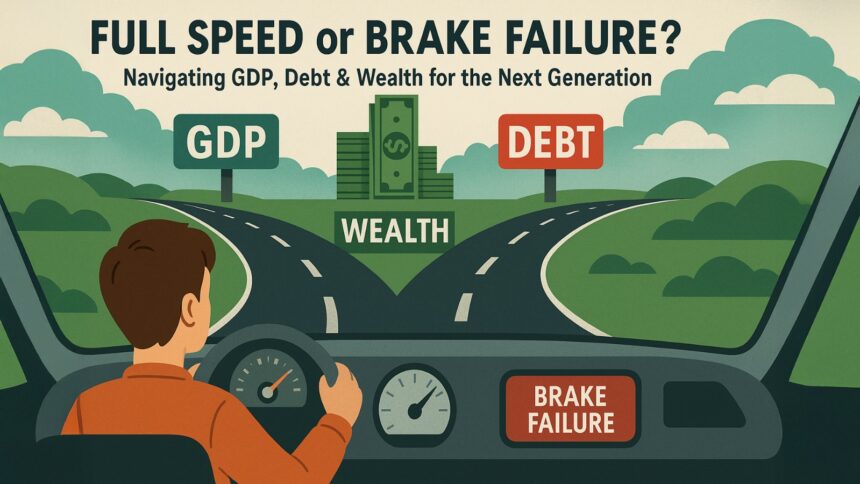
Imagine a country’s economy as a car on a long journey — toward progress, prosperity, and sustainability. This vehicle has three critical components that must function in harmony: the gear, the accelerator, and the clutch. Each of these represents a sector in the economy. The household sector is the gear system — it determines the direction and speed at which the economy can realistically move. The government sector acts as the accelerator, providing the push through spending, policymaking, and regulation. And the corporate sector is the clutch, enabling the transfer of energy from the government’s acceleration to the household’s real motion — essentially linking effort with outcomes.
When the gear (households) is engaged, people are employed, investing in education, consuming responsibly, and saving wisely. They build the nation’s real strength. But gears can only move if the clutch is functional. If the corporate sector doesn’t transmit government stimulus (the push of the accelerator) to real job creation, innovation, and inclusive profits, the car revs loudly but doesn’t move — or worse, overheats. Similarly, if the government pumps the accelerator without checking if the gear and clutch are aligned — like deficit-fueled spending without targeting household upliftment or over-indulgent subsidies to corporations — the engine might eventually fail.
Take South Korea for instance. The household sector is educated, urbanized, and tech-savvy — the gear is solid. But the clutch, represented by corporate Korea, is largely controlled by Chaebols — powerful family-run conglomerates like Samsung, Hyundai, and LG. These groups dominate employment, exports, and policy influence, often concentrating wealth and opportunities within tightly-knit circles. This unbalanced clutch means the motion generated from government acceleration often translates into profits for a few, while young people face rigid job markets and limited upward mobility. The car may be moving, but only a few are in the front seats.
In Japan, the accelerator (government) has long been pushing hard — massive public debt and generous social programs continue to flow. Yet the clutch is slipping. The corporate sector faces stagnation and an aging workforce, while the gear — households — are shrinking. Japan’s low immigration, gender inequality in economic participation, and deep demographic decline mean fewer people to drive or even sit in the car. Women, despite being well-educated, are underrepresented in senior roles. The government’s Womenomics efforts remain limited in structural change. Without stronger engagement from half its population, Japan’s gear grinds ineffectively, even as the accelerator keeps pushing.
China has built one of the world’s most powerful engines — its GDP growth is monumental. The government accelerator has powered infrastructure, exports, and industry. Yet, the clutch is often stuck, as State-Owned Enterprises (SOEs) dominate sectors where innovation and competition are crucial. Local governments — representing the gears of regional households — are deeply indebted, driven by land sales, debt-funded development, and property speculation. The gear moves, but it’s wearing out from misuse. China’s model revs loudly, but unless local governance is repaired and household wealth truly strengthened (including social security and private consumption), the vehicle risks veering off course.
In India, the gear is large and full of potential — over 900 million working-age individuals. But the clutch is slipping inconsistently. The corporate sector remains narrow — heavily dependent on a few conglomerates and underdeveloped in employment-rich manufacturing. Government efforts push the accelerator through subsidies, schemes like Digital India, and PLI incentives. But much of the youth — the gear’s future — is disengaged. Brain drain to the West and muscle drain to the Gulf are symptoms: highly educated Indians seek better opportunities abroad, while millions of laborers head to the Middle East to fill low-paying jobs, often under harsh conditions. If India’s policies don’t align the clutch and gear — bringing education, job creation, and equity together — the nation may be accelerating toward a future that benefits only a few passengers.
Germany, in contrast, manages its vehicle with careful engineering. The government maintains a steady acceleration, avoids fiscal overdrive, and prioritizes household welfare and industrial balance. The corporate sector — particularly SMEs (Mittelstand) — acts as a smooth clutch, transmitting policy and market forces into long-term jobs and equitable wealth. Similarly, France has strong social systems (a powerful gear) but struggles with deficit-fueled acceleration and public debt. The challenge is ensuring the clutch — especially smaller businesses and startups — doesn’t stall under the pressure.
In the UK and USA, the engines are powerful, and private sector innovation makes the clutch dynamic. But inequality weakens the gears. Households with low income or low wealth find it harder to benefit from growth. The accelerator works, the clutch spins, but many gears grind quietly at the back, unheard.
When we hand over this economic vehicle to future generations, we are not just giving them the keys — we’re passing down the condition of the engine, the responsiveness of the pedals, and the wear and tear on the gears. If we don’t address wealth concentration, fiscal overdrive, corporate accountability, and inclusive policies, the next drivers will face a ride full of breakdowns, poor mileage, and detours they didn’t choose.
For them to steer forward, we must tune the system now — realign the clutch (corporations) to distribute growth, ensure the accelerator (government) is not pressed recklessly, and maintain strong, inclusive engagement from the gear (households). Only then will the economy drive safely, sustainably, and smoothly — toward a destination worth reaching.