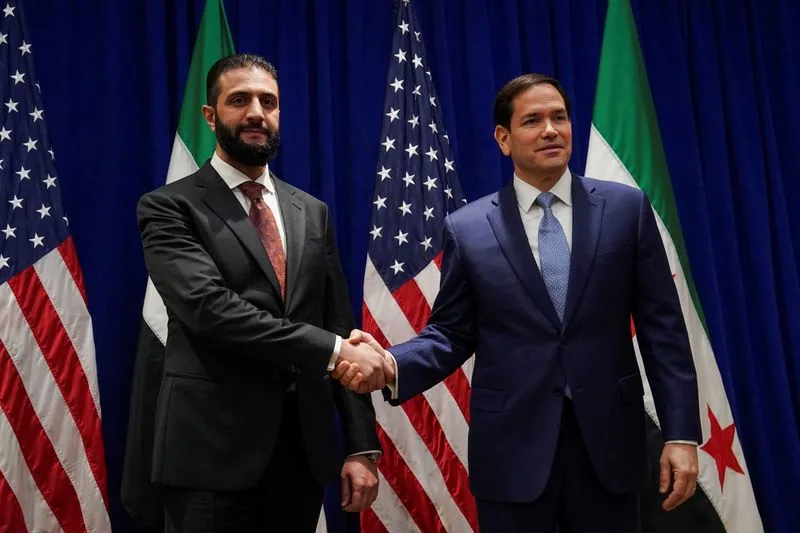
Ahmed al-Sharaa, once known worldwide by his nom de guerre Abu Mohammed al-Jolani and long listed among the most wanted men, is now making headlines for a strikingly different reason. The former jihadist commander, who once carried a $10 million U.S. bounty for his role in orchestrating deadly insurgent attacks in Syria, made his debut at the United Nations this week as Syria’s president. In a surreal moment that captured global attention, al-Sharaa not only addressed cheering crowds outside the UN General Assembly but also sat down for a conversation with retired U.S. General David Petraeus, the very man who once oversaw his capture.
From Captive to Statesman
Al-Sharaa’s appearance in New York marked a dramatic turn in his decades-long journey through war, imprisonment, and insurgency. Captured in Iraq by U.S. forces under Petraeus between 2006 and 2011 for his resistance to the American invasion, Sharaa reemerged after release as the founder of the al-Nusra Front in 2012. The group initially fought to topple Syrian president Bashar al-Assad, aligning with al-Qaeda before cutting ties in 2016 and later transforming into Hayat Tahrir al-Sham (HTS). Despite being blacklisted as a terrorist organisation by Washington in 2018, the U.S. revoked the designation this July, signalling a shift in its policy toward post-Assad Syria.
The shared stage with Petraeus, described by both men as a moment of irony and transformation, reflected the extraordinary arc of Sharaa’s career. “At one time we were in combat, and now we are in dialogue,” Sharaa remarked with a smile, stressing that only those who have seen the horrors of war can understand the value of peace. The event, organised by the Middle East Institute at a prestigious Manhattan venue, drew diplomats, business leaders, and journalists, underlining the international interest in Syria’s evolving leadership.
Applause and Protests
Videos circulated by Arab media showed crowds waving Syrian flags and cheering Sharaa outside his hotel in Manhattan, while inside, he spoke of Syria’s transformation “from an exporter of crisis to an opportunity for peace.” He pledged to hold those responsible for bloodshed accountable and criticised ongoing Israeli strikes, arguing they undermined international efforts for stability. U.S. officials, meanwhile, indicated that Sharaa’s political trajectory is being closely monitored, with Washington viewing him as Syria’s best hope to avoid sliding back into civil war.
Yet the warm welcome was not without its counterpoint. Protesters gathered outside the UN, brandishing placards linking Sharaa to ISIS and Osama Bin Laden, underscoring the polarised views surrounding his leadership. His speech also highlighted sensitive geopolitical issues, including Syria’s commitment to ceasefire agreements dating back to the 1973 Yom Kippur War, despite Israel’s objections following Assad’s ouster last year. “We call on the international community to stand with us in the face of these attacks,” he declared in his first address to the annual UN gathering of global leaders.
Al-Sharaa’s transformation from insurgent commander to head of state addressing the UN represents one of the most remarkable reinventions in modern Middle Eastern politics. His words, celebrated by some and condemned by others, are already reshaping how Syria’s future will be debated on the world stage.