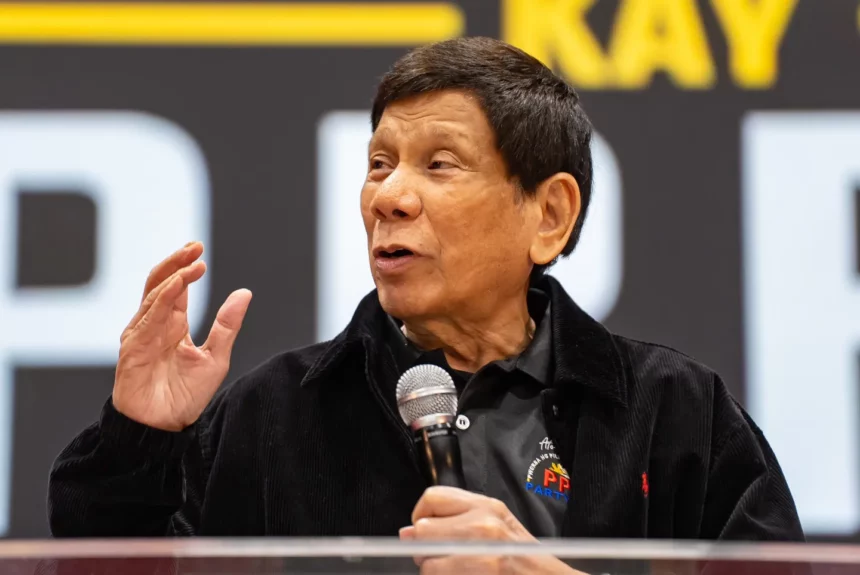
Former Philippines president Rodrigo Duterte has surrendered to the International Criminal Court (ICC) to face charges of crimes against humanity related to his controversial war on drugs. The ICC, based in The Hague, confirmed his custody, stating that there are “reasonable grounds” to charge him with murder as a crime against humanity. Duterte, who led an anti-drug campaign that human rights groups estimate resulted in tens of thousands of deaths, was taken into ICC detention after arriving in Rotterdam by private jet.
Before his transfer, Duterte addressed the nation via a video shared on social media, asserting that he was fully responsible for his administration’s actions. “I led our law enforcement and military. I promised to protect them, and I am responsible for all of this,” he stated. At 79, Duterte becomes the first former Asian head of state to face trial at the ICC.
His surrender has triggered mixed reactions in the Philippines. Supporters gathered outside the ICC detention center in The Hague, some waving national flags and chanting for his return. Others, including families of victims of the drug war, expressed relief. Gilbert Andres, a lawyer representing victims, welcomed the development, stating that the arrest signifies that no one is above the law. UN human rights chief Volker Turk also called it a significant step towards justice for the thousands of lives lost in Duterte’s campaign.
However, opposition voices, including Duterte’s daughter and Philippines vice president Sara Duterte, condemned the ICC’s move. She labeled the transfer as “oppression and persecution,” claiming that her father was forcibly taken to The Hague. The Duterte family’s relationship with the current administration has soured since the 2022 elections, further fueling political tensions.
Duterte had long dismissed the ICC’s authority, withdrawing the Philippines from the court in 2019. However, the tribunal maintains jurisdiction over cases that occurred before then, including the operations of the “Davao Death Squad,” which reportedly killed numerous individuals under Duterte’s leadership as mayor. The ICC believes at least 19 murders in Davao and 24 police killings elsewhere were linked to his orders.
Despite his surrender, Duterte retains significant support among Filipinos who saw his leadership as a tough approach to crime. His legal battle now sets the stage for a high-profile trial that will test the strength of international criminal justice and accountability for state leaders.