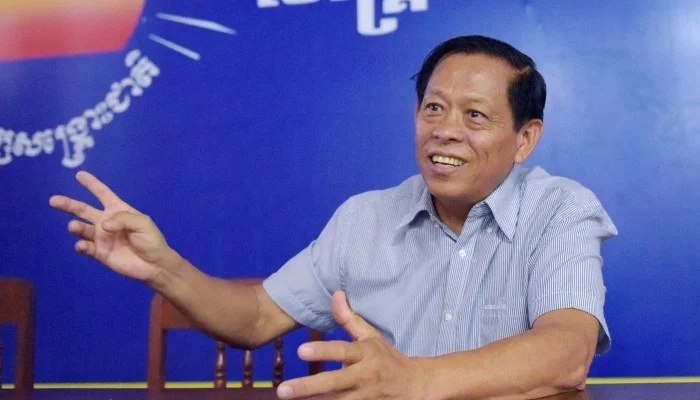
In a shocking and tragic development, Lim Kimya, a former opposition member of Cambodia’s National Assembly, was shot dead in Bangkok, Thailand, in what his political party and human rights organizations have described as a targeted political assassination. Lim Kimya, a member of the now-exiled Cambodia National Rescue Party (CNRP), was killed on the evening of January 7th, just after arriving in the Thai capital from Siem Reap, Cambodia, with his French wife and Cambodian uncle. He was 74 years old.
The incident occurred when Lim Kimya was traveling by bus from Cambodia’s Siem Reap province to Bangkok. After arriving in the Thai capital, he was fatally shot by an assailant, who fled the scene on a motorbike, according to reports from The Bangkok Post. The CNRP, which Lim Kimya had represented as a member of parliament for Kampong Thom province, confirmed the news of his death, expressing shock and sorrow at the brutal killing. The opposition party condemned the act, calling it an “assassination” and a grave threat to political freedom. The statement urged Thai authorities to conduct a thorough and impartial investigation into the murder.
Human rights organizations have been quick to react to the murder, calling for a swift response from Thai authorities. Elaine Pearson, the Asia Director for Human Rights Watch, condemned the “cold-blooded killing,” asserting that it sends a chilling message to Cambodian political activists that no one is safe, even after leaving Cambodia. Philip Robertson, the Director of the Asia Human Rights and Labour Advocates (AHRLA), described the killing as having “all the hallmarks of a political assassination.” He added that the murder would severely intimidate the Cambodian political opposition, NGO activists, and human rights defenders who have sought refuge in Thailand to escape the political repression of Cambodian Prime Minister Hun Manet and his father, the former leader Hun Sen.
Lim Kimya, a dual Cambodian and French citizen, had remained in Cambodia for many years, even as many of his fellow opposition members fled the country after facing threats from the ruling Cambodian People’s Party (CPP) under the regime of then-Prime Minister Hun Sen. The CPP, which has maintained tight control over the country for decades, dissolved the CNRP in 2017, and the party’s activities were banned by the Supreme Court of Cambodia. Despite this, the CNRP continues to exist as a political organization within diaspora communities, especially in countries like Australia and the United States.
This tragic incident occurred on January 7, which is marked as Victory Day in Cambodia, commemorating the fall of the Khmer Rouge regime in 1979. On this day, Cambodian Prime Minister Hun Sen, along with his son Hun Manet, the current leader of the country, commemorated the anniversary. Hun Sen also used the occasion to propose a new law that would label individuals seeking to overthrow his son’s government as “terrorists” who should be brought to justice. The timing of Lim Kimya’s assassination, coupled with Hun Sen’s remarks, highlights the continued repression faced by political opponents in Cambodia.
Lim Kimya’s death marks a stark reminder of the violent political climate in Cambodia, where dissent is often met with intimidation, imprisonment, and, as evidenced by this latest incident, assassination. Lim had been elected to Cambodia’s parliament in 2013 during a period of growing opposition to Hun Sen’s rule. His election was seen as part of a broader movement of political change and reform that threatened the ruling party’s longstanding dominance. However, with the CNRP’s dissolution in 2017 and the subsequent crackdown on opposition members, many of whom have fled into exile, Lim Kimya’s killing serves as a grim reflection of the political repression that continues to plague Cambodia under the rule of the CPP.
Since the dissolution of the CNRP and the subsequent political persecution of its members, many former leaders and activists have sought refuge abroad, with Thailand becoming a key destination for those escaping the regime’s crackdown. However, as Lim Kimya’s assassination shows, even those who manage to escape Cambodia’s borders are not immune to political violence.
While Thailand is now investigating the murder, with the police actively searching for the assailant, the global community and political observers will be watching closely to see if this killing marks a further escalation in political violence against opposition figures, particularly those from Cambodia. The Cambodian government, led by Hun Manet since his succession of his father in August 2023, has yet to make any official statements regarding the assassination.
The assassination of Lim Kimya adds to the growing concerns over the safety and security of political exiles, activists, and human rights defenders who have fled to countries like Thailand seeking refuge from political repression. As calls for justice and a thorough investigation grow louder, the international community will continue to monitor developments surrounding the case, while also raising awareness of the broader implications for political freedom and safety in Southeast Asia.