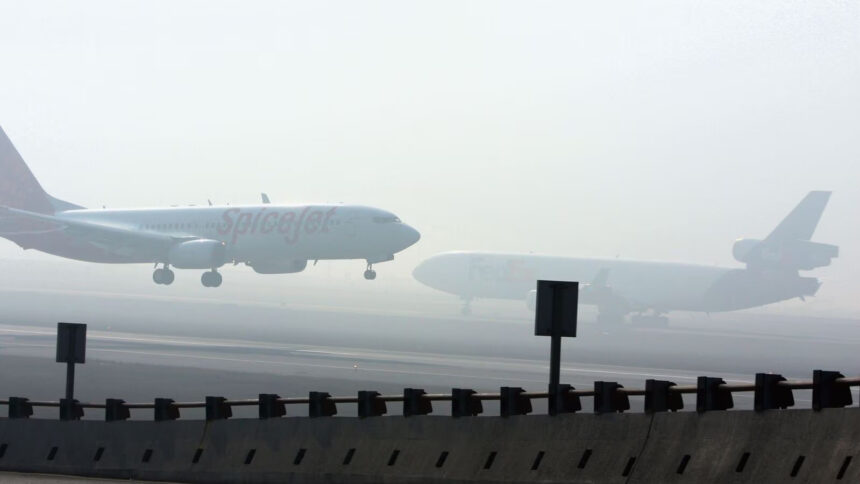
Dense fog engulfed North India on Friday, leading to widespread disruptions in air and rail travel and plunging visibility levels to alarming lows. Delhi, grappling with its fifth consecutive cold day, experienced visibility dropping to zero at the Indira Gandhi International Airport, causing significant delays in flight operations. Over 50 flights were delayed, and train schedules were severely disrupted due to the persistent fog and cold wave.
According to data from the India Meteorological Department (IMD), Delhi recorded a maximum temperature of 16 degrees Celsius in the past 24 hours, three degrees below normal. The minimum temperature was 7.6 degrees Celsius. As of Friday morning, the temperature stood at 9.6 degrees Celsius. The IMD forecasts dense fog to persist in the region until January 8, with light rain anticipated on January 6.
Visibility conditions were particularly poor at Delhi’s airports. Palam airport reported a visibility of 0 meters at 8 am, while Safdarjung Airport recorded visibility at 50 meters. Neither airport handles commercial flight operations, but the fog’s impact extended to the main terminals, causing an average delay of six minutes for incoming flights and 47 minutes for departures. Airlines such as SpiceJet, IndiGo, and Air India reported operational challenges, and passengers were advised to check flight schedules in advance. Routes to cities like Amritsar, Lucknow, Bengaluru, and Guwahati were among the most affected. Airlines warned that cancellations might occur if poor visibility persisted.
Train operations were equally disrupted, with 24 trains departing from Delhi delayed. The Ayodhya Express was delayed by four hours, the Gorakhdham Express by over two hours, and the Bihar Kranti Express and Shram Shakti Express faced delays exceeding three hours. Changes in train schedules were also implemented to manage the disruptions.
The fog also exacerbated air quality concerns. The Air Quality Index (AQI) at Lodhi Road in Delhi was recorded at 309, categorizing it as ‘very poor.’ The combined effect of low temperatures, dense fog, and poor air quality has added to the challenges faced by residents.
The IMD issued a “Nowcast” warning for dense to very dense fog across Delhi and several other regions, including Rajasthan’s Kota, Bundi, and Churu; Punjab’s Amritsar and Gurdaspur; and Haryana’s Kurukshetra and Yamunanagar. The cold wave also led to precautionary measures in educational institutions, with the Gautam Buddh Nagar administration ordering the suspension of classes up to grade 8 in all schools until further notice.
Meanwhile, Himachal Pradesh and Ladakh are expected to receive light rain and snow, adding to the cold wave conditions in northern India. The IMD defines a “cold day” as one where the minimum temperature falls below 10 degrees Celsius, and the maximum temperature is at least 4.5 degrees lower than the seasonal average. With no immediate relief in sight, residents are bracing for continued disruptions and cold weather in the coming days.