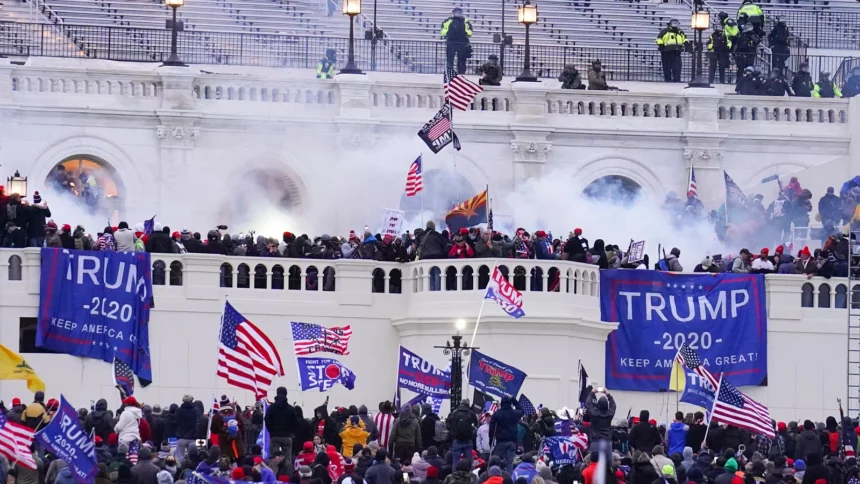
In a powerful condemnation, three federal judges on Wednesday denounced President Donald Trump’s controversial pardons of individuals involved in the January 6th Capitol riot, which aimed to disrupt the peaceful certification of Joe Biden’s victory in the 2020 presidential election. The pardons, granted just hours after Donald Trump assumed office on Monday, included more than 1,500 supporters who stormed the Capitol in an effort to overturn the election results. Donald Trump also commuted the sentences of 14 members from the far-right Proud Boys group and the Oath Keepers militia, both of whom were deeply involved in the violent insurrection.
District Judge Tanya Chutkan, who had previously overseen the criminal case against Donald Trump regarding his efforts to overturn the election results, strongly criticized the pardons. In a ruling dismissing charges against a Capitol riot defendant, Judge Chutkan argued, “No pardon can change the tragic truth of what happened on January 6, 2021.” She emphasized that no executive clemency could “whitewash the blood, feces, and terror that the mob left in its wake.” Chutkan underscored that the riot had inflicted irreparable damage to the American tradition of peacefully transitioning power, and no pardon could erase the scars left on the nation’s political and social fabric.
Donald Trump’s decision to grant these pardons and commute sentences for Capitol rioters came amid growing controversy over his response to the attack. In addition to those involved in the physical assault on the Capitol, the pardons also included members of extremist groups like the Proud Boys and Oath Keepers, whose roles in the insurrection were central to the violence and chaos of January 6th. Donald Trump’s action was viewed by many as an endorsement of the actions of the rioters, whom he had previously described as “patriots” and “political prisoners.” Critics argue that these pardons undermine the gravity of the insurrection and the need for accountability.
Judges Beryl Howell and Colleen Kollar-Kotel, both presiding over cases related to the Capitol riot, also criticized Donald Trump’s actions in no uncertain terms. Judge Howell remarked that there was no factual basis for dismissing charges against two Capitol riot defendants before her court. She rebuked the Donald Trump administration’s claim of a “grave national injustice,” asserting that no such injustice had occurred, and that “poor losers” should not be allowed to disrupt the peaceful transfer of power without facing legal consequences. Howell warned that such actions could set a dangerous precedent, encouraging future lawless behavior by other individuals dissatisfied with electoral outcomes.
Judge Kollar-Kotel echoed these sentiments, stressing that the dismissal of charges and the pardons granted would not alter the objective truth of the events of January 6, 2021. She pointed out that the historical record of the Capitol riot was irrefutable, preserved in countless videos, trial transcripts, jury verdicts, and judicial opinions. “Those records are immutable and represent the truth, no matter how the events of January 6 are described by those charged or their allies,” Kollar-Kotel said.
Despite these sharp rebukes from federal judges, Donald Trump has consistently downplayed the severity of the January 6th assault. In his public remarks and social media posts, Donald Trump referred to the attack as a “day of love,” attempting to frame the violence as a legitimate expression of political discontent. He continues to label those involved in the Capitol attack as victims of a “rigged election,” promoting the narrative that their actions were justified.
The attack on the U.S. Capitol resulted in over 140 police officers being injured as rioters clashed with law enforcement, using flagpoles, baseball bats, hockey sticks, and other makeshift weapons, including Tasers and canisters of bear spray. The brutal confrontation was widely condemned, with lawmakers from both parties expressing horror at the scale of the violence.
Donald Trump’s pardons, along with his ongoing rhetoric about the 2020 election, have sparked fierce debates about the future of American democracy and the integrity of the electoral process. Critics argue that his actions undermine the principle of the rule of law and send a dangerous message that those who attempt to undermine democratic institutions may face little to no consequences.
The controversy surrounding Donald Trump’s pardons and his role in the Capitol riot remains a significant point of contention in U.S. politics. As legal challenges continue to unfold, the nation is left grappling with the long-term implications of the January 6th insurrection and the ongoing efforts to hold those responsible accountable for their actions. The political landscape, already divided, faces further polarization as the consequences of these pardons ripple through the legal system and the broader public discourse.