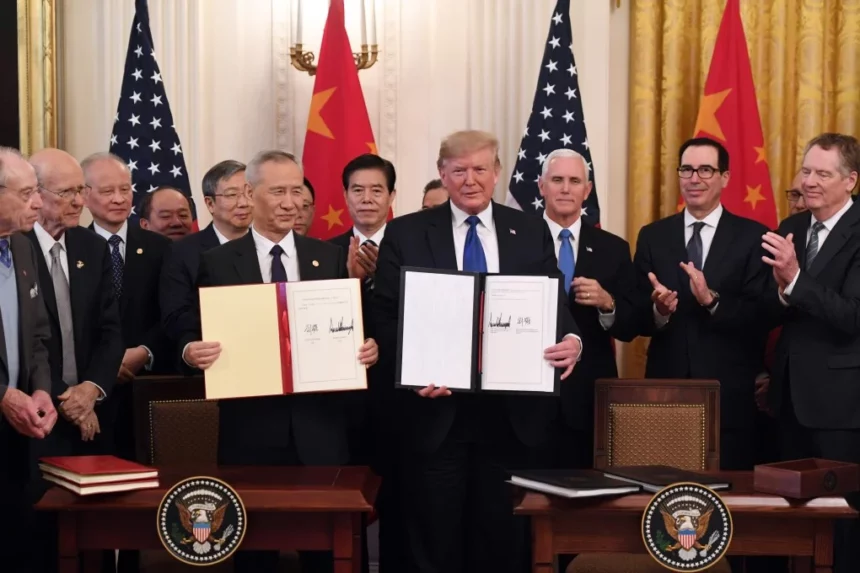
As President-elect Donald Trump prepares to enter the White House and potentially ignite a second trade war with China, the spotlight is increasingly falling on rare earth minerals, which are vital for the production of electronics, vehicles, and military technologies. With China currently dominating the global supply of these crucial elements, the threat of supply disruptions has triggered concerns across industries dependent on these minerals, from electronics manufacturers to defense contractors.
Despite their misleading name, rare earth minerals are not scarce, but they are largely concentrated in China, which controls about 70% of the global production and 90% of the processing of these minerals. According to estimates from the US Geological Survey and the International Energy Agency, the 17 elements that make up the rare earths group—such as scandium, yttrium, and praseodymium—are used to make an array of advanced products. These range from smartphones, electric vehicle (EV) batteries, and semiconductors, to F-35 fighter jets, wind turbines, radar systems, and nuclear reactors. Given their widespread use, rare earths have become critical components in the production of various technologies, including military equipment.
The vulnerability of the rare earths supply chain has become a growing concern for governments worldwide, especially with increasing geopolitical tensions. Last month, China escalated the trade standoff by banning exports of gallium, germanium, and antimony to the United States after President Joe Biden’s administration announced additional restrictions on the sale of advanced chips and machinery to China. This move reflects Beijing’s broader strategy of leveraging its control over rare earths as a tool for geopolitical influence, a strategy it has pursued since declaring rare earths to be state property in October 2022. The country also restricted the export of technologies related to the extraction and separation of these minerals.
The United States has already faced challenges in securing rare earths for its own needs. With Donald Trump’s administration vowing to impose new tariffs and trade restrictions on China—targeting everything from fentanyl exports to allegations of unfair trade practices—there is a real possibility that China could respond by further limiting exports of rare earths. Even without such direct retaliatory measures, Donald Trump’s proposed tariffs on Chinese goods could significantly increase the cost of obtaining these minerals, placing further strain on industries dependent on them.
According to Ryan Castilloux, a rare earths expert at the Canadian research firm Adamas Intelligence, the geopolitical landscape over the next 12 to 18 months is highly unpredictable, and the rare earths supply chain could be heavily impacted as a result. Castilloux noted that certain rare earths like neodymium, praseodymium, dysprosium, and terbium, which are essential for producing powerful magnets used in everything from EV motors to wind turbines, are particularly concerning for the United States. The US and its allies have yet to find alternative sources of these minerals outside of China, despite ongoing projects to mine and process rare earths in other regions, including the US and Estonia.
The United States government has prioritized securing a “sustainable mine-to-magnet supply chain,” with a specific focus on supporting its defense sector by ensuring a stable supply of rare earths for military applications. Danielle Miller, the acting deputy assistant secretary of defense for industrial base resilience, has stated that efforts to establish such a supply chain capable of meeting all of the US military’s rare earths requirements by 2027 are “on track.”
However, the task of reducing dependence on China is proving difficult. While many countries, including Brazil, Canada, and Australia, have significant deposits of rare earths, expanding supply chains beyond China presents considerable challenges. China’s dominance of the industry is largely due to its economies of scale, government subsidies, and massive stockpiles, which have allowed the country to drive down prices to an unsustainable level for competitors. Additionally, rare earths are often by-products of other mining activities, making the quantities of these minerals highly unpredictable. This makes the pricing and supply of rare earths particularly volatile, with prices fluctuating based on market conditions.
Neha Mukherjee, a senior analyst for critical minerals at Benchmark Mineral Intelligence, explained that China’s control of the rare earth market allows it to keep prices stable to support its growing domestic electric vehicle industry. At the same time, this dominance has made it difficult for other countries to establish viable rare earth mining operations. In fact, many investors have been discouraged from entering the market because it simply doesn’t make economic sense to develop a mine when semi-processed materials can be purchased from China at a competitive price.
One of the few successful efforts to break free from China’s dominance is the reopening of the Mountain Pass Mine in California’s Mojave Desert by MP Materials in 2018. This was a significant milestone in US efforts to secure a stable supply of rare earths. Since then, MP Materials has also opened a magnet factory in Texas. Other efforts in the US include a rare earth magnet factory in South Carolina and a magnet recycling facility in Texas. The US Department of Defense and the Department of Energy have awarded over $440 million to companies working on rare earths projects, and additional funding has been made available through the Inflation Reduction Act.
However, these efforts may not be enough to fully eliminate the United States’ dependence on China for rare earths. While these new projects will likely help the US meet its strategic needs in defense and energy, they will not be able to cover all of the demand for rare earths, especially in industries like electronics and consumer goods.
Outside of the US, other countries are also working to reduce their reliance on China for rare earths. Brazil recently opened its first rare earth mine in Serra Verde, and Europe has rare earth processing facilities in France, Estonia, and Germany. However, despite having vast deposits of rare earths in Sweden, Finland, and Norway, Europe has yet to open any new mines. Similarly, Australia has extensive mining and processing facilities in operation but is investing heavily to develop more.
Despite these initiatives, experts agree that these efforts are still not enough to reduce global dependence on China for rare earths. Mukherjee emphasized the need for a circular economy, recycling facilities, and midstream and upstream facilities in the US to further reduce reliance on China. However, these projects will take time and substantial investment to come to fruition.
The growing dependence on rare earths has raised significant environmental concerns as well. Mining and processing these minerals generate large amounts of waste rock and release harmful chemicals into the environment. Despite advancements in technology and automation that could help mitigate these environmental risks, there is still considerable resistance to opening new mines in many parts of the world due to environmental concerns.
Some analysts suggest that these environmental challenges could be overcome in the long term with improved technology, but this will require both time and substantial financial investment. In the meantime, the rare earth industry faces a period of uncertainty as geopolitical tensions and trade wars continue to escalate. Donald Trump’s anticipated policies could further disrupt the rare earth supply chain, leading to increased government investment in alternative sources of supply both within the US and abroad.
As President Donald Trump prepares to take office again, the future of the rare earth industry hangs in the balance. While some analysts believe the US will take steps to secure its supply of these critical minerals, the road ahead remains uncertain, and the geopolitical dynamics around rare earths will continue to evolve. Whether the US can establish a self-sufficient supply chain for rare earths or will continue to rely on China remains a key question for the global economy in the years to come.