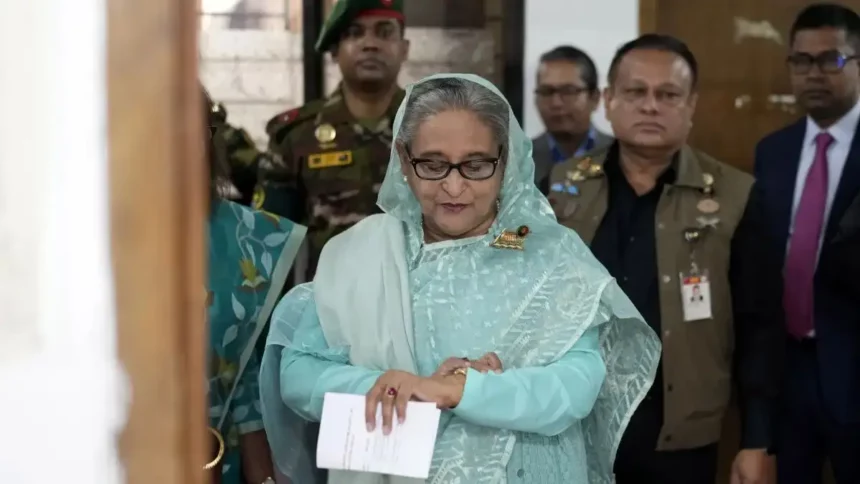
In a powerful and deeply emotional address delivered from New Delhi, former Prime Minister Sheikh Hasina described her homeland of Bangladesh as “bleeding” and “on the edge of an abyss,” painting a grim picture of nationwide violence, erosion of law and order, and profound political unrest that has gripped her country since her ouster from power amid protests and turmoil. Her message, shared at a prominent public event in India’s capital, resonated with members of the Bangladesh diaspora, former political allies, and observers who have watched Bangladesh’s recent descent into turmoil with growing alarm.
A nation in crisis: Hasina’s stark depiction of violence and instability
Sheikh Hasina, a towering figure in Bangladesh’s modern political history and the daughter of the country’s founding leader Bangabandhu Sheikh Mujibur Rahman, addressed the gathering in New Delhi with a tone of urgency and deep concern. In her remarks, she described Bangladesh not merely as politically fractured but as a wounded land, beset by violence that has transformed once peaceful communities into scenes of bloodshed, lawlessness, and fear. The words she chose were deliberate and stark: a nation that once stood proud as a symbol of liberation and collective identity now feels like it is sliding toward chaos.
Hasina recounted that the events which unfolded after her removal from office have eroded the moral and social fabric of the country. What she called the “monstrous onslaught” of extremist communal forces, political vendettas, and the influence of foreign elements has, in her view, pushed Bangladesh toward a perilous edge. She spoke of a land where citizens live in fear, where streets and neighborhoods have borne witness to shootings, clashes, and deepening mistrust between communities that once coexisted peacefully. The emotional weight of her portrayal reflected not just the suffering of individuals, but the erosion of decades of democratic progress and stability.
The use of words like “blood-soaked” and “on edge of abyss” was not accidental. They evoke a profound sense of urgency, danger, and loss. Her commentary underscored the view that what is happening in Bangladesh today is not merely ordinary political disagreement but a systemic breakdown of civil life. Hasina emphasized that the violence was widespread, affecting not just the capital and major cities but also provincial towns, rural districts, and cultural centers where people once felt secure.
In describing the current state of affairs, she drew a poignant contrast with Bangladesh’s proud history of struggle for independence under her father’s leadership. The liberation movement of 1971 was a defining moment that brought the people together with shared sacrifice and hope for a better future. That historical memory, she argued, has been overshadowed by the present reality of discord, bloodshed, and political vendetta. For many in the audience, this juxtaposition was not just rhetorical; it signaled the depth of the transformation Hasina sees in her homeland’s social and political landscape.
Her address also served as a cry for international attention and understanding. By speaking from Delhi, where she currently remains after being ousted, she was reminding the world that Bangladesh’s crisis is not an internal matter isolated from global concerns. It intersects with issues of human rights, governance, and the rule of law, and it invites broader reflection on how political transitions can either uphold democratic values or slide into discord when institutional checks and balances falter.
Hasina’s personal connection to Bangladesh’s history gave her words a unique emotional resonance. As someone who has led the country through both triumph and turmoil, her perspective reflects not only political disappointment but a deep sense of personal loss. The description of her once serene homeland being reduced to scenes of violence struck many listeners as an expression of profound grief, not merely political rhetoric.
The event in Delhi, where her audio message was played, included former ministers from her political movement and members of the expatriate Bangladeshi community who have closely followed developments back home. Their presence underscored the fact that Bangladesh’s evolving crisis reverberates far beyond its borders, affecting diaspora populations and raising questions about the future of democratic governance in a country that once stood as a beacon of post-colonial independence movements.
Accusations against current leadership and calls for restoration of stability
Beyond depicting the scale of the crisis, Hasina’s address was also a searing critique of the interim government that took power after her departure. She did not hold back in condemning the leadership of Muhammad Yunus, whom she accused of overseeing a regime that has systematically dismantled law and order, betrayed the spirit of democratic values, and allowed extremist and communal forces to thrive. Her critique went further, labeling the current leadership as corrupt, authoritarian, and complicit in undermining the freedoms and protections that Bangladeshis once enjoyed.
In her portrayal, the nation has become something far removed from its founding ideals — a place she described as an expansive prison and a valley of death. These vivid metaphors were meant to convey the pervasive nature of the crisis, touching every aspect of social and political life. She spoke of arbitrary arrests, suppression of dissent, and a climate where ordinary citizens feel unsafe expressing their views or participating in public discourse without fear of reprisal.
Hasina also outlined what she sees as necessary steps to heal the country and restore democratic norms. She called for a removal of the current leadership, which she described as illegitimate and externally influenced, and urged international bodies to institute impartial investigations into events over the past year. Her advocacy for external intervention, including appeals to global institutions, reflected her belief that internal mechanisms have thus far failed to safeguard justice, equality, and civic freedoms.
The charge that her successor’s administration has aligned with divisive forces sparked strong reactions among both supporters and critics. Backers of Hasina’s stance argued that her warnings were grounded in genuine concern for the welfare of the nation’s people, advocating for a return to constitutional governance and inclusive politics. They saw her call for unity and reform as necessary to stem the tide of violence and to rebuild faith in national institutions.
In contrast, detractors accused her of political opportunism, suggesting that her fiery rhetoric was aimed at rejuvenating her own political base and discrediting the interim government. They contested her depiction of widespread violence, arguing that transitional moments in national politics often involve friction and protest but do not amount to the apocalyptic vision she described. For these critics, Hasina’s narrative risked exaggerating internal turmoil for strategic advantage.
The sharpness of Hasina’s language also underscored the broader polarization within Bangladesh’s political landscape. For many years, the country’s politics have been shaped by intense rivalries, shifting alliances, and deeply felt grievances. The current moment, however, appears to transcend past disputes, touching themes of identity, national direction, and competing visions for Bangladesh’s future.
International observers and diplomatic circles have taken note of these developments with concern. The specter of escalating violence and institutional breakdown in a populous South Asian state carries implications beyond its borders, touching regional stability, economic prospects, and the wellbeing of millions of citizens whose lives are shaped daily by political uncertainty. As voices within and outside Bangladesh grapple with the unfolding situation, Hasina’s address has become a focal point for broader debates about governance, legitimacy, and the future of democratic processes in the country.
Her detailed critique of the interim leadership also included calls for accountability and for measures that would allow displaced political figures to return to the country safely. Her emphasis on impartial investigations reflected a belief that only transparent review of recent events can lay the groundwork for reconciliation and recovery. The stakes, as she presented them, are nothing less than the restoration of dignity and security for a population caught between competing political narratives.
For listeners, Hasina’s address was an emotional invocation of shared history and collective responsibility. Her words sought to remind Bangladeshis of their shared heritage, the sacrifices made for independence, and the promise that once bound diverse communities together. She framed the current crisis not merely as a political conflict but as a moment that demands reflection on values, leadership accountability, and the future of civic life in a nation once defined by resilience and hope.