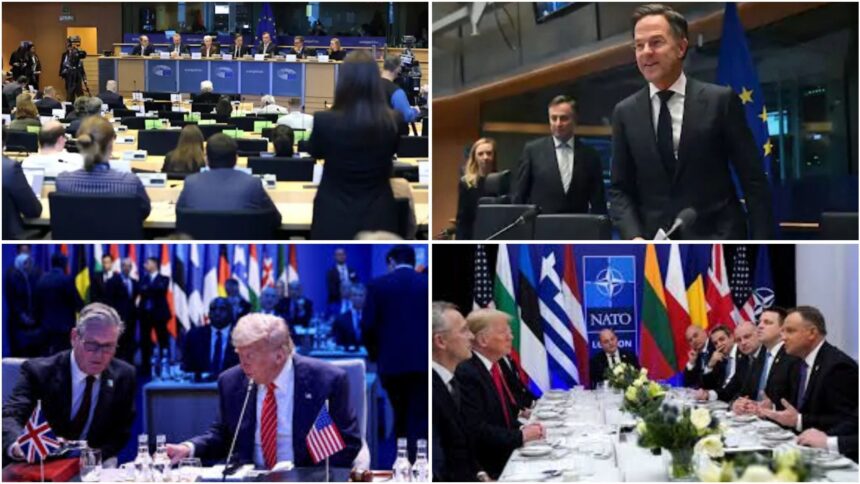
Europe’s long-running dependence on the United States for its security has returned to the centre of global debate after NATO Secretary General NATO chief Mark Rutte delivered a blunt assessment in Brussels, warning that Europe is currently incapable of defending itself without American support. Addressing committees of the European Parliament, Rutte argued that European nations would need a dramatic increase in defence spending, along with costly strategic changes, if they ever hope to become militarily self-reliant. His remarks have intensified political tensions across Europe, especially as questions grow around US commitments, Arctic security, and the future of NATO itself.
Europe’s reliance on American power and the price of independence
Speaking to European lawmakers, Rutte made it clear that Europe’s security architecture remains firmly anchored to the United States, even decades after the end of the Cold War. He noted that European countries currently contribute only about 30 percent of NATO’s overall military capability, despite collectively accounting for a much larger share of the alliance’s population and economic output. On average, most European NATO members spend around 2 percent of their gross domestic product on defence, a level that Rutte described as insufficient for true strategic autonomy.
According to Rutte, if Europe were to attempt defending itself without US support, it would need to raise defence spending to at least 10 percent of GDP. Such an increase, he said, would require political sacrifices, economic restructuring, and public acceptance of long-term military investment on a scale unseen since the mid-twentieth century. Beyond conventional forces, Rutte warned that Europe would also need to build or significantly expand its own nuclear deterrent, a move that would cost billions of euros and fundamentally alter the continent’s security and political landscape.
Rutte’s remarks underscored a stark reality: Europe’s defence model is built around the American nuclear umbrella. For decades, US nuclear capabilities have served as the ultimate guarantee of European security, allowing most European nations to avoid developing or maintaining their own nuclear arsenals. Rutte cautioned that abandoning this arrangement would mean losing what he called “the ultimate guarantor of our freedom,” while gaining only uncertainty in return.
He went further, suggesting that even a defence spending target of 5 percent of GDP by 2035 would not be enough for Europe to stand alone. Without US backing, Europe would face major gaps in intelligence, logistics, air refuelling, missile defence, satellite systems, and advanced military technology. Filling these gaps, he said, would take decades, not years, even with political will and financial commitment.
The comments came at a time when geopolitical pressures are intensifying, particularly in the Arctic region. Rutte echoed US concerns that both China and Russia are increasing their strategic interest in the Arctic, citing new shipping routes, energy resources, and military positioning. He openly supported Washington’s push for stronger Arctic defence, framing it as a shared NATO responsibility rather than a unilateral American ambition.
Trump, Greenland, and rising tensions within the alliance
Rutte’s remarks also drew attention because of his open praise for US President Donald Trump, a figure whose approach to NATO has long unsettled European capitals. Rutte acknowledged that Trump’s blunt style has irritated many leaders but argued that his focus on burden-sharing and strategic clarity has forced Europe to confront uncomfortable truths. “Trump is doing a very good job,” Rutte said, adding that while many are annoyed by it, his warnings about defence spending and Arctic security are justified.
This alignment with Trump has stirred political controversy, particularly over discussions involving Greenland. Leaders in Denmark and Greenland have expressed anger that their region’s future has been discussed by Washington and NATO leadership without their direct involvement. Members of the European Parliament pressed Rutte on what had been discussed with Trump and whether any agreements had been reached that could affect Danish sovereignty.
The controversy intensified after Trump claimed that a NATO framework agreement on Greenland’s future security had been reached, a statement that briefly eased anxiety in some European capitals while raising alarms in others. Although Rutte later clarified that NATO would not negotiate on Denmark’s behalf, the episode highlighted deep sensitivities around Arctic governance and the balance of power within the alliance.
Rutte outlined two broad approaches discussed with Trump regarding Greenland. The first involved NATO taking greater collective responsibility for Arctic defence, ensuring that neither Russia nor China gains undue military or economic influence in the region. The second approach focused on trilateral talks between the United States, Denmark, and Greenland, with Rutte emphasizing that he would not participate in those discussions due to lack of authority to represent Danish interests.
The broader debate is inseparable from Trump’s long-standing criticism of NATO. For years, he has argued that the United States shoulders a disproportionate share of the alliance’s defence burden while European members fail to meet spending commitments. Trump has repeatedly called on NATO countries to raise defence spending to 5 percent of GDP, a target that many European governments have described as unrealistic. Countries like Spain have openly stated they cannot go beyond roughly 2.1 percent, while others are unlikely to reach even 2 percent until well into the next decade.
Trump has also revived threats of US withdrawal from NATO, a position he has held for over two decades. As a presidential candidate in 2016, he questioned whether the US should defend allies who fail to meet their financial obligations. More recently, he warned that if Russia were to attack NATO members spending less than 2 percent of GDP on defence, the US might not intervene. Such statements have sent shockwaves through Europe, forcing leaders to reconsider assumptions that have underpinned continental security since the Second World War.
At the heart of NATO’s credibility lies NATO Article 5, which states that an attack on one member is an attack on all. While Article 5 does not automatically mandate war, it commits members to collective response through their own constitutional processes. Designed originally to counter the Soviet Union, the principle has been the cornerstone of European security for more than seven decades. Any weakening of US commitment to this clause would fundamentally alter Europe’s strategic environment.
The historical roots of Europe’s dependence are deep. After World War II, the continent emerged economically and militarily exhausted, while the United States became the world’s dominant military power with unmatched nuclear capabilities. American forces, bases, and missile defence systems spread across Europe, providing security assurances that allowed European nations to focus on economic recovery and integration rather than military expansion.
Today, the US maintains a massive military presence in Europe, including large deployments in Germany, Poland, and the United Kingdom. This presence underpins not only NATO’s deterrence against Russia but also Europe’s access to advanced intelligence, surveillance, and command systems. Without American involvement, Europe would need to rapidly invest in transport aircraft, refuelling capabilities, drones, satellites, ammunition production, and cyber defence, areas where it currently relies heavily on US support.
The nuclear dimension presents an even starker challenge. While NATO members like the UK and France possess nuclear weapons, their combined arsenals number around 500 warheads, compared to Russia’s estimated 6,000. US nuclear forces fill this imbalance, serving as a powerful deterrent. If the US were to step back, Europe would be forced to rethink its nuclear strategy from the ground up, a process fraught with political, ethical, and security risks.
Rutte’s warning, delivered in unusually candid terms, reflects growing anxiety within NATO as global power shifts accelerate. With rising threats from Russia, increasing Chinese influence, and uncertainty about US political direction, Europe faces a defining question: whether to continue relying on American protection or embark on the costly, complex path toward strategic independence.