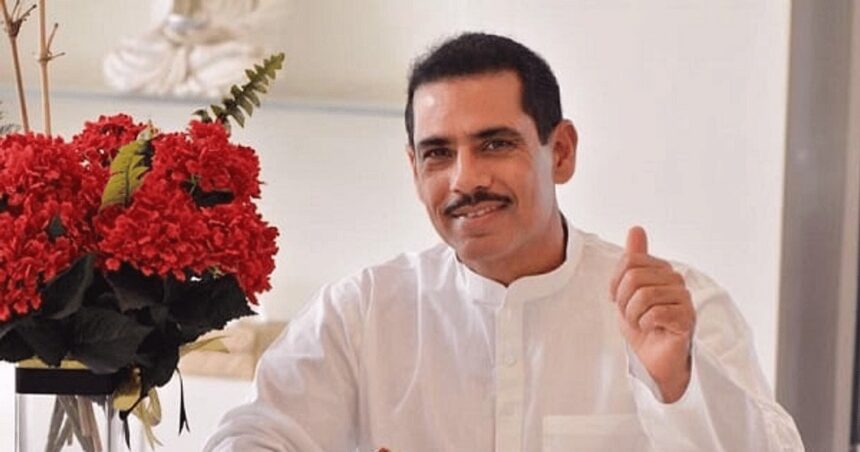
Robert Vadra, a businessman and husband of Priyanka Gandhi, has been summoned by the Enforcement Directorate (ED) in connection with the Haryana land deal case. This marks the second time Robert Vadra has been questioned by the ED in this case. His earlier interrogation was conducted on April 8. The ED is likely to record his statement under the Prevention of Money Laundering Act (PMLA), a law aimed at curbing illegal financial dealings.
This article takes a closer look at the case that has kept Robert Vadra under the ED’s scrutiny and examines the various aspects of the land deal involved.
What is the Haryana Land Deal Case?
The case revolves around the purchase of land in Haryana, which has drawn the attention of the ED and various investigative agencies over the years.
In 2007, Robert Vadra launched a firm named Skylight Hospitality with an initial investment of Rs 1 lakh. A year later, in 2008, Robert Vadra purchased land in the Manesar-Shikohpur area in Gurgaon (now part of Haryana). The land was bought through Robert Vadra’s firm from Onkareshwar Properties.
However, what raised eyebrows was that the land was transferred to Robert Vadra’s personal name within 24 hours, a process that usually takes around three months. Just a month later, Haryana’s town planning department granted Robert Vadra permission to develop a housing society by issuing a letter of intent, allowing him to set up a commercial colony in the area.
At that time, the Congress party was in power in Haryana, with Bhupinder Singh Hooda serving as the chief minister. The value of the land rapidly increased.
Robert Vadra later sold the land to real estate developer DLF for Rs 58 crore in June of the same year. Payments for the transaction were made over a period of time.
The Allegations and the Role of DLF
In 2011, Arvind Kejriwal, the anti-corruption activist and now Delhi Chief Minister, raised questions about the deal, alleging that Robert Vadra had received a Rs 65 crore interest-free loan from DLF. Kejriwal accused Robert Vadra of receiving favorable land deals in return for political favors from the Congress government in Haryana.
However, it wasn’t until 2012 that the deed for the land was transferred to DLF, which further raised questions regarding the legality of the entire transaction.
In October 2012, IAS officer Ashok Khemka, while investigating the deal, canceled the transfer of the land to DLF, citing that the officer who had sanctioned the deal was not competent to do so. This decision was made just hours before Khemka was transferred from his position, allegedly on orders from Hooda’s government.
A government-appointed panel later cleared Robert Vadra of any wrongdoing, claiming that Khemka had acted beyond his authority.
FIR and Investigations
In 2018, a First Information Report (FIR) was registered against Bhupinder Hooda, Robert Vadra, and DLF, accusing them of criminal conspiracy, cheating, fraud, and forgery. The FIR was filed under the Prevention of Corruption Act, and the case has been under investigation since.
DLF, for its part, has maintained that its transactions with Robert Vadra were part of regular business practices.
Robert Vadra’s Defense
Robert Vadra has consistently denied any wrongdoing, calling the case politically motivated. Speaking to the media, he dismissed the accusations and said, “Nobody is evading anything. I am here today… I am expecting a conclusion.” He further stated that he had been summoned multiple times and interrogated for over 10 hours during the past 20 years, adding that organizing 23,000 documents was not an easy task.
Robert Vadra also emphasized that the case was a “political vendetta,” accusing the agencies of misusing their power against him. He has repeatedly said that whenever he speaks up for the people, efforts are made to suppress him.
The Broader Impact of the Case
While Robert Vadra maintains his innocence, the case brings to light the murky intersection of politics, land deals, and corruption. The allegations against him highlight the broader issue of land acquisition practices and how political influence can impact such deals.
The Enforcement Directorate’s investigation into this matter continues, with the potential to uncover more details about the dealings that have long been at the center of political debates.