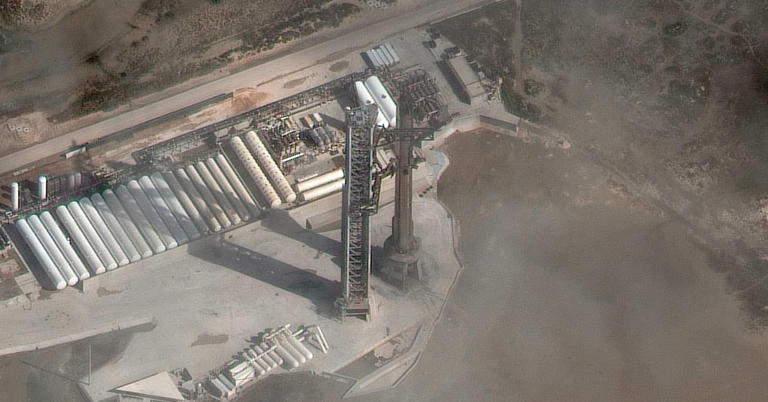
Several commercial flights were diverted or delayed on Thursday following an alert issued by the Federal Aviation Administration (FAA) regarding potential hazards from debris falling from SpaceX’s Starship rocket, which broke up during its seventh test flight. This incident, which occurred shortly after the rocket’s launch from SpaceX’s facility near Brownsville, Texas, caused widespread disruption in the skies, especially affecting flights in and around Florida.
The SpaceX Starship rocket launched just after 5:30 p.m. ET and was headed eastward when it broke apart in midair. SpaceX confirmed the breakup and announced it would continue to analyze flight data to determine the root cause of the incident. Despite the disruption caused by the debris, the FAA stated that no reports of injuries or property damage had been received.
The FAA acted swiftly to manage the airspace, temporarily slowing down or diverting aircraft flying in proximity to the falling rocket fragments. The agency issued an urgent warning to pilots, labeling the area as a “dangerous zone for falling debris.” According to flight-tracker Flightradar24, the warning impacted dozens of flights.
One of the notable disruptions involved a JetBlue Airways flight that was en route from Fort Lauderdale, Florida, to San Juan, Puerto Rico. The flight was diverted back to Fort Lauderdale almost two hours into its journey. Other flights in the vicinity, including those near Turks and Caicos, were also affected. Data from FlightAware showed that a FedEx cargo jet and a Spirit Airlines plane altered their flight paths in response to the FAA’s warnings.
While the airlines involved did not immediately provide comments on the disruptions, an American Airlines spokeswoman confirmed that fewer than 10 of their flights had to be diverted due to the falling debris. This incident highlighted the delicate balance of airspace management, particularly in busy regions such as Florida, where both commercial flights and private planes compete for limited airspace.
The FAA and SpaceX have not yet disclosed full details about the specific locations of the debris or the extent of the flight disruptions. However, the situation underscores the risks associated with high-profile rocket launches and the need for careful coordination between space agencies, airlines, and aviation authorities to ensure the safety of passengers and crew.
In response to the disruption, both the FAA and SpaceX are expected to continue investigating the incident to prevent similar occurrences in the future. SpaceX has faced several challenges during its Starship test flights, but the company remains committed to advancing space exploration and technology despite these setbacks.
As the investigation into the Starship rocket breakup continues, aviation experts and industry observers will be closely monitoring how the incident may affect future space launches and the regulations surrounding commercial air traffic in areas near rocket launch zones. The FAA is expected to issue further guidance on airspace management around such high-risk events to avoid future disruptions.