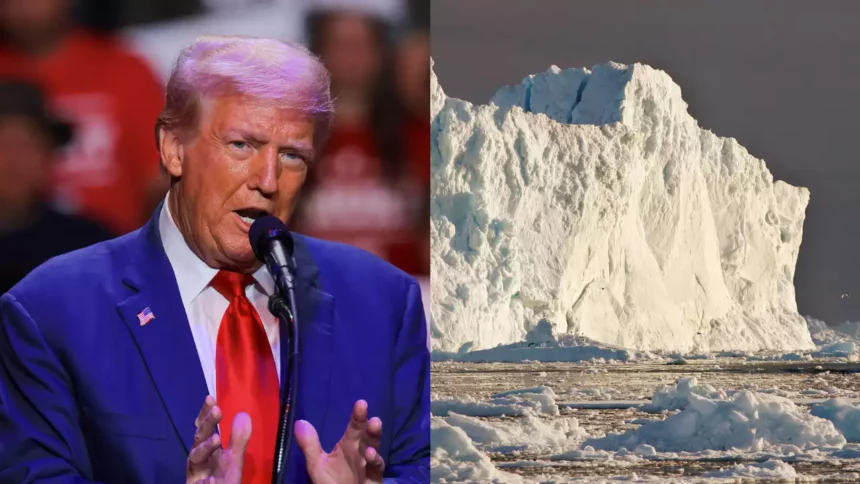
Donald Trump’s recent remarks about his desire to purchase Greenland have once again placed the Arctic region under the global spotlight. The U.S. president’s interest in the autonomous Danish territory is primarily driven by national security concerns and the potential for exploiting its vast mineral resources. However, Donald Trump’s focus on Greenland is only a small part of a larger, more complex economic story unfolding across the Arctic region, a place that was once seen as an emerging frontier for both energy and shipping ventures. Despite the allure of the Arctic’s untapped resources, the momentum for development has come to a halt due to a combination of geopolitical tensions, environmental concerns, and the immense challenges posed by the harsh conditions of the region.
Working conditions in the Arctic are harsh, particularly for fishermen like Sondre Alnes-Bonesmo, who operates in the icy waters off the coast of Norway and Greenland. Alnes-Bonesmo, a 30-year-old fisherman aboard one of the largest factory trawlers, the Granit, describes the extreme challenges of Arctic fishing. With the sun having set for months and temperatures often plummeting below minus 40°C, life in the Arctic is a test of endurance. The constant battles with large waves and storms add to the stress, making work in the Arctic Ocean anything but easy. Nonetheless, Alnes-Bonesmo and others like him are participants in what has been termed the “cold rush,” an economic boom fueled by the potential wealth locked beneath the Arctic’s icy surface.
This “cold rush” began in earnest in 2008 when reports revealed significant mineral and hydrocarbon reserves scattered across the Arctic. The discovery of these resources, combined with vast fishing stocks, raised hopes that climate change, by reducing ice cover, would make the region more accessible for exploration and trade. As ice cover in the Arctic has diminished, the region’s sea routes have gradually opened up, particularly the Northeast Passage that runs north of Russia and Canada. This development has led to a significant increase in shipping activity, with the total recorded annual distance traveled by ships in the Arctic Sea more than doubling from 6.1 million miles in 2013 to 12.9 million miles by 2023.
The ultimate goal for many is the opening of year-round shipping routes through the Arctic that could shorten the distance for cargo ships traveling between Asia, Europe, and the east coast of the United States. Yet, despite these optimistic projections, there is growing skepticism about the feasibility of such ventures. Alnes-Bonesmo, reflecting on the situation, wonders whether he arrived too late to benefit from this promising economic boom.
The invasion of Ukraine by Russia in 2022 dealt a devastating blow to Arctic development plans. As relations between Russia and the West deteriorated, much of the planned economic activity in the Arctic came to a standstill. Morten Mejlaender-Larsen, the Arctic operations and technology director at DNV, a Norwegian company that sets standards for the maritime sector, noted that Russia had been making significant investments in Arctic infrastructure before the war, including the construction of regional rescue centers and shipping facilities for oil, gas, and coal projects in Siberia. However, with the escalation of the Ukraine conflict, much of this activity has been halted, and international shipping in the Northeast Passage has come to a near-complete stop, with only a handful of Chinese ships continuing to operate.
In response to the changing dynamics, Norway has also scaled back its Arctic ambitions. The country has halted oil and gas exploration in the Barents Sea and has shelved plans for deep-sea mining in Arctic waters, particularly in areas between the Svalbard and Jan Mayen islands. This retreat has been welcomed by environmental groups like Greenpeace, which has long warned about the adverse effects of drilling for hydrocarbons on the fragile Arctic environment.
The growing skepticism regarding Arctic development projects has been further fueled by the harsh realities of operating in the region. Helene Tofte, director of international cooperation and climate at the Norwegian Shipowners Association, expressed doubts about the practicality of increased shipping in the Arctic, even with the reduced ice cover. She pointed out that conditions in the region remain extremely challenging and unpredictable, with long distances from emergency response resources. The need for substantial investments in infrastructure and ships, coupled with a short operational season, has made many shipping companies reluctant to invest in Arctic routes.
While the Arctic remains a difficult place to operate, the reduced ice cover continues to open up new opportunities for exploration, particularly in resource-rich areas like Alaska. The U.S. government, under Donald Trump’s administration, has shown renewed interest in Arctic oil and gas exploration, particularly in the Arctic National Wildlife Refuge (ANWR) in Alaska. Donald Trump authorized drilling in one section of ANWR in 2020, and his administration is expected to continue to push for more exploration in the region.
In addition to oil and gas exploration, Canada is also making moves in the Arctic by building a deep-water port at Grays Bay in Nunavut, a Canadian territory in the Arctic. This port is strategically located in the center of the Northwest Passage, a key Arctic shipping route. The construction of this port highlights Canada’s ongoing interest in the Arctic, despite the uncertainties surrounding its economic potential.
Back aboard the Granit, Alnes-Bonesmo continues to fish in the Arctic, aware of the dwindling quotas and the mounting environmental concerns. Despite the challenges, he remains philosophical about his work, acknowledging both the beauty and danger of the region. “After a few years at sea, I’ve grown more scared of the Arctic Ocean, but I’ve also come to respect and value it for all its power and beauty,” he said.
As the geopolitical landscape continues to evolve, the future of the Arctic remains uncertain. With rising tensions between Russia and the West, environmental concerns over resource extraction, and the immense logistical challenges of operating in the region, the Arctic’s economic potential may remain untapped for the foreseeable future. The world will continue to watch as global powers like the U.S. and Canada stake their claims in the Arctic, while environmental groups and local communities push for greater protections for this fragile and vital region.