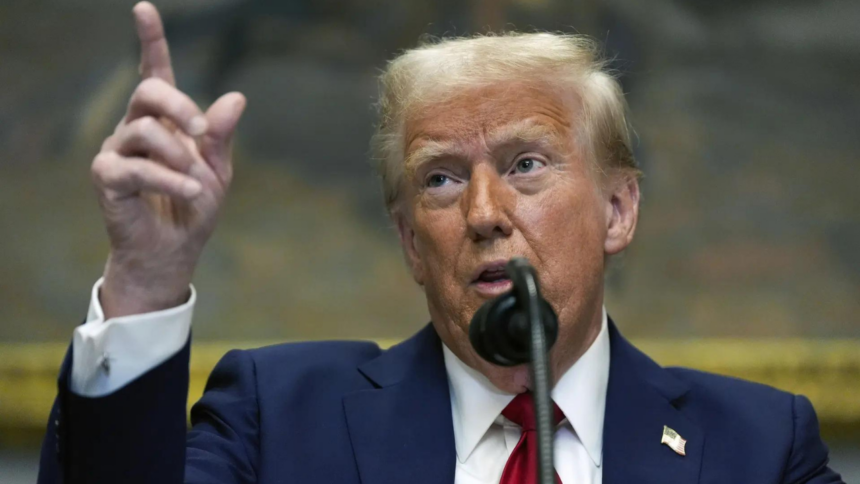
In a significant policy announcement, US President Donald Trump has unveiled a new ‘gold card’ citizenship initiative, which he claims will allow American companies to hire Indian graduates from US universities without the current immigration hurdles. The announcement, which follows the launch of Donald Trump’s ‘gold card’ program on Wednesday, is expected to provide a major boost to Indian students pursuing higher education in the United States. The initiative is positioned as a premium alternative to the existing Green Card system, aimed at both facilitating employment for highly skilled graduates and attracting wealthy foreign investors willing to invest at least USD 5 million in exchange for a pathway to US citizenship.
Donald Trump emphasized that the current US immigration system has forced highly talented individuals, particularly from India, to leave the country despite receiving top-tier education at prestigious institutions such as Harvard and the Wharton School of Finance. He pointed out that under the existing system, international students often secure lucrative job offers from American firms, only to have them rescinded due to visa uncertainties. Highlighting the economic consequences of this restrictive policy, Donald Trump acknowledged that many of these skilled graduates return to their home countries and go on to establish successful businesses, creating thousands of jobs and becoming billionaires. He suggested that the US is missing out on a valuable economic opportunity by failing to retain such talent.
Under the new policy, Indian graduates who have studied in US universities may have a clearer path to staying and working in the country, addressing a long-standing challenge faced by international students. The initiative aligns with Donald Trump’s broader vision of an immigration system that prioritizes economic contributions and business-friendly policies. The ‘gold card’ is also being positioned as a revenue-generating program, with Donald Trump suggesting that if one million gold cards are issued, it could generate up to USD 5 trillion, which he claims could be used to help pay off the US national debt.
Donald Trump’s ‘gold card’ program is set to replace the existing EB-5 visa scheme, which has been in place since 1990 and allows foreign investors to obtain US residency by investing between USD 800,000 and USD 1.05 million in businesses that generate at least ten jobs. The EB-5 program, however, has faced significant challenges, including long processing times of five to seven years and allegations of fraud and misuse. In contrast, the ‘gold card’ plan dramatically raises the investment threshold to USD 5 million while eliminating the job creation requirement, making it a streamlined and more exclusive pathway to US residency and eventual citizenship.
The proposal reflects Donald Trump’s broader approach to immigration, which has often focused on prioritizing economic incentives and reducing bureaucratic barriers for high-net-worth individuals. By removing the job creation mandate, the ‘gold card’ is expected to appeal to ultra-wealthy investors who seek a simpler and faster route to US residency. The program is likely to come into effect by April, with an estimated 10 million gold card visas initially expected to be available.
While the initiative is being marketed as a business-friendly and economy-boosting policy, it also raises questions about accessibility and the potential impact on mid-tier investors, who may find the USD 5 million requirement prohibitively high. Additionally, the plan’s long-term implications for employment-based immigration policies remain to be seen, particularly in the context of Donald Trump’s past stance on restricting certain immigration programs.
As the policy takes shape, it is expected to generate debate among policymakers, business leaders, and immigration experts regarding its feasibility, economic impact, and fairness. For Indian students and professionals, the potential easing of employment restrictions in the US could be a significant development, offering new opportunities for those seeking to build careers in America after completing their education. The coming months will reveal further details on the implementation and reception of the ‘gold card’ program, as the US navigates the evolving landscape of immigration and economic policy.