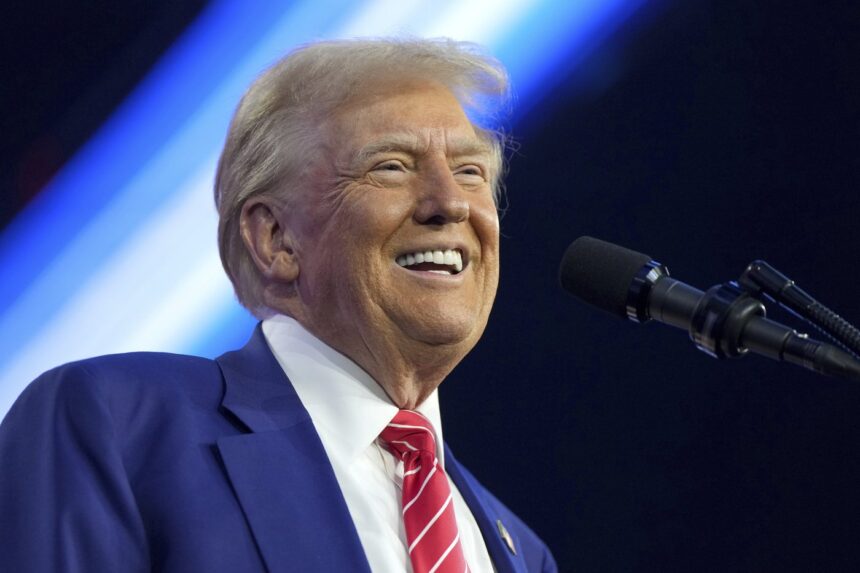
In an unexpected move that has drawn significant attention and controversy, US President-elect Donald Trump shared a map depicting Canada as part of the United States. The map, posted on his social media platform Truth Social with the caption “Oh Canada!”, has triggered a heated debate about the future of US-Canada relations. The post came hours after Donald Trump reiterated his proposal to make Canada the 51st state of the United States and threatened to use “economic force” to achieve this goal.
The dramatic proposal was unveiled at a press conference held at Donald Trump’s Mar-a-Lago residence in Florida, shortly after the certification of his election victory. Addressing reporters, the 78-year-old former president elaborated on his vision for erasing the US-Canada border. “You get rid of that artificially drawn line, and you take a look at what that looks like—it would be much better for national security,” Donald Trump stated, describing the merger as a strategic and economic boon for both countries. “Canada and the United States, that would really be something,” he added.
Donald Trump raised concerns about Canada’s military capabilities, pointing out what he described as their heavy reliance on US military support. “They have a very small military. They rely on our military. It’s all fine, but they’ve got to pay for that. It’s very unfair,” Donald Trump said. However, when asked whether he intended to use military force to push Canada toward a merger, Donald Trump dismissed the notion. “No, economic force,” he clarified, underscoring his intent to leverage trade and financial measures to exert pressure on Canada.
The president-elect also made bold promises about the potential economic benefits of this controversial proposal. “We’re approaching the dawn of America’s golden age,” he declared. Donald Trump expressed confidence that integrating Canada would “turn the economy around very quickly” and strengthen the United States’ position on the global stage.
The reaction from Canadian leadership was swift and unambiguous. Prime Minister Justin Trudeau rejected Donald Trump’s proposal outright, issuing a strong statement on X (formerly Twitter): “There isn’t a snowball’s chance in hell that Canada would become part of the United States. Workers and communities in both our countries benefit from being each other’s biggest trading and security partners.” Trudeau’s remarks underscored the economic and cultural independence of Canada, dismissing any possibility of a merger.
Donald Trump’s strained relationship with Trudeau is well-documented, dating back to his first presidential term from 2017 to 2021. According to sources, Donald Trump has repeatedly floated the idea of making Canada the 51st state since his November 5 election victory. Reports suggest that he brought up the subject during a meeting with Trudeau at Mar-a-Lago, a claim that has fueled further speculation about the motives and feasibility of such a proposal.
On Truth Social, Donald Trump doubled down on his assertion, claiming widespread support for the idea within Canada. “Many people in Canada LOVE being the 51st State,” he wrote. “The United States can no longer suffer the massive trade deficits and subsidies that Canada needs to stay afloat. Justin Trudeau knew this, and resigned.” The statement drew significant backlash, with many labeling it an exaggeration aimed at undermining Trudeau’s leadership.
The proposal to merge the United States and Canada has not only stirred political controversy but has also sparked widespread debate among citizens and experts alike. While some view it as a distraction from pressing domestic issues, others see it as a sign of Donald Trump’s ambitious—and polarizing—vision for his second term.
As global leaders and analysts weigh in on the implications of Donald Trump’s statements, the international community remains on edge, waiting to see how this unexpected narrative will unfold. Whether this is a strategic ploy or a genuine policy initiative, one thing is clear: Donald Trump’s vision for America’s future continues to generate intense debate and uncertainty.