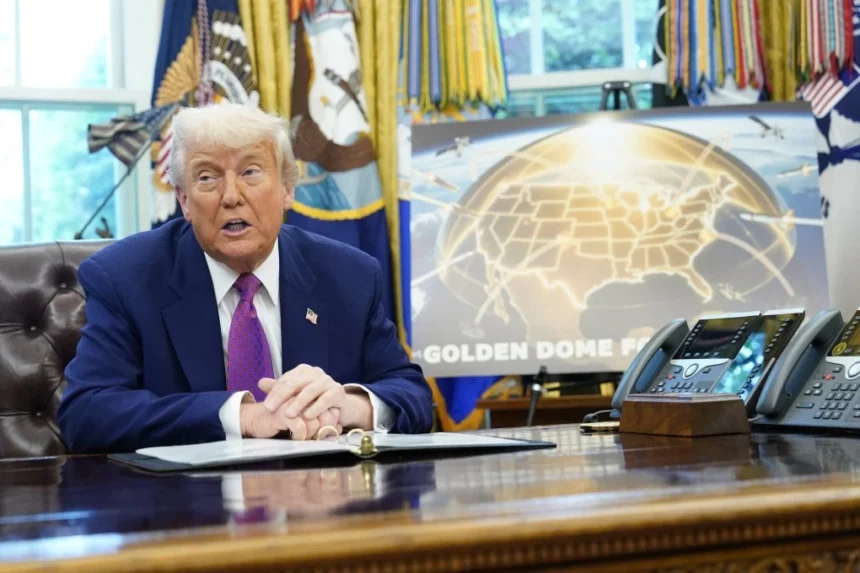
US President Donald Trump has introduced a bold plan for the “Golden Dome,” a new missile defense system designed to shield the United States from advanced missile threats, including those launched from space. Announced from the Oval Office, Donald Trump expressed confidence that the system would be operational before his term ends in 2029, aiming to provide the country with unprecedented protection against missiles traveling at hypersonic speeds. The initiative draws inspiration from Israel’s proven ‘Iron Dome’ but aims to tackle far more complex and technologically advanced challenges facing America’s vast territory.
Golden Dome: Inspired by Iron Dome but Built for Greater Challenges
The Golden Dome takes its name from Israel’s ‘Iron Dome,’ a highly successful missile defense system developed to intercept short-range rockets fired from Palestinian militant groups. However, the American defense needs are significantly different. The US faces threats from countries like Russia and China, which possess Intercontinental Ballistic Missiles (ICBMs) capable of traveling at hypersonic speeds over long distances. Unlike Israel, which is relatively small and mostly flat, the US’s vast and varied geography demands a more complex and capable defense system. The Golden Dome will therefore need to detect and neutralize missiles much faster and over a far greater range than the Iron Dome currently does.
Space-Based Technology: The Future of Missile Defense
A key component of the Golden Dome is its reliance on space-based interceptors. Experts suggest that satellites equipped with missile de tection and interception technology will form the backbone of the system. These satellites would monitor missile launche s from their earliest moments and intercept them during their initial flight phase, possibly even outside Earth’s atmosphere. This approach addresses the challenge posed by hypersonic missiles, which are too fast for traditional ground-based defenses to handle effectively.
However, implementing such a system is no small feat. Satellites continuously orbit the Earth, making it difficult to maintain coverage over specific regions at all times. To ensure constant protection, the Golden Dome would require an extensive network of interceptors, potentially numbering in the thousands. This vast constellation would allow for quick detection and interception anywhere across the globe. The system’s feasibility is bolstered by advancements like Elon Musk’s Starlink satellite network, which demonstrates the ability to maintain large constellations in orbit, though the cost and technical complexity remain considerable.
Donald Trump’s announcement marks a significant step forward in US missile defense strategy, highlighting the increasing importance of space technology in national security. While experts caution that the Golden Dome will require years of development and investment, its potential to revolutionize missile defense by protecting the nation from emerging space-based threats remains promising.