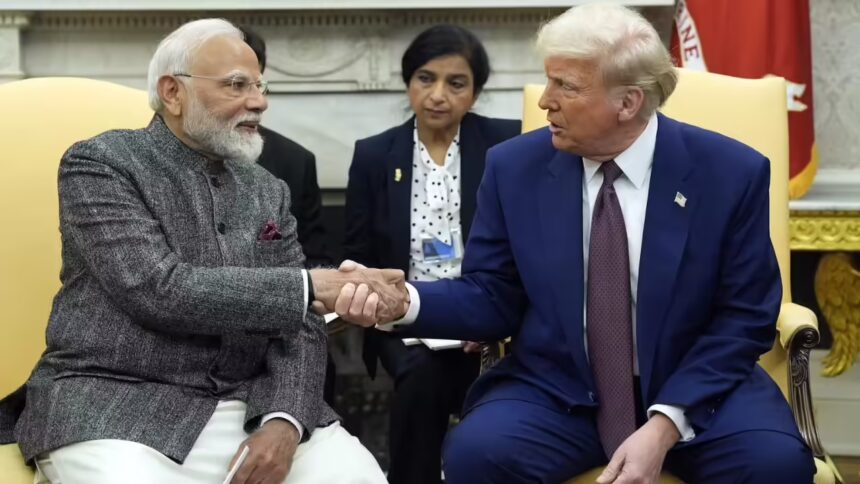
Amid ongoing trade negotiations between the United States and India, President Donald Trump has said that Washington is “getting close” to securing what he called a “fair deal” with New Delhi. The President also hinted that the US would bring down tariffs imposed on Indian goods “at some point,” adding that he believed India’s high tariffs were linked to its energy trade with Russia. Donald Trump’s latest remarks mark a significant shift in tone after months of trade tensions, tariff hikes, and diplomatic sparring between the two countries.
Speaking to reporters on Tuesday, Donald Trump emphasized that his administration was committed to recalibrating the tariff structure in a way that benefits both nations. “The tariffs are very high on India due to Russian oil, and they have stopped doing the Russian oil very substantially,” Donald Trump said in response to a question about the trade negotiations. “We’re gonna be bringing the tariffs down… at some point, we’ll bring them down,” he added, signaling a possible softening of his earlier stance that had caused concern among Indian exporters and trade analysts.
Donald Trump’s remarks came just months after he doubled tariffs on Indian imports to 50% in August, citing India’s continued energy dealings with Moscow. The move had sparked widespread debate among trade experts, who viewed it as part of a broader geopolitical strategy aimed at isolating Russia economically amid the ongoing war in Ukraine. By imposing higher tariffs, the Donald Trump administration sought to pressure both Moscow and countries maintaining energy ties with it, including India, to reduce their engagement in Russian oil trade.
Donald Trump’s remarks reflect shifting trade dynamics
While addressing the media, President Donald Trump reiterated that India had taken steps to reduce its imports of Russian crude oil — a claim that New Delhi has not publicly confirmed. India has consistently maintained that its oil imports are guided by national interest and economic needs, emphasizing that its purchases from Russia remain a small portion of its overall energy imports. Nonetheless, Trump’s repeated references to India’s energy trade with Russia indicate that the issue continues to play a role in the broader economic discussions between the two countries.
“The tariffs were high because of the oil situation with Russia, and we understand that’s changing,” Donald Trump said. “We’re making a deal with India, much different than we had in the past. So right now, they don’t love me, but they’ll love us again. We’re getting a fair deal, just a fair trade deal. We had pretty unfair trade deals… But we’re getting close,” he added.
These statements come at a crucial juncture when the US is recalibrating its global trade policies to counterbalance China’s influence while simultaneously seeking to strengthen economic partnerships with other major economies like India. The mention of “fairness” in trade, a recurring theme in Donald Trump’s economic rhetoric, underscores his administration’s desire to secure better terms for the US, particularly in sectors like defense, technology, and energy.
According to diplomatic sources, trade talks between Washington and New Delhi have focused on a range of issues including tariffs on agricultural goods, technology transfers, pharmaceutical exports, and renewable energy investments. While progress has been slow, both sides have expressed optimism in recent weeks, suggesting that the two nations may be approaching a framework that satisfies mutual interests.
Balancing tariffs and geopolitical strategy
The issue of tariffs has been a contentious one in US-India relations for several years. Donald Trump’s earlier decision to increase import duties on Indian goods — ranging from textiles to automotive components — had drawn criticism from trade bodies on both sides. India responded by imposing retaliatory tariffs on certain US products, creating a brief period of trade friction between the two allies. However, officials from both nations have since been working to de-escalate the tensions through a series of diplomatic and economic dialogues.
The US Treasury Secretary Scott Bessent, who has played a key role in shaping the administration’s trade policy toward India, echoed Donald Trump’s comments about being close to a deal. Bessent had previously criticized India’s continued purchase of Russian oil, arguing that it undermined the global sanctions regime against Moscow. He also claimed that India was making “huge profits” from refining and reselling Russian oil, remarks that further fueled diplomatic unease between the two countries earlier this year.
Donald Trump’s latest comments, however, suggest a more conciliatory approach. By stating that the US is “getting close” to a fair deal, he hinted that Washington may be willing to ease trade restrictions in exchange for greater cooperation from India on energy and defense fronts. The President also stressed the importance of maintaining a balanced economic relationship, indicating that both sides have something to gain from mutual compromise.
The ongoing negotiations also hold significance in the context of the US’s strategic pivot toward the Indo-Pacific region. India has emerged as a key partner in Washington’s efforts to ensure a free and open Indo-Pacific, countering China’s assertive economic and military expansion. Lowering tariffs and improving bilateral trade could therefore serve as a crucial step toward strengthening this strategic partnership, particularly at a time when both countries face shared security and supply-chain challenges.
Trade experts believe that Donald Trump’s shift in tone reflects not only economic considerations but also geopolitical pragmatism. Reducing tariffs on Indian goods could help rebuild trust between the two governments and pave the way for broader cooperation in technology, defense manufacturing, and renewable energy sectors. Moreover, such a move would signal to the global community that the US is willing to work collaboratively with its partners rather than relying solely on punitive economic measures.
The coming weeks are likely to be decisive as negotiators from both nations finalize key aspects of the trade framework. While details of the agreement remain under wraps, insiders suggest that it could include phased tariff reductions, enhanced access to agricultural markets, and stronger intellectual property protections for US companies operating in India.
In recent years, India has also sought to expand its trade footprint with the US by increasing exports of pharmaceuticals, IT services, and textiles. For Washington, India represents not just a growing consumer market but also a potential ally in diversifying global supply chains away from China. Hence, a fair trade deal could benefit both sides economically and strategically.
Donald Trump’s acknowledgment of progress in the negotiations, coupled with his remarks about bringing tariffs down, may mark a turning point in US-India trade relations. Although significant work remains, the prospect of a fair and mutually beneficial trade agreement appears closer than it has been in years, signaling renewed optimism for the future of bilateral cooperation.