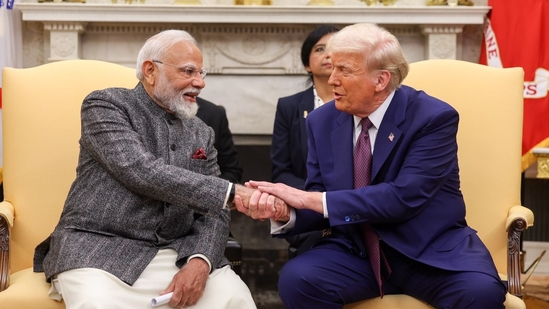
In a televised interview alongside billionaire entrepreneur Elon Reeve Musk, United States President Donald John Trump reaffirmed his stance on imposing reciprocal tariffs on India, asserting that Washington will not exempt any country from its tariff policies. Speaking with Fox News host Sean Patrick Hannity, Donald Trump recounted his conversation with Indian Prime Minister Narendra Damodardas Modi, emphasizing his firm position on trade imbalances.
Donald Trump described his direct approach in negotiations, stating, “I told Prime Minister Narendra Modi yesterday—he was here—I said, ‘Here’s what we’re going to do: reciprocal. Whatever you charge, I’m charging.'” He added that Narendra Modi was resistant to the idea, responding, “‘No, no, I don’t like that.'” However, Donald Trump maintained his stance, insisting, “‘No, no, whatever you charge, I’m going to charge.’ I’m doing that with every country.'”
The discussion highlighted long-standing trade tensions between the two nations, particularly concerning India’s high tariffs on certain United States imports. One of the most contentious issues remains the automobile sector, where India levies tariffs as high as 100 percent on foreign car imports. Elon Reeve Musk, seated beside Donald Trump, interjected to confirm this, saying, “It’s 100 percent—auto imports are 100 percent.” Donald Trump responded with skepticism, suggesting that the actual burden on United States companies could be even higher, calling it “peanuts” compared to other tariffs India imposes.
Donald Trump argued that such high tariffs place American manufacturers at a disadvantage, making it nearly impossible for them to compete in the Indian market unless they set up production facilities in the country. He considers this policy unfair, claiming that it forces United States companies to establish local manufacturing units to avoid steep import duties. To counter this, he reiterated his plan for a reciprocal tariff system, where the United States would impose the same level of duties on Indian imports as India levies on American goods. “Nobody can argue with me,” he said, explaining that critics of his earlier trade policies could no longer accuse him of unfair practices. “If I said 25 percent, they’d say, ‘Oh, that’s terrible.’ I don’t say that anymore… because I say, ‘Whatever they charge, we’ll charge.’ And you know what? They stop.”
This is not the first time Donald Trump has targeted India over trade policies. During his first term, he frequently referred to India as the “tariff king,” citing high duties on United States exports. Despite past trade disputes, both countries recently pledged to double their bilateral trade to $500 billion by 2030 and to finalize a bilateral trade agreement by autumn 2025 following Narendra Modi’s visit to Washington. However, Donald Trump’s renewed emphasis on reciprocal tariffs signals that trade negotiations between the two nations could remain contentious in the coming years.