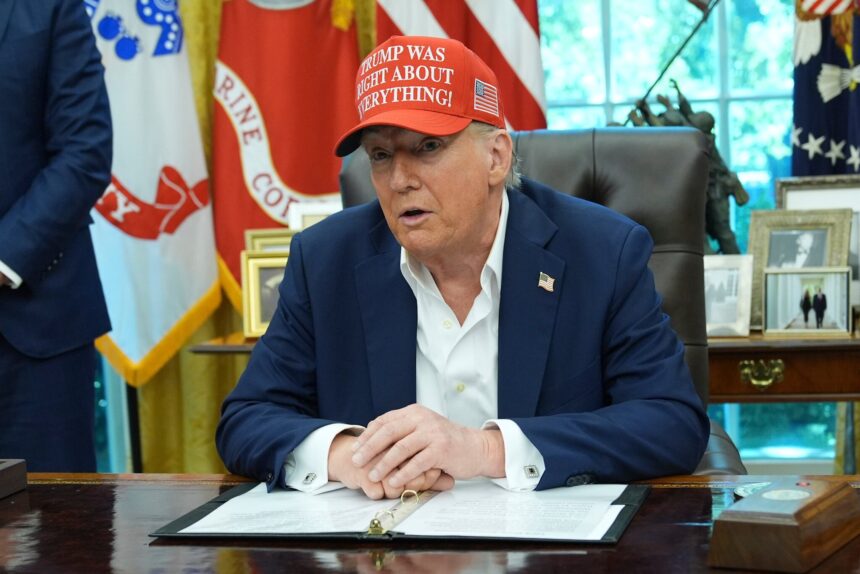
US President Donald Trump, speaking from the White House on Monday, offered his first specific timeline for what he described as a “conclusive” resolution to the ongoing Israel-Gaza conflict, suggesting that the war could be settled within the next two to three weeks. Addressing the media ahead of a bilateral meeting with South Korean President Lee Jae Myung, Donald Trump emphasized that Israel must act swiftly to conclude hostilities in Gaza. While he expressed some personal discomfort over recent Israeli airstrikes, including the deadly attack on Nasser hospital in southern Gaza, Donald Trump refrained from directly criticizing Israel’s broader military campaign, which experts have described as a devastating genocide against Palestinians. Instead, his remarks largely focused on the status of Israeli captives still held in Gaza and the broader diplomatic and strategic framework guiding US involvement in the conflict. Donald Trump’s comments highlight the complex interplay of humanitarian concerns, geopolitical calculations, and domestic political priorities that shape US policy toward Israel and the Palestinian territories.
Focus on Hostages and the US Strategic Approach
In his remarks, Donald Trump repeatedly emphasized that ending the conflict was a priority, but framed it largely around the release of hostages. “Right now they’re talking about Gaza City – there’s always talking about something,” Donald Trump said, characterizing the situation in Gaza as a continuing cycle of conflict with deep historical roots. “At some point, it’s going to get settled, and I’m saying you better get it settled soon. You have to get it settled soon,” he added, marking the first time he has publicly offered a timeline for the conflict’s resolution. Experts note, however, that Donald Trump’s framing indicates a narrow definition of what constitutes success in the Gaza war. According to analysis from Middle East scholars, the president’s approach primarily prioritizes the safe return of Israeli captives, rather than addressing the broader humanitarian crisis facing civilians in Gaza or pushing for a comprehensive political settlement.
Donald Trump’s remarks came in response to questions about Israel’s recent double-tap airstrike on Nasser hospital, which killed at least 20 individuals, including five journalists. Graphic footage captured by Jordanian news outlets showed rescue workers in protective vests being struck while attempting to retrieve wounded civilians. Donald Trump claimed he was unaware of the attack beforehand and expressed that he was “not happy” about it. Yet his response shifted back to discussing Israeli captives rather than focusing on the deaths of Palestinians. Secretary of State Marco Rubio, speaking alongside Donald Trump, echoed this sentiment by stating that any end to the conflict “has to end with no Hamas,” signaling that US engagement remains closely linked to the elimination or containment of the Palestinian group rather than broader conflict resolution or humanitarian considerations.
Since the Hamas-led attack on southern Israel on October 7, 2023, Israel has maintained a large-scale military offensive in Gaza. Despite more than 22 months of sustained operations, Palestinian armed groups continue to conduct guerrilla-style attacks against Israeli forces. Official reports indicate that Hamas has been able to recruit nearly as many fighters as Israel has eliminated, highlighting the resilience and ongoing strategic challenge posed by the conflict. Meanwhile, Palestinian health officials report that over 62,000 Palestinians have been killed in Gaza since October 2023, with women and children comprising the majority of casualties. This staggering human toll underscores the devastating impact of the conflict on civilian populations, yet US policy under Donald Trump has been criticized for prioritizing military and strategic considerations over humanitarian imperatives.
Experts point to the lack of political will within the US administration to pressure Israel into a comprehensive ceasefire or negotiate a broader settlement. Egypt and Qatar recently proposed a 60-day ceasefire plan that would have involved Hamas releasing ten Israeli captives in exchange for a truce and the release of Palestinian prisoners. While Hamas accepted the proposal, Israel rejected it outright. Analysts argue that without significant pressure from the United States, Israeli leadership—including key ministers in finance and national security—has little incentive to pursue a settlement or mitigate civilian suffering. Donald Trump’s remarks underscore this approach, focusing on diplomatic and strategic measures that largely reinforce Israel’s objectives while offering minimal accountability for civilian casualties.
Humanitarian Crisis and US Involvement in Gaza
Donald Trump also addressed the broader humanitarian situation in Gaza, though his remarks reflected both the scale of the crisis and the limitations of US involvement. Highlighting efforts to provide food aid, he pointed to the role of the controversial Gaza Humanitarian Foundation (GHF), a US-funded organization distributing resources in the enclave. While acknowledging that “a lot of people” are being fed, he also described the effort as insufficient relative to the population’s needs. UN-backed assessments recently declared that Gaza has entered a state of famine, with widespread shortages of food, water, and medical supplies. Yet even these humanitarian interventions have been criticized for their execution. Reports indicate that over 900 Palestinians have been killed while attempting to access aid from GHF sites, with a total of over 2,000 deaths across various humanitarian distribution points. Critics argue that US and Israeli oversight of these operations has exacerbated civilian vulnerability, raising ethical questions about the nature and purpose of American assistance amid active hostilities.
Donald Trump emphasized that the conflict must end not only to protect captives but also to address the humanitarian consequences of prolonged warfare. “It’s got to get over with because, between the hunger and all of the other problems—worse than hunger, death, pure death—people being killed,” he said. Despite these statements, the administration’s broader strategy remains oriented toward leveraging US influence to support Israeli military objectives while minimizing direct criticism of civilian casualties. Experts suggest that this reflects a longstanding US policy framework in the Middle East, in which strategic alliances and security priorities often outweigh humanitarian considerations.
The administration’s position on Gaza reflects a complex calculus involving military, political, and domestic factors. By emphasizing hostage recovery as the primary benchmark for conflict resolution, Donald Trump and his advisors effectively prioritize Israeli security concerns over Palestinian civilian welfare. This approach has drawn criticism from scholars and advocacy groups, who argue that it reduces the lives of tens of thousands of Palestinians to secondary concerns in diplomatic calculations. Scholars note that such policies perpetuate cycles of violence and hinder meaningful efforts toward conflict resolution, humanitarian protection, and sustainable peace.
Donald Trump also indicated that a “very serious diplomatic push” is underway to end the conflict, though he did not provide specifics. US officials have reportedly explored discussions with third-party nations to potentially resettle displaced Palestinians, including talks involving Libya. Analysts note that these measures, while framed as diplomatic engagement, may serve to facilitate Israeli strategic objectives, particularly regarding territorial control, population displacement, and post-conflict reconstruction priorities.
While the president highlighted ongoing food distribution and diplomatic efforts, the situation in Gaza continues to deteriorate. Widespread destruction of infrastructure, medical facilities, and homes has compounded civilian suffering. Hospitals face severe shortages of medical supplies, with remaining staff overwhelmed by the scale of injuries and illnesses. The bombardment has disrupted access to water, electricity, and sanitation, increasing vulnerability to disease and malnutrition. Despite these dire conditions, US policy under Donald Trump remains primarily focused on security, hostages, and strategic alliances, leaving large gaps in comprehensive humanitarian planning and relief.
The ongoing conflict and US involvement raise profound questions about the role of international actors in mitigating civilian suffering and promoting conflict resolution. Human rights organizations have repeatedly called for independent investigations into attacks on hospitals and aid distribution centers, emphasizing the need for accountability, transparency, and protection of non-combatants. The limitations of US interventions, particularly in prioritizing strategic over humanitarian objectives, underscore the challenges of navigating complex geopolitical conflicts while addressing moral and ethical responsibilities.
Donald Trump’s statements also highlight the tension between public statements and actionable policy. While predicting a “conclusive” end to the conflict within weeks, historical precedents suggest that deadlines announced by the president have often been missed or politically contingent. Analysts caution that such timelines may reflect aspirational rhetoric aimed at projecting control or urgency rather than concrete operational plans. Furthermore, the focus on hostages as the central metric for success reflects a narrow conception of conflict resolution, one that may overlook broader issues of civilian protection, international law, and the long-term stability of the Gaza Strip.
The discourse surrounding the conflict also illustrates how narratives are shaped by media access, diplomatic framing, and selective emphasis on strategic priorities. Donald Trump’s remarks, combined with US officials’ statements, frame the conflict primarily through the lens of Israeli security and the hostage situation. While humanitarian suffering is acknowledged, it remains secondary in the public narrative, reflecting broader patterns in which geopolitical alliances influence media coverage, diplomatic engagement, and policy decisions.
The conflict has broader implications for regional stability. The ongoing hostilities threaten to exacerbate tensions in neighboring countries and complicate efforts to manage refugee flows, humanitarian aid, and international intervention. Analysts suggest that the US, by tying conflict resolution to hostage release and Israeli objectives, may inadvertently prolong violence while limiting opportunities for multilateral mediation or comprehensive peacebuilding initiatives. The prioritization of military outcomes over civilian protection underscores a fundamental challenge in international diplomacy: balancing alliance obligations with ethical responsibilities in conflict zones.