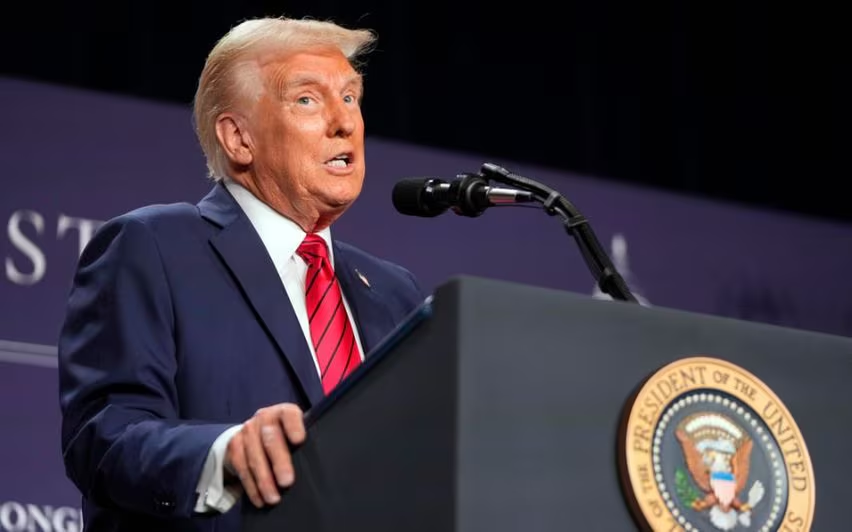
U.S. President Donald Trump signed an executive order on Tuesday aimed at restricting gender transition procedures for individuals under the age of 19. This marks the latest in a series of actions taken by the Donald Trump administration targeting transgender individuals, following his return to office. The order directly addresses gender transition procedures, including hormone treatments and surgeries, which the president has strongly criticized in recent speeches.
The executive order follows Donald Trump’s comments in his inauguration speech, where he declared that his administration would only recognize two genders—male and female. His remarks have further fueled the ongoing cultural and political debate over gender identity in America, reflecting the deeply divisive issue that has become a focal point of the nation’s culture wars. The President’s decision to limit gender transition options for minors resonates with conservative values that seek to preserve what they deem to be traditional gender norms.
The executive order condemns what it describes as “chemical and surgical mutilation,” referring to medical procedures such as puberty blockers, hormones, and gender-affirming surgeries. According to the order, this type of medical intervention for minors should not receive any federal support. “Across the country today, medical professionals are maiming and sterilizing a growing number of impressionable children,” the order states, echoing Donald Trump’s rhetoric against what he deems as harmful and irreversible medical practices. The President also argued that this “dangerous trend” should be viewed as a “stain on the Nation’s history” and called for an end to it.
The new policy effectively bans federal funding for gender-affirming procedures under various government programs, including Medicaid, Medicare, and U.S. Defense Department health insurance, which provides coverage for approximately 2 million children. These procedures, which are often accessed by transgender youth seeking medical support in their transition, would no longer be subsidized by the federal government, according to the order.
In addition to halting federal financial support for gender transition procedures, President Donald Trump indicated that he would push for new legislation aimed at allowing parents and children to sue doctors who perform gender-related surgeries. This effort aligns with the broader agenda of curbing access to gender-affirming care for minors. Donald Trump’s administration has been outspoken in promoting policies that restrict medical interventions for minors seeking gender transition treatments, despite the lack of a nationwide law prohibiting such practices.
Several states across the U.S., led by Republican lawmakers, have already passed laws restricting gender transition procedures for minors. These measures reflect a growing trend of state-level restrictions that aim to limit the accessibility of medical care for transgender youth. The debate has been contentious, with opponents of such laws arguing that they infringe on the rights of transgender individuals to make decisions about their own bodies. Supporters, on the other hand, contend that these laws protect children from making life-altering decisions at a young age.
The issue has also reached the highest levels of the U.S. judicial system. In December, the U.S. Supreme Court justices debated a Tennessee law that bans the use of puberty blockers or hormone therapy for minors under 18, signaling the growing legal battles over transgender rights and medical care. The high court’s involvement underscores the magnitude of the issue, as legal experts and lawmakers grapple with balancing parental rights, medical autonomy, and the rights of transgender minors.
The order also reveals a deeply polarized political landscape, with the executive branch moving to enact policy that reflects conservative concerns over gender identity, while LGBTQ+ advocacy groups and medical professionals continue to push back, arguing that transgender youth should have access to necessary medical care. As Donald Trump pushes forward with his executive order, it is clear that the debate over transgender rights and medical access will remain a key issue in American politics.
As the debate continues, Donald Trump’s administration is focused on reshaping how gender transition procedures are perceived and regulated across the U.S. With numerous states already implementing similar restrictions, the issue is likely to continue fueling divisive political battles in the coming years. As new legal challenges arise, the nation is bracing for further controversy and litigation surrounding transgender rights, medical care, and the legal recognition of gender identity.