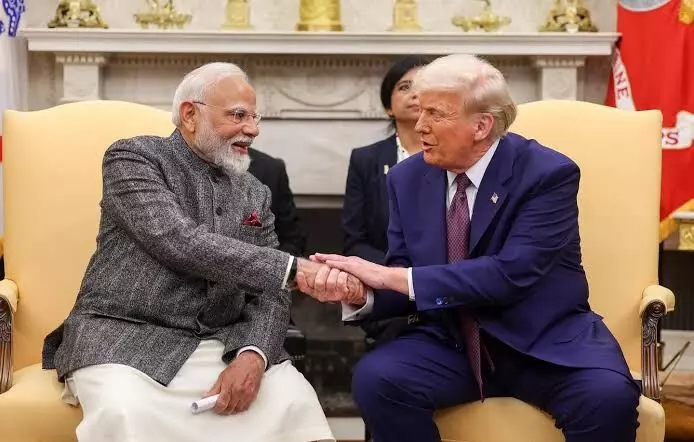
In a move that underscores Washington’s shifting trade priorities, President Donald Trump has announced that the United States is close to finalizing a trade deal with India, even as he introduced a fresh wave of tariffs on 14 countries, including Bangladesh, Japan, South Korea, and Thailand. The announcement follows a week-long series of negotiations between US and Indian officials in Washington, indicating a cautious optimism toward resolving ongoing trade differences while protecting respective national interests.
“We made a deal with the United Kingdom, we made a deal with China, we’re close to making a deal with India,” Donald Trump said, noting that letters detailing new tariff measures have been sent to countries where trade negotiations have stalled or failed to progress.
Fresh Tariffs on 14 Countries
Donald Trump’s latest trade measures will take effect from August 1, with countries such as Bangladesh, Cambodia, Indonesia, Malaysia, Myanmar, Serbia, and South Africa among those impacted. Myanmar and Laos face some of the steepest tariffs, with 40% levies imposed, reflecting the administration’s aggressive stance on countries perceived as not aligning with US trade expectations.
“We’re sending out letters to various countries telling them how much tariffs they have to pay. Some will maybe adjust a little bit depending if they have a cause, we’re not going to be unfair about it,” Donald Trump said, indicating some flexibility within the framework of the newly announced measures.
India Seeks to Balance Interests
Donald Trump’s comments on the US-India trade deal came amid reports that the two countries had been working toward a resolution ahead of the previously announced July 9 tariff imposition deadline, which has now been extended to August 1. Union Commerce Minister Piyush Goyal had earlier stated that India was prepared to enter into trade agreements with the US in the national interest while clarifying that any agreement would not be made under pressure or against India’s strategic needs.
The trade discussions have reportedly focused on sensitive areas, with India modifying certain demands to protect its farmers against large-scale US agricultural imports, particularly concerning dairy and genetically modified crops. An official familiar with the discussions highlighted that “the livelihoods of millions of farmers are at stake as they could not compete with America’s commercial-scale dairy farms,” underscoring India’s cautious approach to opening up its agricultural markets fully.
India has sought the withdrawal of all retaliatory tariffs, which currently include a 10% baseline tariff and an additional 16% country-specific levy. The US, while firm on its trade demands, has indicated openness to adjusting measures based on further discussions. “I would say firm, but not 100% firm. If they call up and they say we’d like to do something a different way, we’re going to be open to that,” Donald Trump said, signalling that despite the tariffs, Washington remains open to negotiating terms that could lead to a mutually beneficial trade agreement with India.
Donald Trump’s remarks and the subsequent tariff measures reflect the administration’s continued use of tariffs as leverage in trade negotiations while positioning the United States to secure favourable terms from its global trading partners. As the August 1 deadline approaches, attention will remain on how the US and India navigate the remaining hurdles to finalise a trade deal that aligns with both countries’ economic and strategic interests, setting the tone for their evolving bilateral trade relationship