U.S. President Donald Trump defended the severity and success of recent American airstrikes on Iranian nuclear facilities, controversially likening their impact to the atomic bombings of Hiroshima and Nagasaki during World War II. Despite a U.S. intelligence assessment suggesting the strikes may have delayed Iran’s nuclear program by only a few months, Donald Trump insisted that the operation marked a decisive turning point, claiming it ended the war between Iran and Israel and delivered a major blow to Tehran’s nuclear ambitions.
Donald Trump rejects preliminary intelligence doubts
During a NATO summit in The Hague on Wednesday, Donald Trump addressed the growing scrutiny following reports that the U.S. Defense Intelligence Agency (DIA) had deemed the strikes’ impact “limited and preliminary.” The president, however, pushed back strongly against the intelligence findings, labeling them inconclusive and not reflective of the true devastation caused.
“The intelligence says, ‘We don’t know,’ and I’m okay with that,” Donald Trump told reporters. “But I think it was obliteration. It was very severe.” He argued that such uncertainty could not discount the scale of destruction he believed had been achieved. Donald Trump also criticized journalists for reporting on the DIA findings, accusing them of undermining the military’s efforts and the pilots who carried out the strikes.
Standing alongside NATO Secretary General Mark Rutte, Donald Trump compared the operation’s consequences to America’s nuclear bombings in 1945. “When you look at Hiroshima, Nagasaki, that ended a war too. This ended a war in a different way,” he said, referring to the recent ceasefire between Israel and Iran.
Administration rallies behind Donald Trump’s narrative
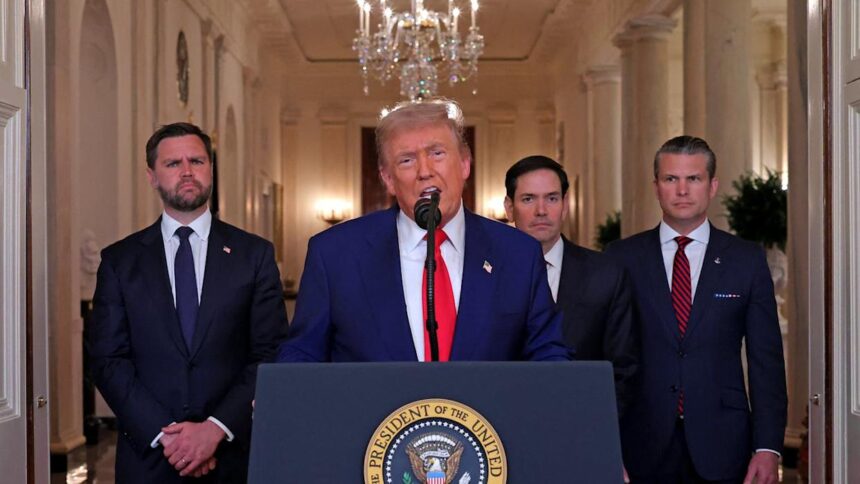
The president’s stance was strongly echoed by Secretary of State Marco Rubio and Secretary of Defense Pete Hegseth, both of whom accompanied him at the summit. They cast further doubt on the DIA’s credibility, asserting the leaked report was still under review and lacked high confidence.
Hegseth in particular expressed outrage over media leaks, labeling the DIA report as “top secret,” “low-confidence,” and politically motivated. He also revealed that the FBI had opened an investigation into the source of the leak, while Rubio accused the leakers of misrepresenting classified information to shape a misleading public narrative.
The administration’s frustration appeared rooted in the political stakes of the operation. Donald Trump has long positioned himself as a leader who avoids foreign wars, often repeating his commitment to the “Make America Great Again” agenda. The Iran strike, therefore, needed to be framed not as military overreach, but as a necessary, targeted action to prevent nuclear proliferation.
According to Donald Trump, intelligence assessments from Israel’s Atomic Energy Commission aligned more with the administration’s claim, estimating that Iran’s nuclear program had been pushed back by “many years.” The White House circulated that statement widely, bolstering its narrative despite the contrasting U.S. agency view.
Iran talks expected but uncertainty remains
Despite his tough rhetoric, Donald Trump confirmed that the U.S. plans to initiate nuclear talks with Iran in the coming week. He gave no specific details about the format or participants but reiterated his belief that Iran would not be eager to resume its nuclear ambitions after the strikes.
“I don’t think they want to enrich anything right now,” Donald Trump said. “They want to recover.” His remarks hinted at a cautious diplomatic window following the intense military escalation that had shaken the region just days earlier.
Meanwhile, NATO allies used the summit to announce a collective decision to increase defense spending to 5% of GDP—an outcome the Donald Trump administration celebrated as a diplomatic win. While nuclear tensions remained high, Washington’s message was clear: the U.S. viewed the strike as justified, effective, and a means to bring both pressure and dialogue back to the table.