As Delhi heads into its upcoming assembly elections on February 5, one demographic group has emerged at the heart of political discourse: the Purvanchali voters. Hailing from Bihar, Jharkhand, and eastern Uttar Pradesh, Purvanchalis now make up a significant portion of Delhi’s electorate, with their growing political influence evident as both the BJP and AAP actively court their support.
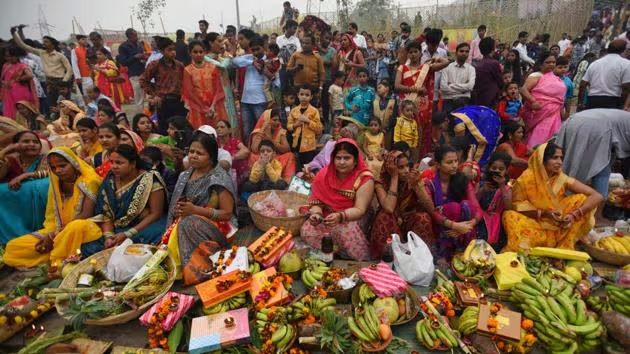
Prime Minister Narendra Modi, in a recent election rally, accused the Aam Aadmi Party (AAP) of subjecting Purvanchalis to inadequate conditions during their most important festival, Chhath Puja. “This is fraud and shamelessness,” Modi said, criticizing the Delhi government for allowing the celebration of Chhath amid unsanitary conditions. For Purvanchali voters, the festival—dedicated to worshipping the sun god and the river—remains central to their cultural and religious identity, especially for those from the region’s rural background.
The political attention given to the Purvanchali community speaks volumes about their growing clout in Delhi’s electoral landscape. Retired Kirori Mal College principal Professor Bhim Singh explained that the community’s significance is finally being recognized after decades of marginalization. Singh recalled that in the past, the term ‘Bihari’ was often used as an insult in Delhi, even though many of Delhi’s top officials and professionals hailed from Bihar and its neighboring regions. “We were treated with disdain despite our achievements. But today, the community’s contribution is being acknowledged,” Singh said.
With an estimated one-sixth of Delhi’s population now comprising Purvanchalis, their influence extends over approximately 20 key assembly constituencies, including Burari, Deoli, Sangam Vihar, Uttam Nagar, Dwarka, Kiradi, and Vikaspuri. Both political parties, BJP and AAP, have taken note of this and are deploying Purvanchali candidates in many of these seats to appeal directly to the community. AAP has fielded Purvanchali candidates in at least 10 constituencies, while BJP, which has alliances with parties like JD(U) and LJP(R), is using its Purvanchali face, MP Manoj Tiwari, to campaign in areas with a high concentration of Purvanchali voters.
However, the growing political engagement of Purvanchalis raises the question: Are they a homogeneous bloc? While issues like Chhath Puja and unclean Yamuna often dominate discussions of this community, it’s clear that there are diverse concerns among the Purvanchali electorate.
Manoj Kumar, a resident of Deoli originally from Munger, Bihar, believes that the main unifying factor for Purvanchalis in Delhi is the desire for mainstream recognition. “I have been here for 20 years, but I still haven’t been able to buy a house,” Kumar says, voicing the common grievance of many tenants who feel neglected. “We don’t receive the benefits that other residents enjoy, like free electricity or water.” These sentiments are shared by many, reflecting the Purvanchali community’s struggle for basic rights and equality in a city where they have contributed to its labor force but feel sidelined in urban planning and development.
Snehalata, a resident of Deoli who migrated from Ayodhya 30 years ago, further underscores this point by arguing that while Chhath Puja holds significance, the pressing issues for most Purvanchalis are related to basic amenities like clean water, sanitation, and sewage systems. These everyday concerns are becoming central to the community’s electoral choices.
In Burari, another constituency heavily populated by Purvanchalis, local businessman AK Jha runs a Litti-Chokha stall, a popular food outlet from his home state of Bihar. He shares his frustration about the lack of government support for small businesses. “I had to start this stall after my company moved to Ghaziabad,” Jha explains. “But even now, I have to bribe to keep my business running smoothly.” Despite these difficulties, Jha notes that his steady customers are often not from Bihar or Jharkhand, proving that the Purvanchali community’s influence is far-reaching beyond their immediate circle.
Kavita, another small business owner in the same area, voices a different concern—rising inflation. She has not received any assistance from the government, despite promises of financial aid if certain parties are voted into power. “Price rise is the real issue for us,” she asserts. “Promises of Rs 2,100 to 2,500 in assistance don’t feel credible. I’m just hoping for something to be done about inflation.”
At Sarai Kale Khan, Jaya, a cook by profession, is concerned with both her religious practices and her children’s safety. Jaya, a regular participant in Chhath Puja, emphasized the improvements made in public safety after the Nirbhaya case but expressed mixed feelings about who she will vote for in the upcoming election. “I voted for AAP last time because I felt they were doing something,” she says. “But now, all my colony friends are saying BJP is better.”
This blend of concerns—safety, economic relief, and basic infrastructure—echoes the sentiment shared across communities in Delhi. Despite the focus on Purvanchali issues like Chhath Puja, it is clear that their concerns align with those of other marginalized groups in the city. BJP and AAP, in their bid to secure the Purvanchali vote, have tried to highlight each other’s shortcomings. BJP has reminded Purvanchalis of AAP leader Arvind Kejriwal’s past accusations against Bihar and UP migrants, labeling them as “fake voters.” On the other hand, AAP has blamed the BJP-led Haryana government for polluting the Yamuna River, further fueling the debate on basic living conditions for the Purvanchali community.
In what could be a game-changer in the Delhi polls, Purvanchali voters are keenly observing these developments. Their choice in the upcoming election could potentially shift the political landscape, as their collective concerns—spanning from safety to basic amenities—intersect with larger issues facing the city. The evolving dynamics between the BJP and AAP, driven by their attempts to win over this growing electoral force, will undoubtedly play a crucial role in shaping the future of Delhi’s politics.