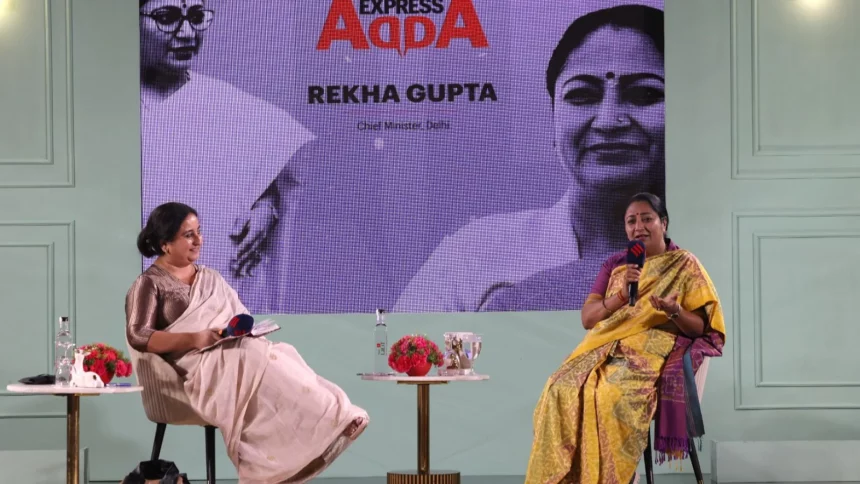
Delhi Chief Minister Rekha Gupta recently shared her vision for the city, highlighting the historic moment of a “triple-engine government” working together — the Centre, State, and Municipal Corporation — with a shared goal to uplift Delhi. Reflecting on her personal journey from a student taking the University Special train to Daulat Ram College to now steering the capital’s governance, she emphasized the immense responsibility of leading a metropolis that symbolizes India’s diversity and complexity. Rekha Gupta talked candidly about overcoming challenges, the need for cohesive development, her plans for tackling Delhi’s air pollution, and her focus on cleaning the Yamuna river. Her leadership represents a new chapter for Delhi, aiming for inclusive growth and infrastructural reforms.
Rekha Gupta’s rise in politics is notable, particularly for a woman without a political family background. She shared how the BJP’s internal system, promoting youth and women, supported her journey from student politics to councillor, MLA, and now Chief Minister. She underscored the importance of political opportunities for those without traditional connections, crediting leaders like Narendra Modi, Arun Jaitley, and Sushma Swaraj for fostering inclusive leadership.
New Governance Model and Urban Challenges
Delhi has historically grappled with fragmented governance and insufficient infrastructure, despite its status as India’s capital. Rekha Gupta criticized the previous administrations for dividing the city into two parts: one that pays taxes but remains neglected, and another that was enticed with freebies, leading to stagnation in development. She pointed out glaring issues such as poor water supply—40% from taps and 60% from tankers—lack of sewer lines in unauthorized colonies and villages, and inadequate healthcare infrastructure with just 0.42 hospital beds per 1,000 people.
She urged Delhi to “dream bigger” and not settle for patchwork fixes like focusing only on potholes or sewer blockages. Delhi’s growth demands systemic improvements including water pipeline networks, sewer connectivity, and modern hospitals. The emphasis is on infrastructure that supports a large and diverse population, many of whom have migrated from across India, making Delhi a microcosm of the nation.
Regarding the fear of slum demolitions post the BJP victory, Rekha Gupta clarified that government initiatives aim to provide slum dwellers with proper housing and essential utilities like electricity and water while simultaneously improving city infrastructure such as roads, flyovers, schools, and hospitals. She stressed that urban development should not compromise the city’s functionality.
A Unified Triple-Engine Government and Statehood Debate
One of the most transformative changes under Rekha Gupta’s leadership is the unprecedented coordination between the Central government, the Delhi state government, and the Municipal Corporation. This “triple-engine” cooperation marks a shift from earlier years when conflicts among these bodies hampered progress. Rekha Gupta noted the removal of police licensing from the state, facilitated by the Centre, which streamlined business processes benefiting Delhi’s traders. She emphasized that this synergy removes bureaucratic hurdles and enhances service delivery.
On the sensitive topic of Delhi’s statehood, Rekha Gupta acknowledged the ongoing demand but reframed the conversation in the context of effective governance. Previous governments focused on confrontations among institutions, resulting in administrative paralysis. The current alignment of Centre and State, she suggested, reduces the urgency for statehood as agencies now work collaboratively for Delhi’s development. Still, she maintained that clear accountability remains essential, insisting that elected representatives must be held responsible for governance outcomes without shifting blame to the Prime Minister or other entities.
Rekha Gupta also spoke about her cooperative relationship with Lieutenant Governor Vinai Kumar Saxena, highlighting his active engagement with citizens and administrative support, contrasting with the political tussles of earlier years.
Environmental Priorities: Yamuna and Air Quality
Cleaning the Yamuna river stands at the top of Rekha Gupta’s agenda. She lamented that previous governments failed to study or address the massive pollution, resulting from nearly 200 untreated drains pouring sewage and industrial waste into the river. Her plan includes tapping these drains, installing decentralized sewage treatment plants, and improving sewer connections in colonies and villages. Additionally, she underscored the need to increase the river’s environmental flow (e-flow) and reduce its biological oxygen demand (BOD) for restoration.
Delhi’s water supply suffers significant losses due to leaking canals and theft, and ensuring clean drinking water reaches every household remains a priority. Rekha Gupta’s administration is implementing phased infrastructure projects to systematically upgrade water pipelines and reduce wastage.
Regarding air pollution, Rekha Gupta revealed an ambitious plan to electrify Delhi’s public transport system. So far, 950 electric buses have been deployed, with a target to increase to 2,000 by the end of the year and a complete transition to electric buses within 18 months. Besides vehicular pollution, dust is a major concern. To address this, the government will deploy year-round water sprinklers on roads and high-rise buildings, going beyond the traditional winter-only approach.
Rekha Gupta’s leadership signals a focused, pragmatic approach to Delhi’s complex challenges. By leveraging cooperative governance and prioritizing sustainable infrastructure, she aims to transform the city into a model capital ready for future generations, embodying the hopes and diversity of all its residents.