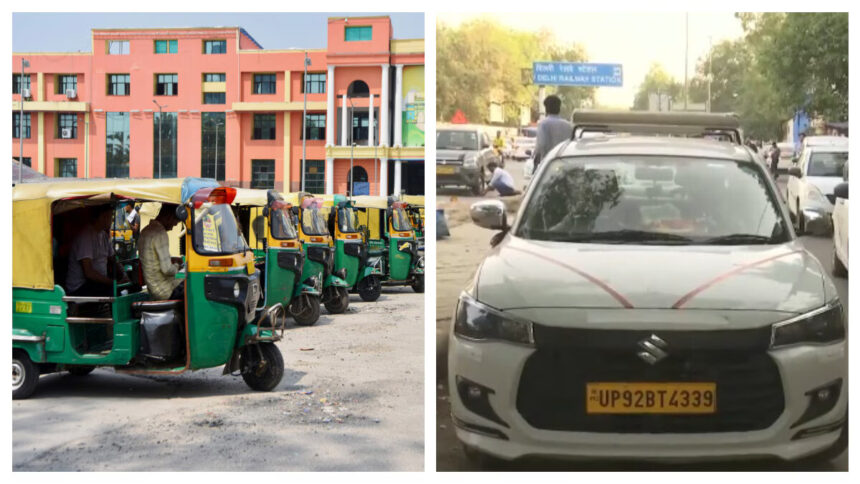
A major transport strike has begun across Delhi NCR, raising concerns over severe commuting disruptions and supply chain challenges in the national capital region. Taxi drivers, auto rickshaw operators and commercial vehicle unions have launched a three day protest against rising fuel prices and increasing operational costs, leading to uncertainty for millions of daily commuters.
The strike, called by transport unions and driver organisations, is expected to impact taxi services, app based cab operations, auto rickshaw availability and goods transportation across Delhi, Noida, Gurugram, Ghaziabad and Faridabad. Passengers are likely to experience longer waiting times, reduced vehicle availability and overcrowding in public transport systems during peak office hours.
Transport leaders argue that continuously rising prices of petrol, diesel and compressed natural gas have made it increasingly difficult for middle class drivers to survive financially. According to union representatives, operating expenses have risen sharply over the years while fares for taxis and autos have remained largely unchanged.
The protest has emerged at a time when fuel prices in Delhi have witnessed another increase. Petrol and diesel rates were recently revised upward, while compressed natural gas prices also saw multiple hikes within a short period. Drivers claim that a significant portion of their daily income is now being consumed by fuel expenses, leaving very little money for household needs and savings.
Union representatives have stated that taxi fares in the Delhi NCR region have not been revised substantially for nearly fifteen years despite the sharp rise in fuel costs and inflation. They argue that the current fare structure no longer reflects economic realities and has pushed thousands of drivers into financial distress.
The strike is expected to create major inconvenience for office workers, students, elderly passengers and travellers heading to airports or railway stations. Daily commuters who depend heavily on app based cabs and auto rickshaws may face serious difficulties during the next three days.
Public transportation systems such as the Delhi Metro and city bus services are expected to witness increased passenger pressure as many commuters shift to alternative travel options. Authorities are anticipating heavier crowds at metro stations and bus terminals, particularly during morning and evening peak hours.
Travellers heading toward major NCR hubs including Gurugram, Noida, Ghaziabad and Faridabad are being advised to plan their journeys in advance and allow extra travel time. Airport passengers and railway travellers may also face transportation uncertainty due to reduced taxi and auto availability.
Apart from passenger transportation, the strike is likely to affect commercial goods movement as well. Goods transporters have announced symbolic road blockades and disruptions, raising fears of delays in the supply of vegetables, fruits, groceries and other essential commodities.
Wholesale markets and local supply chains could experience bottlenecks if the strike gains significant participation. Experts warn that perishable goods transported daily from neighbouring states are particularly vulnerable to delays and shortages during prolonged transport disruptions.
Market analysts believe even a temporary slowdown in goods transportation can lead to local shortages and higher prices for consumers. Retail vendors and small businesses dependent on daily deliveries may also experience operational challenges if supply chains remain affected for several days.
Transport unions maintain that the strike became necessary because repeated appeals to the government regarding fare revisions and driver welfare issues failed to produce meaningful results. According to the unions, drivers are struggling not only with fuel expenses but also with increasing maintenance costs, insurance charges and regulatory burdens.
The organisations have also raised concerns regarding environmental compensation charges imposed on commercial vehicles. They have demanded rollback of increased environmental cess and relaxation of restrictions on older emission standard vehicles. Driver groups argue that sudden policy changes are affecting the livelihoods of small transport operators and independent drivers.
Another major issue raised by the unions relates to app based cab companies. Driver organisations accuse large aggregator platforms of arbitrary pricing practices and excessive commission deductions. Many drivers claim that despite rising customer fares, a large share of earnings goes to platform operators, leaving drivers financially vulnerable.
Union representatives have described the working conditions of many drivers as exploitative and economically unsustainable. They argue that without immediate intervention from the government, a large section of drivers may be forced to leave the profession entirely.
However, the strike has not received unanimous support from all transport bodies in Delhi NCR. Several auto rickshaw and taxi associations have distanced themselves from the protest and announced that services would continue normally.
Some organisations representing auto drivers stated that the ongoing issues are primarily linked to goods transport operators and are not directly connected with passenger auto services. They assured commuters that autos would remain available at railway stations, bus terminals and key public locations.
The Delhi Taxi and Tourist Transport Association also announced that it would not participate in the strike, citing larger national and economic concerns. According to association representatives, the country is already dealing with challenges arising from global increases in oil and gas prices, and public inconvenience should be avoided wherever possible.
Despite these assurances, uncertainty remains regarding the actual scale of participation in the strike. Authorities have not yet provided an official estimate of how many vehicles are expected to remain off the roads during the protest period.
Political observers note that rising fuel prices have increasingly become a sensitive economic and political issue in urban regions where millions depend on transport services for daily livelihood and mobility. The growing dissatisfaction among commercial drivers reflects broader concerns regarding inflation and the rising cost of living.
Experts believe that unless meaningful dialogue takes place between transport unions and the government, tensions within the sector could continue to grow. Many drivers feel that operational costs have risen far faster than their incomes, creating financial instability across the transport industry.
The Delhi NCR region relies heavily on interconnected transport networks for business activity, office commuting and daily market supply. Any prolonged disruption therefore carries the potential to affect not only commuters but also commercial activity, local markets and consumer prices.
Government agencies are closely monitoring the evolving situation as the strike enters its initial phase. Officials may attempt discussions with transport unions if disruptions intensify or public inconvenience increases significantly over the coming days.
For now, commuters across Delhi NCR are preparing for travel challenges, uncertain vehicle availability and possible delays as the transport strike unfo