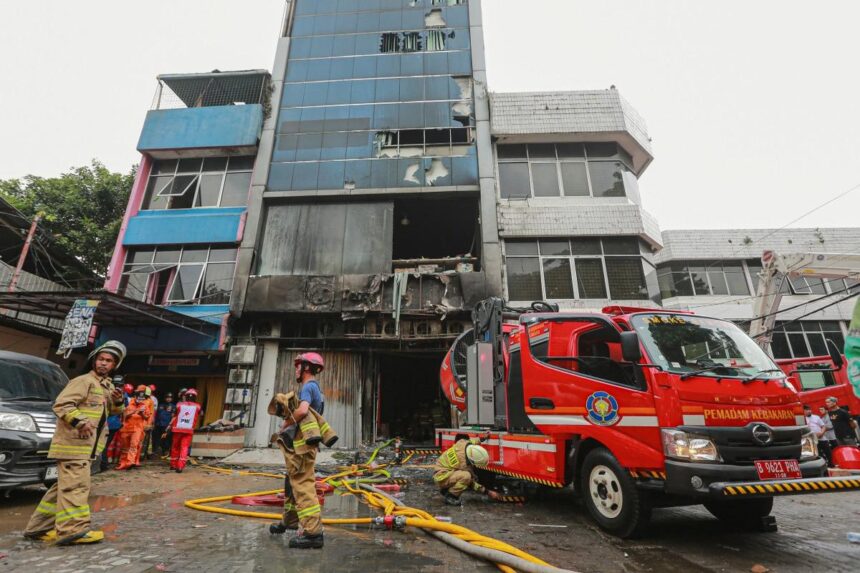
A devastating fire that tore through a seven-storey office building in central Jakarta on Tuesday has left at least twenty-two people dead, prompting a major investigation into what authorities believe may have been triggered by an exploding drone battery. The incident, one of the deadliest urban fires Indonesia has witnessed in recent years, has raised urgent questions about workplace safety, fire preparedness and the risks associated with battery-powered devices in commercial settings.
Investigators Probe Drone Battery Blast as Firefighters Battle Intense Blaze
Jakarta police reported that a drone battery stored on the ground floor of the building likely ignited the blaze, which rapidly travelled through the structure’s upper floors. The office housed Terra Drone Indonesia, a company specializing in agricultural drone services. Although the suspected cause has been tentatively identified, police emphasised that the exact origin of the fire remains under forensic examination.
Central Jakarta police chief Susatyo Purnomo Condro told reporters that the force is committed to conducting a thorough investigation, involving the forensic laboratory team, to determine whether negligence or other factors played a role. Authorities are currently questioning witnesses, including the building’s owner and the business operators, to reconstruct the sequence of events and assess accountability.
According to eyewitness accounts, the fire broke out during the lunch hour and had already grown significantly by the time firefighters arrived. A local resident, Nurhayati, described seeing flames intensely consuming the interior as emergency personnel struggled to break open closed doors. By then, the blaze was already “very big and very red,” she recounted, highlighting the speed at which the fire escalated.
Initially, police confirmed seventeen deaths, but the toll rose to twenty-two as firefighters continued to search the building. Of the victims, fifteen were women, including one who was pregnant. Many of the fatalities appeared to have resulted from asphyxiation rather than burns, indicating that smoke inhalation played a critical role in the tragedy.
The Jakarta Fire Department deployed an extensive response force, with at least one hundred firefighters and twenty-nine fire engines working to extinguish the blaze in Kemayoran, a dense commercial neighbourhood. The rescue operation was complicated by thick smoke and heat trapped within several floors of the building, forcing firefighters to use large industrial fans to cool the interior and clear visibility for search teams.
One police commander assisting with evacuations sustained injuries during the operation, underscoring the hazardous nature of the conditions inside the structure. Firefighters carried multiple body bags from the charred building as crowds gathered at a safe distance to witness the aftermath.
Video footage showed the building’s blackened façade, shattered windows and smoke-stained walls — stark evidence of the fire’s intensity. The interior suffered extensive structural and material damage, with investigators preparing to re-enter once temperatures stabilize.
Authorities Review Safety Failures as Indonesia Faces Recurring Industrial and Structural Fires
The tragedy has again cast a harsh spotlight on Indonesia’s recurring fire safety challenges. Deadly fires are not uncommon, often attributed to weak enforcement of safety regulations, lack of emergency preparedness and insufficient oversight of industrial facilities. In 2023, an explosion at a nickel-processing plant in eastern Indonesia claimed at least twelve lives, adding to a series of industrial accidents that raised nationwide concern.
In the Jakarta incident, authorities intend to scrutinize whether safety protocols at the Terra Drone Indonesia office were adequate and whether hazardous materials such as drone batteries were stored appropriately. Lithium-based batteries, commonly used in drones, are known to pose fire risks if damaged, improperly stored or exposed to high temperatures.
The police investigation will examine whether employees had received sufficient safety training, whether fire extinguishers were accessible, and whether emergency evacuation routes were properly maintained. Investigators are also reviewing the building’s fire suppression systems, including alarms, extinguishers, ventilation systems and fire exits.
A complicating factor is the presence of technological equipment and batteries, which can release toxic fumes when they catch fire. The asphyxiation-related deaths suggest that smoke accumulated quickly, possibly due to inadequate ventilation or delayed response time. Forensic teams will analyse residue from the scene to determine how the fire spread and what hazardous materials may have contributed.
Authorities are also examining the building’s design and its compliance with local fire safety regulations. In many older buildings in Jakarta, outdated electrical systems or overcrowded office spaces can exacerbate the severity of fires. The seven-storey structure will undergo a structural assessment to ensure that it remains safe for further examination and potential restoration.
As the investigation proceeds, the tragedy has triggered public demands for stricter regulation of workplaces that handle battery-powered devices. The growing use of drones, electric tools and lithium-ion equipment has amplified fire risks in office and industrial settings. Experts argue that updated safety standards are essential to manage the hazards associated with modern technological devices.
The incident has also renewed conversations about the speed and training of emergency responders. While the Jakarta Fire Department mobilised quickly, challenges in accessing the building’s interior and the rapid spread of fire highlight systemic vulnerabilities that require attention.
Indonesian authorities have pledged a transparent investigation and potential criminal accountability if negligence is found. The tragedy underscores the broader issue of fire safety in urban commercial areas, where dense construction, heavy equipment usage and limited oversight can combine to create dangerous conditions.
For now, grieving families and concerned residents await answers as investigators continue to comb through the ruins of the building, looking for clues to prevent such a disaster from recurring.