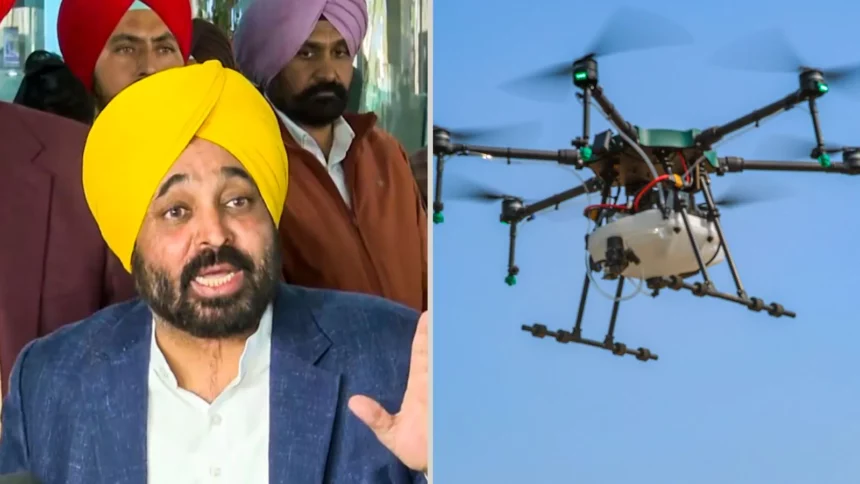
Punjab Chief Minister Bhagwant Mann recently claimed that the state has witnessed a 70% decline in incidents of drone-dropped consignments. However, official data from central agencies suggests otherwise, indicating a rise in drone-related activities along the border. The contradiction has sparked debate over the extent of the drone menace and the effectiveness of countermeasures.
According to the Border Security Force (BSF), between January 1 and March 16 this year, 48 drones were seized or recovered, compared to 31 during the same period last year. The recovered payloads have also increased, with BSF seizing 28 kg of narcotics, four arms, and 47 rounds of ammunition in 2025, compared to 21 kg of narcotics, one firearm, and four rounds of ammunition in 2024. These figures contradict Bhagwant Mann’s assertion that drone incursions have dropped significantly.
Speaking to the media, Bhagwant Mann emphasized that the influx of drones from Pakistan has reduced due to enhanced vigilance and crackdowns on drug cartels. He credited the BSF and state authorities for preventing illicit consignments from reaching their intended recipients, arguing that stricter enforcement has deterred smuggling operations. However, central agencies paint a different picture, indicating that while the interception rate has improved, drone activity itself has increased.
Officials from the Ministry of Home Affairs (MHA) acknowledge that while logistical support networks for drone operations in Punjab have been disrupted due to increased arrests of overground workers, Pakistan’s agents are adapting their smuggling tactics. Intelligence reports suggest that a majority of the drones originate from launchpads in Lahore, Narowal, and Kasur, targeting border districts in Punjab and even Rajasthan.
The Indian government has intensified its counter-drone initiatives through technological advancements. The BSF has deployed anti-drone jammers, rifle-style anti-drone guns, and high-resolution surveillance cameras to curb unauthorized aerial intrusions. Additionally, the Punjab Police has implemented a Drone Emergency Response System (DERS) and strengthened grassroots intelligence through Village-Level Defence Committees (VLDCs) to track and report drone movements.
A multi-agency crackdown is also underway to dismantle networks facilitating drone-based smuggling. The National Investigation Agency (NIA) has arrested several operatives linked to Punjab-based gangs allegedly conspiring with Pakistani handlers. Groups like Lawrence Bishnoi’s network have been targeted for their suspected role in receiving and distributing drone-delivered contraband.
Despite these measures, security agencies remain concerned that undetected drones may still be completing their missions. The MHA has established a committee under the BSF Director General to explore cutting-edge counter-drone technologies globally. The Anti-Rogue Drone Technology Committee (ARDTC) is evaluating potential solutions to secure India’s western border effectively.
While Bhagwant Mann’s claim highlights the government’s efforts to combat drone threats, the latest data underscores that the challenge remains formidable. As technology evolves, so do smuggling tactics, necessitating continuous upgrades in surveillance and interdiction methods to safeguard national security.