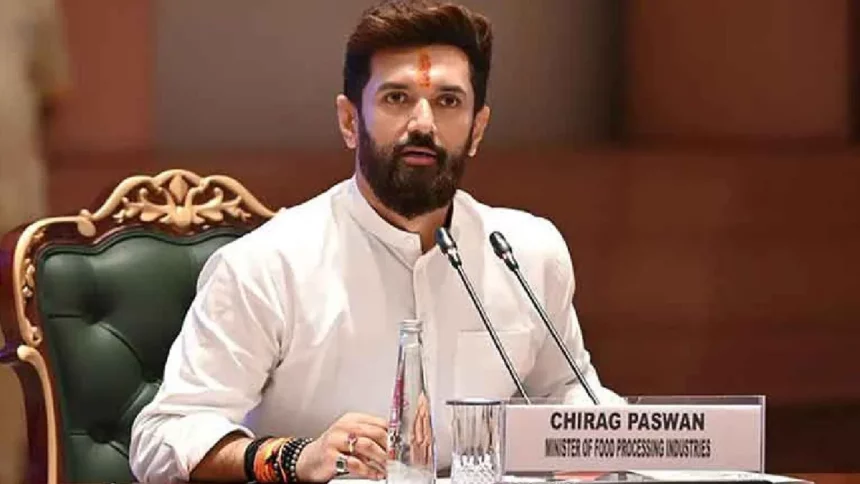
The dramatic rise of Chirag Paswan and the Lok Janshakti Party (Ram Vilas) in the 2025 Bihar assembly elections marks one of the most remarkable political turnarounds in recent years, reshaping coalition dynamics within the NDA while altering traditional caste and regional vote patterns across the state. From securing just a single seat in 2020 to emerging as one of the most influential players in the current polls, the LJP (RV) has not only expanded its electoral footprint but has also strengthened the BJP–JD(U) alliance by mobilising Dalit and Extremely Backward Class (EBC) voters in areas previously dominated by the RJD. The transformation underscores Paswan’s growing political maturity, the party’s evolving organisational strategy, and shifting voter expectations in a state long defined by complex caste alignments and coalition politics.
The Lok Janshakti Party’s rise has become the central headline of the ongoing Bihar assembly elections, placing Chirag Paswan at the core of a rapidly changing political environment. Contesting 28 seats and leading in 22 according to Election Commission trends, the party’s showing has positioned it as a significant force within the NDA, with influence far beyond its numerical presence. What makes this surge even more extraordinary is the contrast with the party’s performance in 2020, when internal rifts, alliance disarray, and electoral miscalculations had left it with a solitary seat. The current surge represents not just an electoral comeback but a decisive re-entry into Bihar’s mainstream political theatre, driven by renewed organisational strength and strategic clarity under Paswan’s leadership.
Historical Trajectory and Changing Political Alignments
The Lok Janshakti Party’s journey over the past two decades reflects the shifting contours of national and state politics. Founded in 2000 by Ram Vilas Paswan, one of India’s most influential Dalit leaders, the party initially aligned with the NDA under the leadership of Atal Bihari Vajpayee. However, the aftermath of the 2002 Godhra riots marked a turning point, prompting the LJP to leave the alliance and join the UPA in 2004. During this period, Ram Vilas Paswan held several critical cabinet positions, strengthening both his national stature and the party’s influence among marginalised communities.
The LJP’s return to the NDA in 2014 coincided with the rising political dominance of Prime Minister Narendra Modi. Ram Vilas Paswan once again played an important role in the central government, reaffirming the party’s relevance within the coalition. His death in 2020, however, unleashed internal tensions that had been quietly brewing for years. The eventual split between Chirag Paswan and his uncle Pashupati Kumar Paras in 2021 created two competing factions: the Lok Janshakti Party (Ram Vilas), led by Chirag, and the Rashtriya Lok Janshakti Party, led by Paras. Although both factions claimed ownership of Ram Vilas Paswan’s legacy, Chirag gradually emerged as the more visible and electorally potent leader.
However, Chirag’s early years after the split were far from smooth. The 2020 assembly elections were marked by disagreements over seat-sharing with the JD(U), leading him to contest independently on 137 seats. While the party won only one seat, it managed to significantly dent JD(U)’s performance in nearly 30 constituencies, exposing deep internal fractures within the NDA. This period, though politically turbulent, became a defining chapter for Chirag Paswan, shaping his strategic approach ahead of future elections.
The 2024 Lok Sabha elections marked a turning point. The LJP (RV) contested five seats and won all of them, placing Chirag Paswan firmly back in the national narrative. His relationship with the BJP leadership strengthened considerably, reflecting a renewed sense of trust and shared objectives. This performance also re-established the LJP (RV) as a key Dalit political force in Bihar, setting the stage for its strong showing in the 2025 assembly elections.
LJP’s Strong Performance and Chirag Paswan’s Growing Role in NDA
As the 2025 assembly elections approached, Chirag Paswan pushed for a substantial share of seats within the NDA alliance, reflecting his strengthened bargaining power after the Lok Sabha sweep. However, the party was ultimately allotted 28 seats. Instead of expressing discontent publicly, Chirag struck a note of cautious diplomacy, describing Chief Minister Nitish Kumar as a “necessity” for Bihar and “an example of political endurance.” The tone was markedly different from 2020, signalling maturity and a willingness to prioritise coalition stability over personal disagreements.
The LJP’s performance across its allotted constituencies indicates a strategic reshaping of electoral focus. The party is leading in a large and diverse set of constituencies—Sugauli, Govindganj, Belsand, Bahadurganj, Kasba, Balrampur, Simri, Bakhtiarpur, Bochahan, Darauli, Garkha, Mahua, Bakhri, Parbatta, Nathnagar, Fatuha, Dehri, Obra, Sherghati, Bodh Gaya, Rajauli, Gobindpur, and others—spanning different regions, demographic profiles, and caste compositions. Many of these seats lie in central and western Bihar, areas traditionally dominated by the RJD and considered the strongholds of Dalit and EBC voters. The LJP’s ability to make inroads into these regions represents one of the most significant developments of the election cycle.
The underlying reason for the LJP’s surge lies in the consolidation of Dalit and EBC votes, which have historically played a decisive role in Bihar politics. Under Chirag Paswan, the party has broadened its appeal beyond its core Paswan voter base by emphasising development, infrastructure, social mobility, and youth upliftment. His campaign messaging has been centred on issues such as employment, skill development, and welfare delivery, themes that resonate strongly with younger voters and first-time participants in the electoral process.
Additionally, Chirag’s public image—stylised, articulate, and youth-centric—has worked in his favour, distinguishing him from the traditional political leadership in the state. The LJP’s communication strategy has been more digitally driven than ever before, utilising targeted outreach through social media, digital platforms, and village-level mobilisation teams. This modernised campaign style has contributed to the party’s growing relevance among younger demographic segments.
Most significantly, the LJP’s performance has strengthened the NDA by reinforcing the BJP and JD(U)’s traditional voter bases. In constituencies where the BJP faced stiff competition from the RJD, the LJP helped consolidate Dalit and EBC votes that were previously susceptible to shifting. In JD(U)-dominated regions, the LJP’s presence provided the alliance with a broader social coalition, creating a more comprehensive electoral front against the RJD-led Mahagathbandhan. This three-pronged consolidation—BJP’s upper castes, JD(U)’s Kurmi-Koeri base, and LJP’s Dalit-EBC strength—has played a crucial role in shaping the election trends.
Chirag Paswan’s emergence as a strong NDA face also comes at a time when Bihar’s political atmosphere is undergoing major changes. The electorate has shown signs of fatigue against traditional polarisation and is increasingly receptive to a narrative centred on development and welfare delivery. Nitish Kumar’s governance model remains a central pillar of the NDA’s messaging, but Chirag’s rising stature has added a dynamic and youthful component to the alliance. The LJP’s success therefore reflects not only its organisational resurgence but also the shifting aspirations of Bihar’s electorate.
Moreover, the LJP (RV)’s clean sweep in the 2024 Lok Sabha elections had already created expectations among party workers and supporters. The 2025 performance represents the fulfilment of those expectations, providing Chirag Paswan with the political momentum needed to negotiate from a position of strength within the NDA. His ability to balance assertiveness with alliance cooperation has played a key role in ensuring the party’s smooth functioning within the coalition.
The broader political implications extend beyond seat tallies. The LJP’s rise signals the growing importance of Dalit and EBC mobilisation in Bihar’s changing political equations. It also underlines the electorate’s openness to new leadership models that combine legacy with modernity. Chirag Paswan’s journey—from inheriting a complex political legacy, navigating internal splits, enduring a humiliating electoral setback, rebuilding organisational structures, and eventually emerging as a formidable state-level leader—encapsulates the evolving dynamics of Bihar’s political landscape.