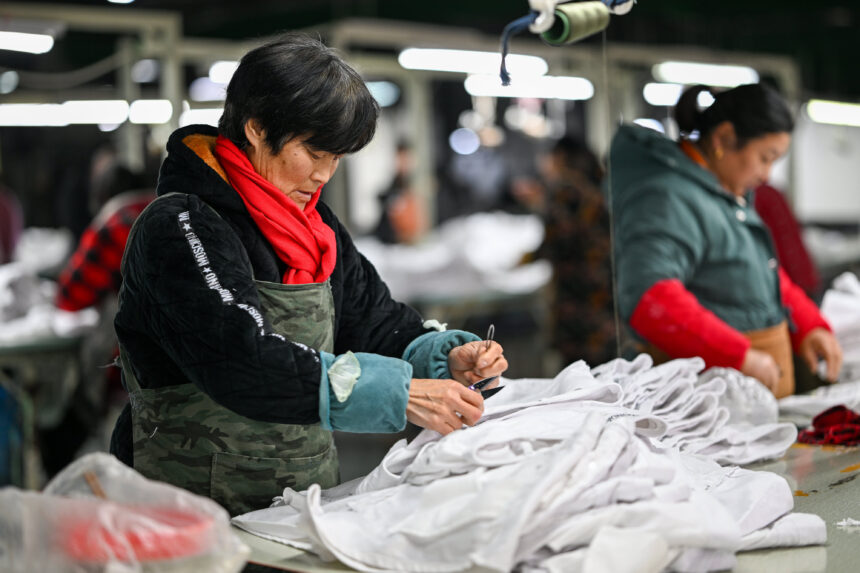
China’s factory activity unexpectedly contracted in January, highlighting ongoing economic challenges despite recent efforts to stabilize growth. The official purchasing managers’ index (PMI) for January stood at 49.1, as revealed by the National Bureau of Statistics on Monday. This was below the 50.1 forecast by economists in a Reuters poll and marks a reversal from the expansionary trend of the previous three months, which had seen PMI readings of 50.1 in December, 50.3 in November, and 50.1 in October. A PMI reading above 50 signifies expansion, while readings below this threshold signal contraction.
The contraction in January is partly attributed to a seasonal slowdown, as migrant workers traditionally return to their hometowns ahead of the Lunar New Year, which this year falls on January 29. Hui Shan, chief economist for China at Goldman Sachs, explained that the softer PMI in January is typical for this time of year due to the holidays. The slowdown has led to a slight dip in China’s blue-chip CSI 300 index, which reversed early gains following the release of the data.
Despite the disappointing manufacturing PMI, analysts pointed to some positive signs in other sectors. Bruce Pang, senior research fellow at the National Institution for Finance and Development, noted that the overall demand outlook remains relatively positive, supported by stronger readings in two price sub-indexes. The indexes measuring price levels for purchasing and selling major raw materials showed improvement in January, although they remained in contraction territory. Zhao Qinghe, senior statistician at the NBS, highlighted that a gauge of companies’ production and operational activity outlook expanded to 55.3, indicating that many manufacturers remain optimistic about business expansion after the holiday season.
China’s non-manufacturing PMI, which reflects services and construction activity, dropped to 50.2 in January, down from 52.2 in December. This decline was mainly driven by a slowdown in construction activity, which fell to 49.3 as companies paused operations in the lead-up to the New Year. On a more positive note, the services PMI rose to 50.3, albeit lower than the previous month’s reading. Despite this decrease, the services sector continues to show growth, driven by increased demand in industries related to seasonal travel, such as public transportation, hospitality, and food services.
The latest PMI data underscores the ongoing challenges for China’s policymakers as they attempt to steer the economy toward a sustainable recovery. Zichuan Huang, China economist at Capital Economics, noted that the weak PMI figures highlight the difficulties the government faces in achieving long-term growth recovery. He suggested that while economic activity might pick up in the coming months, with the government likely to implement more stimulus measures, structural challenges such as weak domestic consumption and trade tensions with the U.S. continue to weigh on the economy.
Despite the contraction in manufacturing, China’s industrial profits showed signs of improvement, with December’s industrial profits rising by 11% from a year earlier, reversing a long-standing downward trend. This marked the first annual profit increase since July, following three consecutive years of declining industrial profits. Corporate profits had plummeted by 27% year-on-year in September, their steepest drop since the early months of the COVID-19 pandemic. However, the recovery from the September low has been notable, with a 3.4% increase in profits among manufacturers of consumer goods, supported by strong exports and government policy incentives aimed at boosting consumption.
Overall, industrial profits remain a critical indicator of the health of China’s factories, utilities, and mines. The recent surge in December industrial profits has provided some relief, although the outlook remains uncertain. A key factor contributing to the uncertainty is the ongoing U.S.-China trade conflict, particularly the threat of additional tariffs from the new U.S. administration. President Donald Trump has threatened to impose further tariffs of 10% starting February 1, exacerbating concerns among Chinese exporters who have been rushing to frontload shipments to avoid potential tariff hikes.
Goldman Sachs’ Hui Shan pointed out that China’s economic downturn has yet to show signs of reversing, citing the continuing weakness in domestic consumption and the uncertainty surrounding U.S. tariffs. Shan emphasized that the Chinese government will need to implement significant stimulus measures to help boost inflation and restore consumer confidence. This call for additional fiscal support comes amid concerns about the sustainability of the current economic recovery.
January’s contraction in factory activity coupled with the positive surge in industrial profits presents a mixed picture of China’s economic performance. While some sectors show signs of resilience, the economy continues to face significant challenges, particularly from structural weaknesses and the looming threat of U.S. tariffs. Policymakers in China will be closely monitoring these developments as they seek to balance fiscal stimulus with efforts to address longer-term economic headwinds.